Benatar Part Two: How Bad is Coming Into Existence?

In a previous post, I went over Benatar’s argument on why coming into existence is always a harm, even if there is a small amount of it. Now, I will look at his next chapter and see how he argues that human lives suffer much more than they realize, thereby showing that we are indeed harmed by coming into existence. Even the best of lives that most humans consider are still bad according to Benatar.

Because this chapter is much easier, I won’t do much critical remarks here and I will simply present his argument.

Benatar doesn’t want to go down a simple utilitarian calculation. “How well or badly a life goes depends not simply on how much good and bad there is, but also on other considerations–most prominently considerations about how that good and bad is distributed” (p. 61-62), such as the order of pleasures, the intensity of the good and the bad, and the length of one’s life. Here, one could argue that Benatar is giving a clue to what Harmon calls “higher qualitative pains” on p. 63: “Arguably, once a life reaches a certain threshold of badness (considering both the amount and the distribution of its badness), no quantity of good can outweigh it, because no amount of good could be worth that badness.” Doing a simple utilitarian addition or subtraction isn’t going to cut it.


The Flaws of Self-Assessment

Objection 1: But if I can look within and see whether I’m suffering or not, I can judge whether I’m being harmed. Since I’m not suffering right now, I’m not being harmed. Indeed, most of my life I’m not suffering. Thus, I’m not harmed. In other words, most people deny of actually seeing their life as being bad. After all, most people are actually pleased that they have come into existence.

Benatar’s reply to Objection 1: Actually, I am suffering. We are all suffering and thus, we are all harmed. This is more of a psychological assessment rather than a metaphysical explanation. Benatar calls this the Pollyanna Principle (PP). (Actually, he footnotes that he got the term from another book, but it still applies.) PP is a tendency towards optimism.

Objection 1.2: Could Benatar be tend toward pessimism? In other words, is he falling into an “Anti-Pollyanna Principle?” He answers this question in the last chapter of his book. At any rate, I’ll continue…

There is a lot of evidence for PP:

1. If you can think about your previous experiences, most people are inclined to recall positive rather than negative experiences. Benatar cites this from a paper in the American Psychologist. I have some reservations on this. In a general setting, I’ve been around people that talk about their day and there’s positive aspects that come out, but I’ve also been around people that simply complain about their whole day. Now, I don’t know how it is for people on the whole, but I think the complainers don’t see the worldview or their experiences as positive overall. On the other hand, optimism may be something that we are biased toward evolutionarily speaking. Benatar even mentions this. We all hope for something, even at the worst of times because that helps us survive. Time magazine did an article about it recently. The majority of people do consider themselves happy or very happy and most people consider themselves better off than the average person. But Benatar points out that this projection biases our past as well as our future expectations: we expect good things. Perhaps it’s a sign of hope. In a footnote quoting from another book, Benatar writes that “[t]here is quite a bit of evidence that happier people with greater self-esteem tend to have a less realistic view of themselves. Those with a more realistic view tend to either to be depressed or have low self-esteem or both” (p. 65).

2. We can quickly adapt to worse situations. If one gains a disability to one’s well-being, one may, at first, be disappointed but one can then adapt to the new situation, even though one had become worse off.  “Because the subjective sense of well-being tracks recent change in the level of well-being better than it tracks a person’s actual level of well-being, it is an unreliable indicator of the latter” (p. 68).

3. We compare our well-being to others instead of some objective criteria.

With these three criteria, we start with a bias toward optimism. “Thus, in the best cases, adaption and comparison reinforce Pollyannaism. In the worst cases, they mitigate it but do not negate it entirely” (p. 68).


Three Views About the Quality of Life

There are three theories about the quality of life: hedonism, desire-fulfilment theories, and objective list theories. I shall go over them one at a time and show why Benatar thinks that all of them lead to the conclusion that either that theory is false or how that theory must eventually lead one to believe that coming into existence is a harm. In other words, no matter which theory we take, life is still bad.

Hedonism–according to this theory, life is considered good or bad depending on the the positive or negative states–which are usually characterized by pleasure and pain. You can take it in it’s simplest or complex form. We avoid pain and go for pleasure.

So why does this theory fail? As mentioned before, we forget about the negative states and focus on the positive aspects. For example, there are more negative mental states than we realize everyday of our lives. “These include hunger, thirst, bowel and bladder distension (as these organs become filled), tiredness, stress, thermal discomfort (that is, feeling either too hot or too cold), and itches” (p. 71). These are things that we experience everyday and we usually don’t relieve these pains immediately. We experience them and we must wait for a while (perhaps a long while) to relieve that pain. “For example, unless one is eating and drinking so regularly as to prevent hunger and thirst or countering them as they arise, one is likely hungry and thirsty for a few hours a day” (p. 71). The same could be said about being tired and thermal discomfort. We don’t think about these things because of all three principles of PP. There are just too many negative elements in our lives, and we don’t think about them because we are used to them.

There are other negative things as well: allergies, headaches, frustration, colds, menstrual pains, nausea, itches, negative feelings (such as guilt, shame, boredom, sadness, lonliness), diseases. Based on this, it’s just simply not worth it to come into existence because of the overwhelming negative aspects of life.

Desire-fulfilment theories–”the quality of a person’s life is assessed in terms of the extent to which his desires are fulfilled” (p. 69). This can include desires of mental states or obtaining something in the external world.

Now why does this theory fail? Just like Buddhism, we actually don’t have all of our desires fulfilled and that just frustrates us. There is actually a lot of dissatisfaction in our lives. More than that, this theory is actually worse than hedonism because we can actually be mistaken about whether our desires have been fulfilled (unless the desire was for pleasure). Accordingly, “we have less privileged access to whether our desires have been satisfied” (p. 74). We are more prone to error under this theory and therefore, cannot assess our well-being. With PP, we may actually overestimate on how good our lives are.

Moreover, this theory falls under the same flaws under hedonism: there are many desires, even little desires, that we don’t immediately fulfill and so we are constantly frustrated everyday. For example, if we are tired in the middle of the day, we have to wait to fulfill that desire at night time. Fulfilling that desire is very temporary because there is another desire that we would want to immediately fulfill. It’s a treadmill of desires. Benatar brings up Schopenhauer (which is very appropriate) suggesting that life is just a constant state of striving, a pure state of dissatisfaction. According to Schopenhauer, suppose we did fulfill our desires, then we become bored, which is just another dissatisfaction. The only way to stop these dissatisfactions is to stop living.

Objective list theories–”the quality of a life is determined by the extent to which it is characterized by certain objective goods and bads” (p. 69). Thus, things are good for us regardless if they bring us pleasure or whether we desire them. Accordingly, things are bad for us regardless if they don’t bring pain or we don’t desire them. So what possibilities could be on this list? What are some things that are objectively good for us? Benatar mentions some possibilities from various authors which include: agency, basic capabilities, liberty, understanding, enjoyment, deep personal relations, moral goodness, rational activity, development of one’s abilities, having children, being a good parent, knowledge, awareness of true beauty.

What are some objectively bad things? Some various answers include: being betrayed, manipulated, slandered, deceived, being deprived of liberty or dignity, enjoying sadistic pleasure, taking in aesthetic pleasure of what is in fact ugly.

There are two types of objective list theories.

The first type is a  sub specie aeternitatis type, meaning that they are objective from an eternal point of view. These truths would be true even if there were no humans around, in the same way that 2+2=4 is true even if there were no humans around.

The second type is a sub specie humanitatis type, meaning that they are objective but from a human perspective. This applies to all people. Objective here means that they don’t vary from person to person like desire-fulfillment theories do. Under this type, we can determine if a life goes well only in comparison with other human beings.

So what’s wrong with this theory? Benatar argues that it if we were to take up this theory, the first type is more reasonable than the second.  In other words, we should use the pure objective type.  Later in Part Three, we’ll another argument on why objectivity from a human perspective (i.e. life goes well only in comparison with other human beings) is a wrong perspective.  With the previous two theories, Benatar uses a reductio ad absurdum to show the flaws, but here, Benatar simply points out the problems with the second type by presenting two objections.

Objection 2: One objection is that one cannot simply imagine a purely objective perspective, this sub specie aeternitatis.

Benatar’s Reply to Objection 2: One isn’t just imaginative enough.  One can easily imagine eternal truths.

Objection 3: Judgements of quality of life must be context specific. For example, teachers don’t have an all-out criteria for grading students. A teacher is sensitive to the context. We would not use the same standards of grading post-university students to twelve year olds. Similarly, we can only judge based on human standards and not through objectivity.

Benatar’s Reply to Objection 3: We have standards for age criteria of students, but just because a twelve year old gets an “A”, this does not mean the student should be offered a departmental chair. In other words, there are criterium for all sorts of situations, but nevertheless, they can be objective. It could be the case that letting five year olds do heavy manual labor wouldn’t be appropriate, but this could even be judged objectively without going the route of a human perspective. More than that, it may be better to judge people by objective (read, non-human) standards. In other words, “knowing how well a particular life goes in comparison with other lives tells us very little about the baseline–how good human life is. If one’s aim is to determine how good human life is, then the human perspective [the second type], given the psychological phenomena mentioned earlier, is manifestly an unreliable perspective from which to decide on what should be on the list of goods” (p. 82).

As a reminder, this is to argue that all lives are not worth starting. This is not an argument that live is so bad right now that they are not worth continuing. But what Benatar wants to show is that we have assumed that the criteria for judging whether one has a good life is by comparing it to other people, which Benatar disagrees with. We must look at it from an objective point of view and under this view (the first type), the standard is much to high for us to reach. We will always fall short of living a good life.

Objection 4: But in his earlier chapter, he argues that good and bad are relative to the individual. Here, it seems that he is arguing that existence is objectively bad. Can he have it both ways? Is it compatible to say that harms and benefits are relative to the individual, yet that it is objectively bad for a person to exist?

Benatar’s Reply to Objection 4: You’re misunderstanding the application of relativity to the individual.  Individuals have different preferences, and that is the relative part.  However, by using the three criteria above, they all show that life is not worth starting, and that’s the objective part.

Objection 5: Isn’t this form of pessimism just a form of whining?

Benatar’s reply to Objection 5: This suggests that the optimist is simply blind to the suffering of humanity. Combine the natural disasters, hunger, diseases, etc. we get about 11 million deaths per year (based on the WHO report). Combine this with accidental deaths, this just adds more to the toll. This is equivalent to 107 people dying per minute. Higher population means more death. The death of a loved one causes more grief and pain, thereby increasing the suffering. There’s more. Think of the atrocities committed by humans: wars, rape, murder, torture, assaults, muggings, enslavement, betrayal, oppression. This is just too much. But PP leads to the idea to the idea that people (and their children) will be spared from all of this. But avoiding all of this seems unlikely. To avoid this seems to be pure luck. Suffering could come to anyone born at any minute. Even your child could go through the atrocities mentioned above. If one is willing to take that chance, this is equivalent of taking a chance with someone’s life. “The optimist surely bears the burden of justifying this procreational Russian roulette” (p. 92).

How can this be justified? Don’t think of the extreme sufferings above, but even the ordinary sufferings that we all go through everyday. This is like playing Russian roulette with a fully loaded gun aimed at one’s descendants.  Next time, I’ll look at Benatar’s argument for anti-natalism.
Posted in Anti-Natalism, Book Review, Ethics, Values | Tagged | 6 Comments

Go the F**k to Sleep as Read by Samuel L. Jackson

In a previous post, I wrote about child’s book entitled Go the F**k to Sleep.  Now, you can listen to it appropriately read by Samuel L. Jackson:


Posted in Books, Children, Humor | Leave a comment

Conjoined Twins Sharing a Brain

A fascinating article about twins conjoined at the head which leads scientists asking whether they share a mind.  The girls are about three years old and if one senses an object, the other knows what the other is sensing!  How is this possible?

Their brain images reveal what looks like an attenuated line stretching between the two organs, a piece of anatomy their neurosurgeon, Douglas Cochrane of British Columbia Children’s Hospital, has called a thalamic bridge, because he believes it links the thalamus of one girl to the thalamus of her sister. The thalamus is a kind of switchboard, a two-lobed organ that filters most sensory input and has long been thought to be essential in the neural loops that create consciousness. Because the thalamus functions as a relay station, the girls’ doctors believe it is entirely possible that the sensory input that one girl receives could somehow cross that bridge into the brain of the other. One girl drinks, another girl feels it.

Also, one of the girls started drinking water, and the other one could feel it in her stomach.  For a blood test, the doctor pricked one sister, and the other sister started crying.

The sensory exchange, they [the family] believe, extends to the girls’ taste buds: Krista likes ketchup, and Tatiana does not, something the family discovered when Tatiana tried to scrape the condiment off her own tongue, even when she was not eating it.

Yet, the girls do display differing personalities.  Nevertheless, they are so in sync it’s as if they are one being.

The girls surely have a complicated conception of what they mean by “me.” If one girl sees an object with her eyes and the other sees it via that thalamic link, are they having a shared experience? If the two girls are unique individuals, then each girl’s experience of that stimulus would inevitably be different; they would be having a parallel experience, but not one they experienced in some kind of commingling of consciousness. But do they think of themselves as one when they speak in unison, as they often do, if only in short phrases? When their voices joined together, I sometimes felt a shift — to me, they became one complicated being who happened to have two sets of vocal cords, no less plausible a concept than each of us having two eyes.

Although each girl often used “I” when she spoke, I never heard either say “we,” for all their collaboration. It was as if even they seemed confused by how to think of themselves, with the right language perhaps eluding them at this stage of development, under these unusual circumstances — or maybe not existing at all. “It’s like they are one and two people at the same time,” said Feinberg, the professor of psychiatry and neurology at Albert Einstein College of Medicine. What pronoun captures that?

Epistemic privacy seems to be lost just for these girls to each other.  Imagine all of your thoughts, desires, perceptions, memories, and hopes are shared with another person.  Sometimes, shared perceptions may be disastrous:

Someone ordered them chicken fingers, and Krista took a bite. Suddenly, Tatiana made a face. “It’s too yucky,” she said, starting to cry. The mayhem level went up a notch, and Tatiana crawled under the table, wailing, as Krista was trying to pull her back up by the force of her neck. Krista tried to put the chicken finger directly into Tatiana’s mouth. “Krista likes it!” she said. “It’s yummy!” Tatiana spit the food out, crying: “Let me hide! Let me hide!” She covered her mouth with her hand. “Don’t make her eat it, sweetie,” said their grandmother, as Doug sighed in frustration. “Sissy eat it!” Krista said again, trying to push it in Tatiana’s mouth. Krista started pulling her sister’s hair, and then both girls were crying. Tatiana’s futile declaration rose above the sounds of the restaurant. “I am getting out of here!” Tatiana sobbed. “Let me alone.”

So this brings up interesting questions: the neural networks makes both of their minds sync up.  Do they share one mind?  How does this affect personal identity?  Can one mind have different personal identities?

Posted in Mind, Personal Identity, Relationships | 1 Comment

Benatar: Why Coming Into Existence is Always a Harm

This is an essay clarifying Benatar’s argument on why coming to existence is always a harm.  I will be concentrating on his book, Better to Never Have Been: The Harm of Coming into Existence, particularly on pp. 30-49. This the crux of Benatar’s argument and I really want to understand his argument, so I’m posting it here to not only help clarify my thoughts on Benatar’s ideas, but hopefully get some feedback from others out there. You’ll have to forgive me if I’m being tedious and repetitive in this post, but this is something that has been on my mind lately and I really want to understand Benatar’s argument. I will also supplement my essay a nice critical study of Benatar from Harmon which you can read here. Specifically, I’m more concerned with what Harmon calls the First View.

These are the four premises that Benatar starts with on p. 30:

(1) The presence of pain is bad.
(2) The presence of pleasure is good.

Seems like the above are not controversial. The next two gets tricky:

(3) The absence of pain is good, even if that good is not enjoyed by anyone.
(4) The absence of pleasure is not bad unless there is somebody for whom this absence is a deprivation.

Notice that (3) and (4) are asymmetrical. (3) is good whereas (4) is not bad. Benatar will later imply that (3) is good whereas (4) is neither good nor bad. It gets complex because they are absence of states for existing persons, but they aren’t states for non-existing persons.

In other words, I think it is safe to say that pretty much everyone will agree that pleasure is good and that pain is bad.  The asymmetry comes about in (3) and (4).  If there is no one there, then the absence of pain is a good thing.  If this seems abstract, imagine something trivial like lightening striking a spot.  If someone was there, then that person would be in pain, which is bad.  However, if no one was there, then it’s a good thing.  We often say things like, “Thank goodness no one was there when that happened.”

For me, (4) is no problem. If someone does not exist, then it does not make sense to say that the being was missing out on pleasure.  I understand his asymmetrical argument and I accept it. (3) is the sticking issue for me, especially combined with (4). Why?  On the surface, (3) suggests that even if no one is around (which also entails there is no pain), then that state of affairs is good. So here are some problems that Benatar encounters:

Objection 1: Combined with (4), it seems that (3) entails some intrinsic goodness (he even states this on p. 42, where he says that pleasure is an intrinsic good) whereas (4) entails some instrumental badness (he suggests this on p. 41 where he says that badness is relatively, not intrinsically, bad). This suggests that Benatar is equivocating “good” and “bad” to definitions that fits his conclusion. In other words, “good” means “intrinsically good” and “bad” means “instrumentally bad.” If we are going to make the argument valid, the definitions need to stay the same throughout. Interestingly, Harmon makes a similar point, but she deals with impersonal and person goods. While, I see what Harmon is driving at, I think that Benatar can reply as will be shown later. Thus, I don’t think Harmon’s objection holds.

Objection 2: How can the absence of pain be good if no one is around to enjoy that good? After all, if no one exists, then it isn’t good for anybody.

Benatar’s Response to Objection 2: “The judgement made in (3) is made with reference to the (potential) interests of a person who either does or does not exist” (p. 30). If I’m understanding this correctly, Benatar is saying that the absence of pain is good if someone was there to experience that absence of pain. Ok, this may escape objection 1. The absence of pain is good but only for that person (even if that person doesn’t exist). This gets convoluted with a counterfactual in which a non-existent person may possibly exist. However…

Objection 2.1: This response doesn’t matter because under (3), this person doesn’t exist. (3) doesn’t say anything about an existing person.

Benatar’s Response to Objection 2.1: (3) can say something about counterfactuals. For example, I am now existing. I didn’t have to exist. So with (3), if I’m in pain, then the absence of pain would have been better. Continuing farther, “(3) says that the absence of this pain would have been good even if this could only have been achieved by the absence of the person who now suffers it” (p. 31). In other words, (3) says that absence of pain would be good even if the only way to achieve this is that I had not existed. Absence of pain is good to people, even if they don’t exist.

This is where it gets very confusing. But this is what I think Benatar’s getting at. Imagine a place where every possible person happens to “live” there. If they are born, they move from this possible world to the real world. This means that they are no longer a potential person, but an actual person. Ok, so far so good. Now imagine that there’s a poll taken in this imagined land where the question is asked: “Is the absence of pain a good thing?” All of these possible people answer unanimously “yes.” So (3) still holds because it’s judged by the person, even if the person doesn’t exist (yet). This, then, would escape objection 2.1: “Clearly (3) does not entail the absurd literal claim that there is some actual person for whom the absent pain is good” (31). (By the way, Benatar hints that this is plausible. On p. 179, he hints that Rawls’ “original position” could theoretically inhabit possible people: “Why might we not imagine hypothetical people inhabiting a hypothetical position?” (p. 180) After all, there’s no reason against it.)  Moreover, when we say that something is good, we can say that it’s something that we like.  When something is bad, we can say it’s something that we don’t like, or that we will try to avoid experiencing that.

Objection 2.2:  But if good and bad are based on what we like or don’t like, then it all depends on the existence of that person.  Good and bad cannot exist if that person doesn’t exist because there is no one there to evaluate it.  If there is no existence, there is no good (or bad for that matter).  To say that the absence of pain is good, even if no one is there doesn’t make sense.  Again, if Benatar is going to aim that good and bad come from what we like or what we don’t like, this already implies existence.  That’s like saying a hammer is good, even if there are no people around.  That doesn’t make sense.  Hammers are only useful in the context of existing humans.

Response to Objection 2.2: Notice that I put a “we” above.  Benatar is making a case based off his experiences and he thinks that you share in similar experiences as well.  Think of Descartes’ Meditations, the “I” isn’t just Descartes, but it’s supposed to be us following through Descartes’ arguments so that we can follow his beliefs and arguments as if they were our own.  Now, if one follows through Benatar’s arguments, one may come to see that anti-natalism is true and that bringing people into existence works against what one believed.  It teaches us to be rigorous in our epistemic consistency.

Secondly, this works in the case of counterfactuals.  I grab this example from Jim Crawford’s Confessions of an Anti-Natalist on p. 83-84:

Imagine you live in a kingdom ruled by an all-powerful, incredibly sadistic and brutal king.  Upon each child’s second birthday, he or she is delivered to the royal castle to be thoroughly tortured purely for the entertainment of the king and his entourage.  The child is administered to by court physicians throughout these proceedings, so as to keep him/her from actually dying.  In this way, the entertainment can be protracted, sometimes for years!  No child ever escapes this fate, for the King’s spies are EVERYWHERE!  Under such circumstances, is it truly beyond the bounds of rationality to at least consider the future welfare of a child who does not, as yet, exist?  During the potential parents’ conversations regarding the wisdom of bearing a child under such vile circumstances, surely the natural question to arise might be something along the lines of “My dearest husband, do you really think bringing a child into this world, at this time, would be a GOOD thing to do?” (the ‘good’ referring to the future state of the not-yet-existent child, of course).

And of course, not being born would be good, even though that child did not exist.  Absence of pain, then, is a good thing, a better thing than pain, even though there is no one there to experience it.

Benatar then argues for the asymmetry between (3) and (4) which I’ll skip over since I accept it.  So something exists, then it will experience both pleasure and pain, which has both good and bad features.  However, if that being doesn’t exist, it will be deprived of both pleasure and pain, which is overall good.  What this means is that no matter what, there will always be a pleasure/pain ratio, which means that one would have been better off not existing.  The only way a being’s existence could benefit is if it had no pain at all, which is impossible.  Therefore, existence will always be negative because of the fact that pain exists and through the asymmetry, non-existence is better.

Overall, the upshot is that existence is always a harm because it always entails some sort of pain and suffering.  That pain and suffering comes about because of the birth of that being.  So that being’s birth always brings harm with it; that harm wouldn’t have existed if the being wasn’t born.  But of course the being brings pleasure, but Benatar dismisses this because of the asymmetry.

Next, given the arguments above and the asymmetry, Benatar then shows that coming into existence is always a harm. His basic view is that we all harm people once they are created, and we cannot benefit them all. In short, whenever one creates a person, it is always bad because of the harm and suffering that the new beings encounter. When one fails to create a person, that is not bad because there is no being that would experience the pain (there is an absence of pain, in other words).

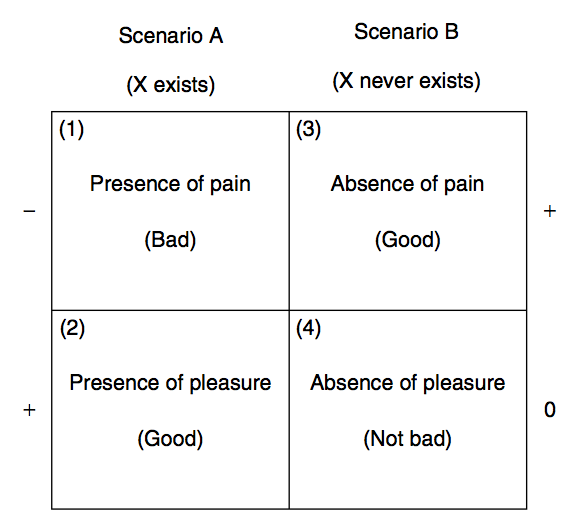
Compare two scenarios A and B. In scenario A, person X exists. In scenario B, person X never exists. With the arguments above, Benatar gives a very helpful diagram shown below:

Again, (1) is bad and (2) is good. These are uncontroversial. (3) is good even if X never existed. Remember, if you could ask potential people whether absence of pain is good, they will say yes. (4) is not bad because there is nobody there being deprived.  Benatar brings up other diagrams if (3) and (4) are symmetrical, but those I will skip.

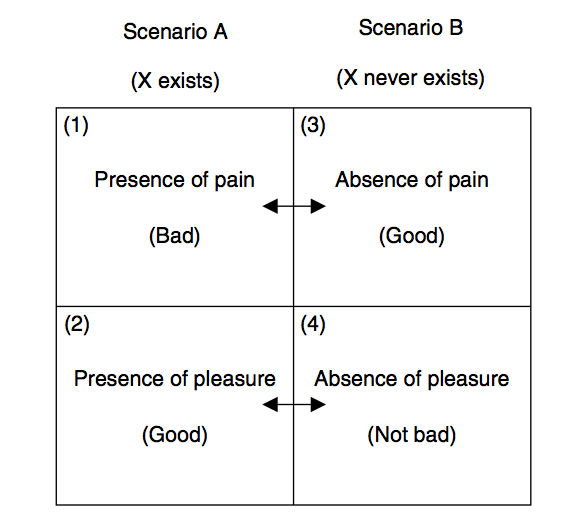
We can now see which is preferable. Let’s compare (1) with (3), and (2) with (4). Spelling it out, we are comparing:

Comparison 1: (1) Presence of Pain and (3) Absence of Pain.
Comparison 2: (2) Presence of Pleasure and (4) Absence of Pleasure.

With comparison 1, we can see that (3) is preferable. This means that non-existence is more preferable than existence. Non-existence has an advantage over existence.

With comparison 2, both seem to be on equal footing. Remember that (2) is good whereas (4) is not bad. So even though (2) is good, it doesn’t take over (4). This means that existence does not have an advantage over non-existence. In order for (2) to have an advantage over (4), (4) would have be bad, but it’s not.

Objection 3: But “good” is an advantage over “not bad” because anything good is better than some quasi-neutral state. This objection is partially from Harmon: if the absence of a pain is good, then the absence of pleasure may actually be bad. I disagree with Harmon’s analysis as I’ll show later.

Benatar’s Response to Objection 3: You’re treating the absence of pleasure–which is (4), under scenario B–as if it was absence of pleasure in scenario A which isn’t even a possibility.

Objection 3.1: But why? My disagreement with Harmon is as follows, but it may still be an objection to Benatar.  I don’t understand why (3) and (4) can’t also be in scenario A. Many existing people have experienced both (3) and (4).  As of now, I’m not tasting nectarines, which I consider a great pleasure. So the absence of tasting nectarines is, for me, an absence of pleasure. I’m not in some deprived state either. In terms of pleasure or pain, I’m in a non-bad state. So it seems that I’m in an absence-of-pleasure state. It seems that Benatar needs to add this to his matrix. Benatar reiterates (4) again: the absence of pleasure is not bad unless there is somebody for whom this absence is a deprivation.

Benatar’s reply to Objection 3.1:  This is taken from Harmon:  “Benatar says that the good things in a person’s life are not better than their absence, because their absence is not bad—indeed it has no value at all. Nor, Benatar points out, is the alternative that the person is in a neutral state; rather, in the alternative, she doesn’t exist at all. He concedes that it is better to have pleasure than to be in a neutral state. However, he says, if what we are comparing is something good with something that lacks any value at all (I think he means it does not even have a neutral value), then it’s not true that the good thing is better than the other. So having the good things in their lives is not better for those who are brought into existence than the alternative. So they are not benefited” (p. 780).

Is this a good reply?  I have more questions about it, but let me show the argument in its fullest form.  The overall argument can be stated as thus.  (I’m getting help from here on this argument):

1) An action harms a person only if experiencing its effects are worse for that person than the alternative of not experiencing its effects; an action benefits a person only if its effects are better for that person than the alternative of not experiencing those effects.

2) When it comes to pain, the effect of non-existence are clearly better than the effects of existence; when it comes to pleasure, the effects of existence is not clearly better than non-existence.

3) Causing someone to exist harms them, but it does not benefit them.

4) It is morally wrong to harm a person.

5) In bringing a person into existence one harm them by causing all the bad aspects of their lives, but one does

6) The act of procreation is the act of bringing a person into existence.

7) Therefore, in all cases, it is morally wrong to procreate.

Ok, so let’s apply this to me: the absence of the pleasure of eating nectarines is not bad unless I see this absence as a deprivation. If I do see this as a deprivation, then it is a pain in which case it becomes (1).

Still, I don’t see why this needs to be scenario B. Ah, but Benatar adds something: “…when I say that it is bad, I do not mean that it is bad in the same way that the presence of pain is bad” (p. 41). Ok, what? Benatar continues: “What is meant is that the absent pleasure is relatively (rather than intrinsically) bad. In other words, it is worse than the presence of pleasure” (p. 41).

Ok, but isn’t that exactly what objection 3.1 states? Stating it in terms of me, Benatar would say that since I exist, it would have been better if I had the pleasure of eating nectarines of which I am deprived. But instead, I’m in a non-bad state. But for scenario B, these aren’t non-bad states. And why is that? It’s because X doesn’t exist! Non-existent entities cannot have states, not even neutral ones. So even though “the pleasures in A are better than the absent pleasures in A, the pleasures in A are not better than the absent pleasures in B” (41).  Benatar states that “absent pleasures that do not deprive are ‘not bad’ in the sense of ‘not worse’. They are not worse than the presence of pleasures. It follows that the presence of pleasures is not better, and therefore that the presence of pleasures is not an advantage over absent pleasure that do not deprive” (p. 42).

Ok, so if I’m not having pleasure by not eating nectarines, then I’m in a state of absence of pleasure. Yet, I’m not deprived. So I’m in a “not bad” state. But this “not bad” state is not worse than me getting the pleasure of eating nectarines.

So let’s think about this: I’m eating nectarines and I get pleasure from it. I’m not eating nectarines and I have the absence of pleasure. Am I made worse off because I’m not getting the pleasure of eating nectarines? Assuming that I’m not deprived of anything else (e.g. I’m really hungry or I really need vitamin C), I guess I can concede that I’m not made worse off. So if I’m having pleasure from eating nectarines, that state isn’t better than the absence of pleasure from eating nectarines. This applies to all pleasures and lack there of them. Therefore, presence of pleasures is not an advantage over absent pleasures.

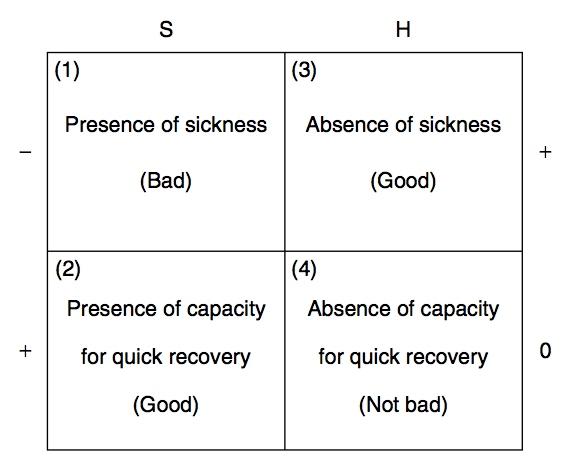
Benatar offers an analogy which may be helpful. Suppose that S (Sick) usually gets sick. But fortunately, he recovers quickly. H (healthy) lacks the capacity to recover quickly, but he never gets sick. So it’s good that S recovers quickly, but it’s bad that he gets sick. It’s good that H never gets sick, but it’s not bad that he lacks the capacity to recover quickly. This is because it’s not a deprivation for H because he never gets sick. Yet, H is overall better off than S even though S is better off than if he lacked the capacity to recover quickly.

Here, we can finally see if Objection 1 holds. Benatar tackles whether the differences between intrinsic and instrumental goods are relevant. Benatar argues that it’s not because because given scenario B, the differences between intrinsic and instrumental goods are irrelevant.

I got confused with this portion (p. 43) but Benatar argues that “there is a deeper explanation of why absent intrinsic goods could always be thought to be bad in analogies involving only existing people. Given that these people exist, the absence of any intrinsic good could always be thought to constitute a deprivation for them. In analogies that compare two existing people the only way to simulate the absence of deprivation is by considering instrumental goods. Because (3) and (4) make it explicit that the presence or absence of deprivation is crucial, it seems entirely fair that the analogy should test this feature and can ignore the differences between intrinsic and instrumental goods.”

Huh? Why only instrumental goods when it comes to existing people? With my thought experiment above, it seems that we could still talk about both intrinsic and instrumental goods, and talk about them in terms of existing and non-existing people.

Overall, since (3) has an advantage over (1), and (2) does not have an advantage over (4), scenario B is preferable to scenario A.

Benatar then tackles the disadvantages and advantages through another route.

Comparison 3: (2) Presence of Pleasure and (3) Absence of Pain.
Comparison 4: (4) Absence of pleasure and (1) Presence of Pain.

Benatar states that there are benefits in both comparisons but “[b]ecause there is nothing bad about never coming into existence, but there is something bad about coming into existence, it seems that all things considered non-existence is preferable” (p. 44).  With comparison 4, scenario B is preferable. Now Benatar needs to argue that (3) has an advantage over (2) in Comparison 3.  Indeed, he suggests this by the next figure:

The “+” signs indicate positive values, the “-” sign indicates negative value, and 0 indicates no value. So we would assume that Benatar’s argument could be construed as a crude utilitarian cost-benefit argument. He argues in the next chapter that he is not. The ratio of pain and pleasure doesn’t cut it; the sheer quantity of pain is enough to show that life is bad. “Once a certain threshold of pain is passed, no amount of pleasure can compensate for it” (p. 46). In other words, (2) is good for the existing person, but it doesn’t constitute an advantage for the non-existent person. Even if (2) has a + and (4) has a 0, the assumption is that (2) has an advantage over (4). But that’s mistaken. How so? Benatar uses the Healthy Person and the Sick Person as mentioned above.

Again, (2) may be good for S, but it has no advantage over H. No matter how high + is on (2), it cannot topple the + of (4). Therefore, + in (4) will always be higher than (2). In the same way where it’s always preferable to be H rather than S, Scenario B is always better than Scenario A.

The next chapter argued that coming into existence is always a harm and that this harm is very substantial for every person. If one is not convinced by the arguments here, the next chapter argues that our lives (and presumably lives that will come into existence) are actually very bad. This is what Harmon calls the Second View.  If needed, I may possibly do a summary on a chapter for a later post, but I think simply giving a book review/summary as a post will suffice.

Overall, there are two more objections that I can bring out that Benatar doesn’t consider. However, these next objections are contentious and aren’t accepted in any mainstream thinking, or even esoteric thinking either.

Objection 4 – The Economic Argument:  Most people consider that a huge world population is a problem.  It’s a Malthusian outlook where the more people there are, the less resources there will be and that will cause more suffering later on.  Now Benatar argues that there is a lot of suffering that many people go through and that’s true.  But it also seems that the suffering has been alleviated somewhat over the centuries and that’s got to count for something.  Even with his high standards, we’ve reached the bar a tiny bit.  Coming from certain economists, such as Steven E. Landsburg, he argues that increasing the population may actually be beneficial and may improve suffering.  How so?  We basically free-ride from our ancestors.  We have more availabilities of goods than in the past.  With more people, we get more ideas and one of those ideas may improve mankind.  Think of it like this: suppose you take a class by yourself and the professor grades on a curve.  If so, you really don’t need to work that hard just to get an A.  But now add another person.  Suppose the best that this person can do is 50%.  Ok, so you need to work a bit harder because you’re competing with this other person, but again, not too hard.  You only need to get above 50%.  Now add five more people.  Now you have work even harder to get that A because you’re competing with more people.  Now what about a whole classroom filled with 30-40 people.  You have to work even harder now to get that A.  The same is said with sports.  Better football players comes out of bigger schools.  Now increase the population, you increase your chances of having geniuses out there solving problems.  This also makes more people which drives up the competition.  Now this view is contested, but it may be something to think about.  I don’t expect this objection to be as serious as previous objections.

Benatar’s reply: p. 184. He writes, “the creation of new generations could only possibly be acceptable, on my view, if it were aimed at phasing out people.”  Thus, it is possible to create more people in order to have the previous generation suffer less than if the new generation didn’t exist.  But the purpose of this is to eventually make the human population extinct.

Objection 5 – The Transhuman Argument:  This deals with the Singularity that I talked about in a recent post.  If AI becomes possible, then suffering of humanity will presumably be gone.  Of course, this is also a controversial claim and I also don’t expect this objection to be as serious as previous objections.

However, I think one thing can be said for Benatar.  Even though he isn’t a utilitarian (at least that’s his claim), he seems to bring about an idea of higher qualitative plesaures (coming from Mill) and, as mentioned before, no amount of pleasure can compensate for the sheer quantity of pain.  Now, this sounds more Benthamite than Millian, but again, this is coming from Harmon.  What if there were higher qualitative pains that’s analogous to higher qualitative pleasures?  Harmon considers it but doesn’t say much about it.  But perhaps the idea that “no amount of pleasure can compensate for the sheer quantity of pain” may be considered as a “higher qualitative pain”.  I’m not sure if this Benatar would accept this or not, but it’s something that may add to his argument.

The old cliché is that it is better to have loved and lost, then to have never have loved at all. Most people, I would presume, agree with that statement.  (As an aside, I don’t agree with that statement.)  Now replaced “love” with the word “lived”: “it is better to have lived and lost, then to have never lived at all.” I think most people would generally agree with that statement. (Of course, most people would also agree that there are a few exceptions. E.g., a baby who is addicted to crack.) However, Bentatar would definitely disagree with the statement: it would have been better to have never lived at all. Or perhaps more specifically, it would have been better to have never existed at all.

UPDATE: June 9, 2011.  Benatar may have a reply to Objection 4 as seen above.
UPDATE: July 10, 2011.  I have added possible Objection 2.2 and gave a response that Benatar may give.
UPDATE: Aug. 25, 2011.  I have added this interesting, humorous youtube clip of an antinatalist superhero.  It may be over the top, but it sure is funny:

Posted in Anti-Natalism, Ethics, Paper Topic | 17 Comments

Dead Philosophers

I’m now a fan of Dead Philosopher Comics.  An example is below:

Malthus could do with a bit of whig reform himself. Booyah!

Posted in Humor | Leave a comment

Individual Houses Make Their Own Levees

The title says it all.  You can check out this gallery to see individual houses with their own levees.  Pretty cool!

Posted in Aesthetics, Culture, News | Leave a comment

Neil Sinhababu is Fantastic

Neil Sinhababu is a philosopher at the National University in Singapore.  After going through his blog and listening to a podcast, and reading one of his papers on Possible Girls, he’s now become someone whom I frequently look up.  Sinhababu is an ethical hedonist leaning toward utilitarianism.  Indeed, this philosophy spills onto his other works has a nice consistency.

One of his writings is On Obscene Sexual Expressions which I’m very jealous of because it is a well-written piece of work that I have actually been thinking about but I couldn’t exactly put it into writing.  Well, Sinhababu did it for me.  His writing is accessibly clear and filled with humor.  I’ve hardly ever laughed at philosophical writing and Sinhababu has made me laugh, twice.  That’s quite an accomplishment.  If you look at his graphs, you’ll see why.

Part of the sexual expressions is that calling a girl “whore” and “sluts” is usually demeaning, which I’m sympathetic to, but I go farther and suggest that these words just reinforces gender stereotypes.  I know I’ve been meaning to write a post on it, and I promise I will one of these days.  But Sinhababu actually says that people should embrace these words because they actually connote positive things.  You’ll have to read it to see it.  If anything, just read it for a good laugh, but hopefully you may learn something.

Anyways, his blog is now on the left.

Posted in Humor, Sexuality | 5 Comments

If You Ever Feel Lonely…

…just keep in mind that you have a possible partner in some modal reality.

This paper is seriously impressive.  I don’t think I have actually laughed at a philosophy paper before, but the myriad of possible girlfriends (with and without tentacles) along with talking donkeys is a pretty good read.  Perhaps I may teach this to my class sometime…

Posted in Humor, Paper Topic, Possible Worlds, Relationships | 2 Comments

Year One in the Ph. D. Program: Reflections

So my first year in the Ph. D. program is over.  It was exhausting and stressful, but overall I’m happy to get back into academia and learning new ideas.  First let me say what I’m enjoying so far.

The City

Milwaukee is very diverse, much more diverse than Utah or College Station, Texas.  It’s probably another reason why I enjoy it.  And because it’s a big city, there are plenty of things to do here.  Since I’ve been so busy with school work, I haven’t had time to explore the city yet, but I can already tell that I’ll enjoy it during the summer off.  There’s a trail along the river that I can run along, and the river goes straight into downtown.  One can literally run through restaurant patios because the patios are actually on the running path.

As I take the bus to campus, I always pass the Riverside Theatre and there are always great performers such as Chris Cornell, Lewis Black, Willie Nelson, Sarah Silverman, and Jay and Silent Bob.  Unfortunately, I never have the money to see them.  It’s a town that has everything as far as I’m concerned.

The Geography

Obviously, Wisconsin is up north which means it gets cold quick.  I haven’t lived through a summer yet, but I hear it gets quite humid.  The winters are very cold, but not to the point where it is completely unbearable.  It’s May now and it’s still jacket weather.  But during winter time, you better be prepared quick.  When it was the beginning of December, I remarked that the weather is pretty cold.  A fellow classmate said, “Actually, this is pretty warm.  Wait until January.”  Wow, he wasn’t kidding.  Milwaukee can get very cold.  Just to show you how: I was drinking a cold drink outside.  As I was sipping the last drops, the drops came down the cup more slowly until they froze!  Yeah, it’s that cold.  Overall, I can deal with it, so it’s not that big of a deal to me.

The People

The people are much worse drivers than Utah.  Maybe they’re big risk takers, I don’t know but they are much more aggressive here.  The pedestrians are more assertive too and I’m surprised I don’t see many accidents on the streets.  Other than the driving, the people are very laid back and friendly.

The University

I love Marquette!  It’s in the middle of downtown and the staff is very laid back.  The rest of the graduate students are friendly.  Everyone is willing to discuss ideas and help each other out.  With that, let me tell a little bit about what I wrote about my first semester:

Plato: I learned a lot here and read some dialogues that I’ve been meaning to read but never had the time.  I have a great appreciation for the Republic and the Gorgias.  I ended writing my final paper on the Theaetetus which is really surprising because epistemology is not my strong suit.  Overall, I argued that the Socratic Midwife passage was meant for Theaetetus because of his character.  I surprised myself because I went through the dynamics of knowledge and self-knowledge and whether Theaetetus is an interlocutor that Socrates is looking for, maybe even one who could potentially take Socrates’ place.  Enjoyable class.

Philosophy of Religion: I took philosophy of religion as an undergrad.  After my MA, I wrote a major paper about my religious beliefs and thought I’d never get back into it.  But I signed up for it and I’m glad I did.  We basically went through an anthology of religious issues and it broadened the scope of what I thought religiously.  I haven’t changed my religious beliefs, but it has given me a deeper appreciation for the arguments as well as arguing more carefully.  The final paper dealt with logical positivism stemming from Anthony Flew.  It wasn’t a topic of my choosing, but I think I did pretty well on it.

Political Philosophy: this was a totally new thing for me.  I mainly learned political philosophy on my own and so getting it from a class with other students was a real treat.  It’s a very fast-paced class; we basically read a book per week.  We went through the standards such as Locke, Rousseau, Hegel, and Mill.  But we also went through some of the topics that I’ve never studied or thought of: Critical Race Theory, Political Feminism, and Existential Politics.  I liked the latter so much that I ended up writing a paper on Beauvoir’s book trying to figure out her statement: “I’m not free unless everyone else is free.”  It was a hard topic.  I wished that I had talked to the professor about the topic because I made huge assumptions in that paper.  I got frustrated because of it, but I had to move on and realize that I still need to overcome my shyness and talk to the professors outside of the class.  Very enjoyable class, I just wish I knew about what I was getting into with my paper topic.

For the second semester, I was given the opportunity to teach which was a real treat.  I ended up teaching Theories of Ethics and Philosophy of Human Nature.  Both classes were enjoyable, but I liked teaching Philosophy of Human Nature more because it’s more up my alley.  I enjoy teaching and I really like the idea of students gaining wisdom and learning new ideas from the class.  I learned that my style is more lecture-based rather than discussions-based.  I wish I could get it to a discussion type of class, but they are relatively large classes and any sort of discussion on large classes is pretty difficult, but I can lecture no problem.

Here are the class I took this semester:

Reading French: this was actually my favorite class this semester oddly enough.  I only took one semester of French and so I didn’t know what to expect.  However, I quickly learned that when it comes to languages, there are four sections: reading, listening, speaking, and writing.  In this class, I know how to read French.  I’m barely ok at speaking French, but that’s only because of my previous encounter with it.  I can’t understand it if you spoke to me in French, and I certainly can’t write in it.  But I’m happy with it.  I eventually bought some French books and was relieved that I could read Camus in the original French, for example.  I also bought de Beauvoir’s The Second Sex in the original French too.  I may be overambitious, but I was happy enough that I could read French now.

Augustine: Medieval philosophy is not my strong suit.  In fact, I try to avoid it as much as a I can.  Despite all that, I somewhat enjoyed the class.  We ended up reading the Confessions and sections from the City of God, but it was mainly reading secondary sources to get a deeper understanding of Augustine.  It gets complex because Augustine isn’t very systematic and so writing a paper about him was challenging.  I was originally going to write a paper on sin, but that didn’t pan out.  Eventually, I started over and wrote a paper about pride and used Camus’ The Fall to help illuminate what Augustine meant by pride.  Again, this was too big of a topic.  I didn’t know what to write on so I had to think quickly and this is what I came up with.  It was very challenging.

Philosophy of Language: This class was mainly reading a book that will eventually be published entitled Invisible Language.  What I got out of the class was something like, “Wittgenstein was right.  If we just take the linguistic turn and see what we’re saying, then we won’t be caught up in our bewitchment of language.”  I actually got caught up in the Wittgensteinian mode of philosophy as an undergrad and a little bit for my MA.  I thought why not give it another go?  Overall, we read Wittgensteinian applications of previous philosophers and our project was to write a paper of a similar style.  I ended up writing a linguistic analysis of Plato’s Symposium.  Not my best paper, but it’ll do.

Any Problems?

Overall, let me just say that I’m extremely happy where I’m at and I couldn’t ask for anything better.  And yet, there is something that has been bothering me.  This has actually been bothering me since 2008.  See, the problem was that my specialty is in the philosophy of love & sex and Schopenhauer.  Those aren’t very popular fields so I’ve been reading them on my own.  Yet, it gets pretty discouraging to engage with the readings if you don’t have an outlet to explore these ideas, or someone to converse them with.  So I eventually temporarily abandoned them and delved into my teaching.  I tried to hone that craft by looking at my flaws and tried to get better at explaining the ideas.  For example, if I saw that I couldn’t explain Hume that well, I would go back and read books (mainly intro type) so that I could explain Hume better for the students next semester.  I tried to do this until I got to Marquette.  But by doing this, I think I lost something.  I mainly learned to skim through the surface of the material in order to explain it to intro students, but I didn’t go deep enough to really engage in the ideas.  So eventually, I just looked through the basic ideas, but never really got to a deeper level on anything.

I’m reminded of Meno in the titled dialogue.  Meno is basically getting all these ideas from all sorts of people, but he doesn’t really engage them on his own.  I’m sometimes afraid that’s what’s happened to me.  At times, I don’t see myself as a philosopher, but more of an intellectual tourist wading through the shallow ideas of thoughts, but, unlike Meno, I’m hoping to swim through the ideas of understanding.  I notice this in class as well.  As soon as the topic becomes abstract, I quickly lose interest.  Mind you, I don’t zone out.  I still get engaged in the discussions and try to participate, but at the end of the day, I end up saying, “Eh, so what?”  I look to my fellow philosophy friends and they already have developed a specialty in something that I sometimes can’t keep up with them because I don’t know what they’re saying.

At times, I look at the papers I’ve just written and I’m thinking that it’s not serious work.  Pushing myself to get to the deeper levels is challenging too.  It’s not impossible but challenging.  I think it’s analogous to writer’s block, but I have “intellectual block” where I just can’t seem to get past a stuck point.  I think that reading philosophy has many levels.  A beginning level is to quickly skim through the reading and see what the philosopher is trying to say.  A later level is to actually look at the arguments and see if the argument makes sense.  A much later level is to engage with the philosopher and try to either apply it to one’s life, or make a creative response that either accepts or rejects it.  This later level is one I’m struggling to transition toward.  I’ve always looked at these philosophers as making arguments, but I’ve never thought of myself as owning the idea.  There are a few exceptions, but those are rare exceptions.

Any Solutions?

Honestly, if there are any solutions out there, I’d love to hear them, but one thing that has helped me is talking to other classmates to get a feel for what they’re going through.  Grad school is a rough ride.  It’s stressful, frustrating, but it’s also supposed to be a learning experience as well.

Typically if I get a bad response, I sulk for a few hours, but then I get back to work much more motivated.  It’s not as if I can prove to the professor that I can do the work (after all, the grades have been submitted), but it’s to show myself that I can do this.  It’s a reminder that success doesn’t rely on others necessarily.  A really smart friend of mine says he hates school.  Not because of schooling itself or learning new things, but because he didn’t like the idea that other people would tell him if he would be successful or not.  Trust me, my friend is pretty successful.  That’s the attitude I want.  That’s the attitude I need.  I want to be successful so that I can do this, but I’m not out there proving what I can do.  Yes, grad school (or any school for that matter) does have many hoops that one needs to jump through, but I have to remind myself that it’s part of the process and after all this, I can finally delve into something that interests me and what has made me love wisdom in the first place.

One thing I’ve learned is that perhaps my papers are too big.  The topics I usually choose are probably meant to be a book topic rather than a paper topic.  One of my friends here recommended that I just read a page or a passage from the philosopher and just write about that.  Intriguingly, when I look back at my grad school work, that makes a lot of sense.  I took on too much when I did my political philosophy and my Augustine paper in which I didn’t do so well.  But I only focused on a small chunk reading (only a passage for Plato) and I did really well in the class.  The key is to focus on smaller things.  I’m writing a paper, not a dissertation.

I’ve tried out a plan to see if I can escape this type of thinking, but overall I’m not sure.  I think I just might go back to my roots and read more into my specialty, but again, my worry is that I have no one to engage conversation with.  No one is interested in the philosophy of love & sex and nor in Schopenhauer.  This summer, I want to read ahead for the classes I will be taking.  This way, I will try to balance myself.  I have started Consciousness Explained by Dennett and I’m reading secondary literature on Derrida.  I would also like to dabble through Benatar’s Better to Have Never Been.  It has a Schopenhaurian theme.  It’s a start, and I’m not sure it will work.  But I have to start somewhere.

Posted in Grad School | Leave a comment

If I Ever Have Kids…

this is the book I’ll read to them.

gothefucktosleep.jpg

Here’s a page from the book:

Go The Fuck To Sleep

Posted in Books, Children, Humor | 1 Comment