All Scholarships are a form of Affirmative Action

Not really, but hear me out.

Let’s ask what’s the point of affirmative action.  Well, it started with Johnson’s presidency and the purpose was

  1. to rectify previous injustices, and
  2. to disestablish institutional racism.

Now, the applications of this have been tremendous, especially when it pertains to obtaining a job or going to school.

Critics of affirmative action have been:

  1. it’s the previous generations that have been wronged, not this one.  So why should this minority generation get the benefits when this majority generation didn’t do anything about it?
  2. it could cause resentment of the majority group against the minority groups because it seems that the minority group would get the upper hand, in which case it doesn’t get rid of racism, but seems to bolster it.
  3. people cannot choose their (skin color, nationality, race, sex, creed) so the government shouldn’t propose a program on which an arbitrary factor played into their lives.

Now, I’m not interested whether affirmative action is justified or not, at least not in this post.  What I want to focus on is critique number three: namely that we can’t choose our outward appearances.

Let’s suppose that the critics are right.  So then, affirmative action is wrong and we shouldn’t be “lenient” toward races and genders just because of the fact that they are a certain race or gender.  We treat everyone equally regardless of race or gender.  So then, the argument goes, we should get rid of scholarships that has a race or gender determining factor behind it.  (Actually, I doubt that the schools actually give scholarships based on race or gender, but programs and memorials use the schools to give them away, but let’s ignore that for now.)  Again, remember that we cannot choose our race or gender, so why should we get a “leg up” in life on something that we didn’t choose anyways?

Well, hold on there.  What about academic scholarships?  Basically, these scholarships are given out based on one’s intelligence, and we think that this is a fair way to give out funding because this person earned it or “worked hard for it.”  Well, I’m not so sure.

How is life planned out?  It’s done through two ways:

  1. biology (so basically, genes and DNA)
  2. environment

Now, here’s the rub.  We didn’t choose either of those.  So if one is intelligent, let’s say, then it was just in that person’s genes, just like someone’s race or gender was in someone’s genes.  Simple enough.

But what about environment?  Well, I didn’t choose to live in Utah.  I didn’t choose to live in a surrounding where I had the opportunity to get an education.  I didn’t choose my class or economic standing.  Thus, based on my environment, I was given the education that I had.  If I was born in a ghetto, I would have likely (but not absolutely) not gone to high school, let alone college.  So the environment does have a factor.

Now, I could imagine the reply being this: “but it’s what you do with the environment or the genes.  One still has a choice.  So with the child being born in the ghetto example.  That person still has a choice of raising him/herself up, or still chooses to live life in bad circumstances.  But it’s still that individual’s choice.”  My problem with this sort of reply is that I think it was that person’s genes or environment that “helped” or gave the individual the opportunity to choose.  The environment and biology speak for a lot and it does factor one’s intelligence.

So, just like race and gender aren’t chosen, neither is intelligence.  So then, this is why I wanted to claim that all scholarships are a form of affirmative action because we don’t choose our intelligence, achievements, environment, or biology.

What’s the solution then?  There are two:

  1. Give out no scholarships because they are unfair anyways,
  2. Everyone has the opportunity to get a “scholarship,” thus make college more or less free or at least cheaper.

Now, I’m opting for the second option.  France is doing this and it seems to be working.  They have many public intellectuals and in the philosophy scene, they are actually leading the world (at least in Continental Philosophy, as far as I can see).  I know that I will have many replies to this, so I’ll just leave it at this and see what the replies will be.

Posted in Ethics, Paper Topic | 4 Comments

Sacredness of Life

So here’s a question I’ve been thinking about: is life sacred?

Many people consider life (especially human life) sacred, but what does that mean? If life is sacred, why is it sacred?

UPDATE: Perhaps the word “sacred” is a bad word to use in this context so let me try again. How about valuable?

So then here’s the question: does life have intrinsic value? If so, why? Many people consider life (but perhaps humans exclusively) having intrinsic value. But why? Why does life have intrinsic value?

Posted in Paper Topic, Uncategorized | 7 Comments

Demi-Vegetarianism

As some of you know, I’m a vegetarian of sorts, but I consider myself more of a demi-vegetarian. British philosopher R. M. Hare, used it in the title of an essay: “Why I Am Only a Demi-Vegetarian,” chap. 15 in his Essays on Bioethics (Oxford: Clarendon Press, 1993), 219-35. According to Hare (who says he did not invent the term), a demi-vegetarian is “someone who, while not being a full vegetarian, let alone vegan, eats little meat, and is careful what kinds of meat he (or she) eats” (pages 224-5). Hare wrote that he and his wife ate little or no meat at home (except when hosting guests whom they knew—or guessed—would not like a vegetarian meal) and occasionally ate meat in restaurants when there was “no obvious alternative” (page 225).

Now Hare has exceptions as to when it’s acceptable to eat meat. Here are my exceptions and hopefully this will explain my reasons for demi-vegetarianism:

  1. If the meat is organic or local, I will eat it. If I could, I would be a locavore, but being in Utah, that would mean I couldn’t eat oranges, bananas, kiwi, strawberries, and many other fruits.
  2. If it’s going to waste, I will it eat. Let me give an example: let’s say that my friends and I are going out to eat. I will pick a vegetarian meal and most likely my friends will pick something with meat in it. Now let’s say that my friends are full, but I’m still hungry. Thus, I will eat the rest of their meal because it would’ve been thrown in the garbage anyway.

Now based on this, I am not a vegetarian for ethical or health reasons. So then, why am I doing this?

I guess it’s because I have a moral repugnance to factory farms. For a nice, perhaps cartoonish example of how factory farms operate check out the meatrix (Note: it’s not gross or sickening. If anything, it’s kind of entertaining.)

Let me ask this question: would you be against any form of torture to animals? Imagine taking cats and dogs and just drowning them for fun or burning puppies. Yeah, it’s an extreme example, but I would think pretty much everyone would agree that those activities are immoral. Well, I find the situations in factory farms similar, if not equal, to torture.

If it’s grown organically or locally, then they will not be in factory farm situations.

Here are some books that provides my philosophy well:

Fast Food Nation by Eric Schlosser

This is an excellent book describing how the fast food industry started. It’s an interesting story of the history of fast food but it also gives dark implications about how food has become “fast-fooditized” and that fast food in general is a detriment to our health.

These next books I haven’t read, but I definitely would like to in order to develop my philosophy of food:

The Ethics of What we Eat by Peter Singer

Peter Singer is always known for his vegetarianism combined with utilitarianism.

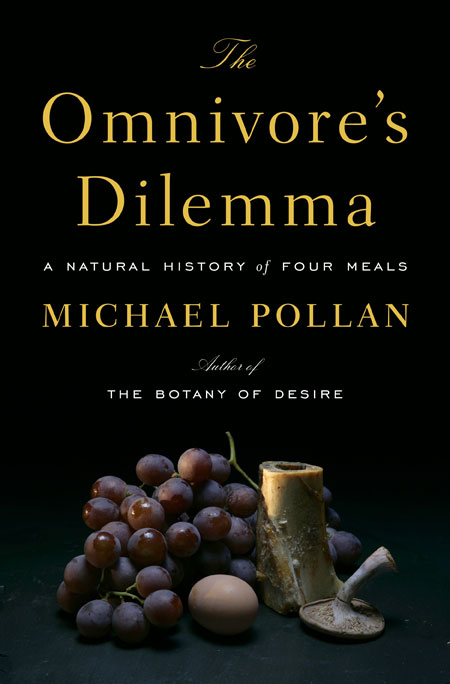
The Omnivores\' Dilemma by Michael Pollan

and

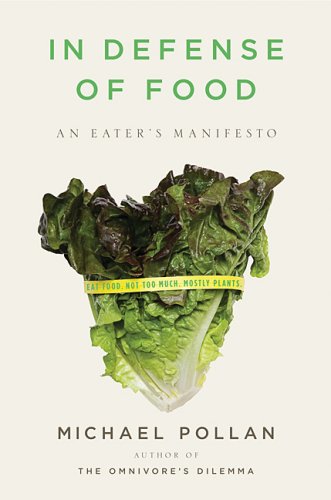
In Defense of Food by Michael Pollan

are books that are next on my list when it comes to the philosophy of food. Pollan argues for eating locally because the way that our food system is going now will be a worldwide catastrophe.

I don’t see the arguments (but as I’ve said, I haven’t read the last three books) but I would like to learn about these philosophies and implement them into my own. Perhaps they have a point, but they may hold on to a nostalgic way of how food has been produced.

Update: 03/09/09.  I have finally read the books above and it was an adventure.  I am ready to say more about the developments of my thoughts on demi-vegetarianism conscienceness omnivore.  That’s the term that Pollan and Singer use.  Before I say more about these books, I re-read Hare’s article and there was something in there that really grabbed me.

Hare has three arguments for his demi-vegetarianism: health, economic, and moral.  The health and moral reasons are easy to understand.  What about the economic?  I think the economic is actually the most persuasive (although it’s mixed in with a little morals).  Basically, the argument is that in economic troubles, it’s more economical to grow food (vegetables and fruits) than to grow fodder, then feed it to the animals, and then eat the animals.  Food is produced more effectively and enormously through growing vegetables.  From this, it seems odd that most of the Western world has given up their land for the sake of raising meat.  When we eat vegetables, they’re mainly getting the source from the sun.  How much does that cost us?  Free. Feedlots to feed animals thrive on corn.  But the corn for feedlots requires chemical fertilizers.  In other words, oil.  Based on this, how much oil does it cost to feed a 534 lb. to a 1250 lb. steer?  284 gallons of oil just to fatten the steer. So economically speaking, if we wanted food for humans, it would be easier to feed the starving millions even outside of the Western World. Of course, we reach another problem of making sure that these people become self-supporting, but that’s a whole other issue. At the same time, there is land where it’s not suitable to raise crops, but it’s perfect to raise pasture and livestock.

With this, let’s say we argue for vegetarianism.  Since the US is about 8 percent vegetarian, this stops or slows the production of organic meat and local meat.  I doubt the regular meat-eaters will eat sustainable food because getting their meat at fast-food or any conventional store is cheap.  So what happens: the factory farms are still in business and the local foods drop because there’s no demand for them.  However, say we argue for demi-vegetarianism.  Now, there’s a demand for local and organic meat.  You’d have to shop at Whole Foods or get your meat from a sustainable farm.  I think more people are willing to do this.  With this, the factory farms will drop in the demand, thus their supply and so not many animals will suffer.  I think it’s a brilliant argument from Hare.

With the books, here’s the order I would suggest:

  1. Fast Food Nation. This is the book to start you off in looking at the reality of food.  You won’t want to eat fast food anymore.  If it’s too long for, I would read Chew on This.
  2. The Omnivore’s Dilemma. From here, you’ll expand your knowledge of fast food and work your way to sustainable food.  You’ll think twice about buying even organic food and trying to eat consciously.
  3. The Ethics of What We Eat. With this, you can bring in some philosophy but you’ll also see the sources for whatever diet you choose to eat.
  4. Finally, In Defense of Food. Now you know what to avoid, here’s what you can eat.

Of course, this is my order.  You can read it any way you prefer.

Posted in Book Review, Ethics, Experts, Paper Topic, Peter Singer, Vegetarianism | 11 Comments

Kierkegaard and Fundamentalist Christians

Back in a previous post, I mentioned that a possible paper topic I could write about was pertaining to Kierkegaard and Fundamentalist Christians.  Well, I’ve been thinking more about that lately.  What would Kierkegaard think about the Fundamentalist Christians?

Here’s what I’m thinking: Kierkegaard is a fideist, which basically mean faith comes first and reason is second priority.  Well, part of Kierkegaard’s philosophy is that:

1.  Faith creates its own justification.

2.  If you have faith and you give reasons why you have faith, then that’s not faith.

3.  Real religious faith is always going to have risk. And it’s a scary risk.

Now in Kierkegaard’s day, and even in our own day, we see many people that claim to be Christian but they sure don’t act like it. People assumed they were Christian because they were born of Christian parents, and they were raised in a Christian society, they went to church once a week, they learned the prayers, and the understood the doctrines. So then to be born a Christian seems to give the presumption that one is a Christian and Kierkegaard says that this is totally insufficient. People think they’re Christians because of certain beliefs. In fact, if you ask certain Christians what they believed, they would find most of the doctrines incomprehensible. So just because you say you believe, or you assent to believe isn’t enough to be a Christian.

If you are to be a certain person, then you must take the whole package. If you truly believed that a certain action is sinful, then your life must reflect that belief. Otherwise, Kierkegaard would call you a hypocrite. But then again, Kierkegaard thought everyone was acting like this. Thus, everyone’s a hypocrite.
You must believe in it, not just merely believe it.  So people thought that just being a Christian meant going to a sermon and listening to the leaders and that’s that.

People have lacked passion.  Indeed, Kierkegaard says that it’s easier to become a Christian if you aren’t one already than if you were born a Christian. It’s a commitment; it’s not something to be taken for granted. So people aren’t true Christians just because they were raised that way or because they spout off certain beliefs. Kierkegaard would consider them as hypocrites. Their beliefs are empty. These people see themselves as part of a banal membership. They belong to a church; they hang out together claiming to be part of a group, but it has nothing to do with Christianity. They are sanctimonious – pretending to be holy. What’s going on is that Kierkegaard would say that it’s false Christianity; that it’s inauthentic Christianity.

Most Christians are part of the herd mentality. People assert what other people believe. They don’t think about it, but most importantly they don’t feel about it. People go to church for rituals and social belonging. But being a Christian is more of an individual passionate commitment.

He really concentrated on the individual saying that philosophy will never capture what the individual is all about.

So based on this, I can see Kierkegaard agreeing with the Fundamentalists.  However, here are some things that he would disagree:  Having faith then doesn’t come from what you hear, or what you’ve grown up with, or what you’ve been influenced by; it’s based on your own solitude alone and no one can make that choice except you.

Kierkegaard regarded Abraham from the Bible as having true faith, a religious life.
The story is that Abraham has been longing for a child and he finally gets it. And now, God tells Abraham to sacrifice his only son. In the name of faith, Abraham sees what Kierkegaard wants to point out: killing your son doesn’t make it morally right, but it’s something that Abraham must do. From any perspective, what Abraham did was absurd. He made that choice through a paradox, there were no grounds to justify his choice and-this is important-he knew it. He couldn’t go to Sarah and ask “What do you think?” or his fellow tribesmen. He knew in advance what they’d say. He can’t justify his actions to other people, but he also can’t justify these actions to himself. He had to face this alone. But there is one perspective where in a weird way, it does make sense: faith. He has to face this alone. All that’s left is a felt commitment to God. When Abraham made his choice, it wasn’t an easy choice. It was agonizing, full of despair, anxiety, and it was hard.

So all of the preachers, the bishops, the chaplains, and rabbis, and the priests. They all talk about Abraham and they say that you just have to have faith like Abraham like it’s the easiest thing in the world. But they’re just taking him for granted, as if it was the easiest thing in the world. Having faith-being like Abraham-is actually hard work. It’s not easy. Thus, religious faith is not easy. Proper religious faith can only be achieved with great difficulty. The Religious life is this: to truly become “a subject”, you must somehow take on this paradox: to obey God while admitting at the same time that you will never know for sure that you are obeying God. You must paradoxically know that you don’t know. Does this make sense? Not really, but Kierkegaard isn’t trying to make sense, he’s trying to edify us. But only faith makes you an authentic, existing self.

So this is where he would say that the Fundamentalists are not authentic Christians because they don’t have this true faith because faith for Kierkegaard is filled with anxiety, disappointment, dispair, and it’s hard.

However, could the Fundamentalists be closer to the religious life then common Christians?

Posted in Existentialism, Kierkegaard, Paper Topic, Religion | 5 Comments

Spiritual but not Religious??

Often I hear that people are spiritual but not religious.  What does this mean?  To say that one is spiritual–does that mean that s/he believes in spirits?  in ghosts? in some afterlife?  in God even?

Next, what does it mean to be religious?  To be religious means to follow a certain religion.  So to put this into a common-language term, it means that someone still believes in (God, ghosts, the afterlife, souls, etc.) but doesn’t follow the dogmas, doctrines or any dictations of a certain religion.

Now here’s my question: WHY?  Why do you still believe in God, souls, etc.?

Here have been a few replies:

1.  “Because it makes me feel better.”  Well, this argument is obviously flawed.  That’s like saying that one should believe in Santa Claus or the Easter Bunny for the pure fact that it makes one feel better.  This argument doesn’t work.

2.  “Because if I don’t believe in God and God exists, then I’m doomed to eternal torment.”  Ahh, but wait a minute.  You just said that you’re not religious.  If you’re not religious, then why is it that you follow the dictates of a certain religion?  It seems odd that you will not follow the dictates of the religion because you find it too dogmatic or you’re skeptical about it.  But when it comes to hell, all the sudden you believe it.  Aren’t you picking and choosing what to believe and what not based on what you feel is good for you?  What it comes down to is that if the facts don’t correspond to your belief, you are more likely going to change the facts instead of your belief.  On top of this, the belief that you will be condemned to hell is a religious belief, not a spiritual one.

3.  “Because atheists are bad people.  I’m not a bad person.  Therefore, I’m not an atheist.”  This is a bad argument.  Assumption one is flawed.  First of all, does it follow that all atheists are bad people?  I’m sure you can think of many people who don’t believe in God yet are good people (the Buddha, for example).  Likewise, I’m sure you can think of many people who are believers but aren’t that good.  So one cannot assume to say that atheists are bad people because there are countless examples that don’t verify that fact.

In short, what I want to say to those people who say they aren’t religious, but spiritual.  My reply to them is you’re really a skeptic, atheist, agnostic, doubter but you’re just afraid to admit that.

Posted in Atheism, Paper Topic | 31 Comments

Chris Hedges doesn’t believe in Atheism

Chris Hedges doesn’t believe in atheists. What he means is that the new form of Atheism (e.g. Sam Harris, Richard Dawkins, and Christopher Hitchens) is another brand of fundamentalism, a new form of radicalism if you will.

The interview is interesting in that Hedges states that he is against radicalism, both religious and secular, but he does something towards the end which I question. He says that humanity is basically (or perhaps inherently evil) and that if we look at the world in binary oppositions, then we’re doomed and we’re just following a utopian dream. However, his belief on human nature seems extreme as well. Check it out and tell me what you think.

Posted in Atheism | Leave a comment

The Problem with Moral Obligations

A lot of moral philosophers have said that we have a moral obligation to do x.  But hold on there!  Let’s back up a bit.  The question that needs to be asked is why.  Why do we have a moral obligation to do x?  In fact, let’s take it one step further: why do we have moral obligations at all?  I could imagine one responding back saying, “well, we should have moral obligations because. . . ” Well, hold on there.  The “should” in that sentence already implies an obligation.  In other words, it’s stating that we have a moral obligation to have a moral obligation.  But then, why have that second order moral obligation.  Again, the response could be “Well, we should have a moral obligation to have a moral obligation because. . .” and again it’s repeating itself.  So the question remains: why do we have moral obligations?  Should we have moral obligations?  If so why, and to what?

Posted in Ethics, Paper Topic | 22 Comments