
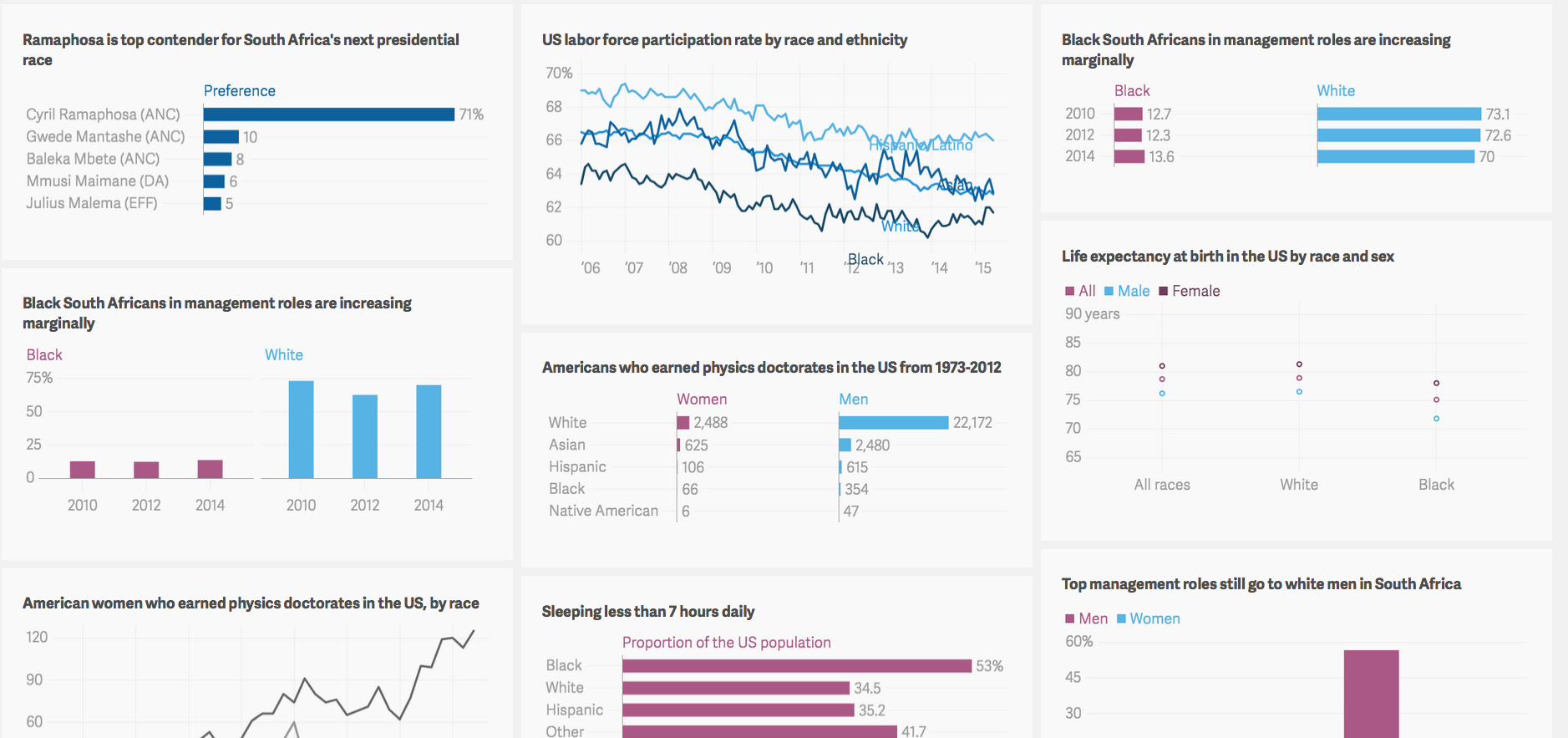
Atlas is a great resource to look up charts of data on anything you need. I just looked up “race” and this is what it produced.
I’ve also looked up “gender,” “students,” and “sex.” Sadly, “philosophers” didn’t turn up any results.
Atlas is a great resource to look up charts of data on anything you need. I just looked up “race” and this is what it produced.
I’ve also looked up “gender,” “students,” and “sex.” Sadly, “philosophers” didn’t turn up any results.
Last June, comedian Aziz Ansari and sociologist Eric Klinenberg wrote a book together called Modern Romance. The book discusses how technology has rapidly changed the way we view love and relationships such as breaking up over texts, emojis as ways of (mis)expressing flirtation, or that with so much choice, we keep looking for the next person that could be “the one.”
Both of them, along with anthropologist Helen Fisher, one of the founders of OKCupid, Christian Rudder, and psychologist Eli Finkel all come together to discuss romantic love. Where it started, where is it going, how has technology played a role, and can we learn from this. It’s really worth watching. My favorite part is when Aziz tries to outdo the sign language impersonator.
John Oliver delivers a top-notch video about what’s wrong with sex ed in America.
In a very interesting article, Pennsylvania is considering to base criminal charges not just on what crime was committed, but also whether that person is more likely to commit a crime in the future. How? Judges could receive statistically derived tools knowns as risk assessments to help them decide.
These tools are already being used to predict recidivism by using statistical probabilities based on factors such as age, employment history, and prior criminal record. But Pennsylvania may be the first state to use these risk assessment tools as part of the sentencing itself.
For example, Milton Fosque received three DUIs. After each arrest, the risk assessment system predicts whether he would commit another crime. However,
Fosque, however, says the chance he will commit another crime is zero. After a year in jail, he’s now out on parole and says he has been sober since he was last arrested, in 2012. He was elected to the board of the re-entry program he attended, is active at his church, and has been working on lifelong family issues with the help of a social worker. He’s even fixing up his home. “I’m not going back there,” he said of his time inside.
Fosque is quick to talk about drinking and the life choices that landed him in jail. But he also feels he owns the responsibility and effort it has taken to stay sober. He hadn’t heard of risk assessment, but after he was told that the tools were used to determine which facility he served time in and what level of supervision he received on parole, he looked them up online. “You mean to tell me they’re using statistics to determine what’s going to happen to me?” he asked. “That ain’t right.”
You should see the article. There’s even a flash site where you can input your own features to see if you would commit a crime in the future.
Three new articles came out recently discussing same-sex attraction. What really struck me on both articles is the idea that being “born this way” should be done with.
The first article is a short interview of Lisa Diamond. Lisa Diamond, developmental and health psychologist at the University of Utah, has written and studied extensively on sexual fluidity. There’s an interview about her take on many issues such as sexual fluidity:
people are born with a sexual orientation and also with a degree of sexual flexibility, and they appear to work together. So there are gay people who are very fixedly gay and there are gay people who are more fluid, meaning they can experience attractions that run outside of their orientation. Likewise for heterosexuals. Fluidity is the capacity to experience attractions that run counter to your overall orientation.
Whether being around same-sex sexuality makes others become same-sex oriented:
same-sex attraction does not appear to be contagious. There have been a number of really cool social network studies done over the years looking at whether some traits, such as obesity, can spread through social communities. And they can. So researchers used data from theNational Longitudinal Study of Adolescent Health, took the same analytic technique and applied it to same-sex attraction. If a lot of your friends are same-sex attracted, are you more likely to be same-sex attracted? Are the attractions themselves spreading? And they found that they were not.
And the idea that being born gay needs to be put to rest:
It is time to just take the whole idea of sexuality as immutable, the born this way notion, and just come to a consensus as scientists and as legal scholars that we need to put it to rest. It’s unscientific, it’s unnecessary and it’s unjust. It doesn’t matter how we got to be this way.
A really short, but good interview.
The next article is long, but really good. In it, the author claims that being born that way isn’t good politics:
While this biological determinism of sexuality has been associated with a great triumph for the gay-rights movement, it’s been a great loss for our public discourse.
Why is this? Because being “born this way” has been associated with oppression.
To the Nazis, immutable genetics required a programme of extermination; in a very different context, the genetics of ‘difference’ require acceptance. But both share the presupposition of biological determinism: that genetics determine identity; such genes must result in either elimination or embrace. This suggests why the activist alliance with genetic determinism yielded such successful results.
Thus, the author argues for a social construction of sexuality rather than biological determinism. With this view, it avoids the pitfalls of determinism vs. free will.
‘Born that way’ is a simple mantra, one that cuts through the concepts and challenges I have outlined. But it is also dangerous. For embracing the fiction of biological determinism risks consistently misunderstanding the most important part of our lives – our intimate relationships. We invented romantic love. And homosexuality. And just about every other kind of relationship. That doesn’t make any of these things less important or less real. But our inventions are not part of a biological nature: they are part of a conversation between a biological and social order of life.
The third article discusses how being “born this way” is itself homophobic.
The author uses great examples to make her case. This phrase was key to me:
arguing that people are born gay isn’t going to convince anyone who thinks it’s immoral to be gay. When we say “they can’t help it”, we’re not actually arguing that someone’s behaviour isn’t immoral – just that they’re not as blameworthy as we once thought. Instead of arguing that people can’t be blamed for being gay because they are born gay, we need to argue that there’s nothing wrong with being gay in the first place.
And to say that they can’t help it, future drugs could change that if people still find it immoral:
We don’t yet have enough evidence to know for sure that sexual orientation is something you’re born with, and something you can’t change (albeit with a lot of effort.) Suppose we were to find out that people actually do have significant control over the gender they are attracted to. Would this mean a significant reason to support gay rights would have been undermined? Would we think it was ok to then revoke those rights? Surely not.
I would like to offer another reasoning why “born this way” has limits. I’m mainly getting this from John Corvino’s articles. But think about how being born this way can lead to some major problems. In a regime that is dangerous, like the Nazis, they used “born this way” as a reason to exterminate certain groups of people. Perhaps not, but suppose that people find out that being non-monogamous is genetic, would people still act as if they are acceptable in society? Many people still act racist or sexist to those who are “born this way.” Now, many people will say that this is a perversion of the principle that being “born this way” should have some acceptance in society. The argument, I presume, is something like this:
This argument is flawed because premise three is faulty. There is some evidence that pedophilia has some genetic component. Or we can imagine a scenario where an activity does have a genetic component. Suppose being a serial killer was biologically determined. Based on the argument above, we would have to accept them. But this is flawed. Now, I’m not saying we should therefore get rid of such people. If they can’t help but have these predilections, then we should have some cautionary concern and place limits around them, but to forever lock them up and punish them is analogous to punishing people for being gay or for being a non-dominate race.
The “born this way” mantra has some leeway, and from a scientific lens, it may be an interesting question, but for progressive politics, it seems best to let it go.
There’s a nice book review of Tessman’s book. This paragraph really grabbed me and it inclined me to read the book when I get a chance:
Tessman’s thesis is that there are some things that morality requires us to do but that we just cannot do. Morality is fundamentally tragic. That parent in the drawing is trying to protect her kids, but there are some harms from which you simply cannot protect your kids. Yet you still have to. The purpose of this book is not to explain away these troubling binds, but rather to embrace them, in a kind of clear-eyed moral pessimism. If Tessman is right, life is marked by “unavoidable moral failures from which there can be no recovery and in which there is no redeeming value” (p. 3).
Check out the rest of the review here.
An interesting story from the NY Times came out recently. It’s about a young man, Zachary Anderson, 19, who, through social media, found a young woman to have sex with. The young woman told Anderson that she was 17. In truth, she was 14. This took place in Michigan and in Michigan, the age of consent is 16. Mr. Anderson landed in jail and is now facing a legal battle because he could be considered a sex offender for life. He was later arrested and charged to fourth-degree criminal sexual conduct after pleading guilty, and was sentenced in 90 days in jail and probation.
He was arrested and charged and, after pleading guilty to fourth-degree criminal sexual conduct, was sentenced to 90 days in jail and probation. Since he’d have to register as a sex offender for life, this means that he’d have to have his residence searched every 90 days, and he cannot live near schools, parks, or other public places. He also cannot use the Internet, which is basically near impossible in today’s world, and Mr. Anderson wants to study computer science, which he would need to use the Internet.
Some questions and comments come up:
the nearly 800,000 people on registries in the United States go beyond adults who have sexually assaulted other adults or minors. Also listed are people found guilty of lesser offenses that run the gamut from urinating publicly to swapping lewd texts.
The problems from this make it so that it will be harder for Mr. Anderson to get it a job, and he has to move to meet the requirements of staying 1000 feet from certain places. The laws were meant to protect young people, but now it seems these same laws are prosecuting them. We need smarter laws and smarter ways of punishing people and make distinctions between actions like Mr. Anderson and those who are real pedophiles. I don’t know where to start, but the current status is not helpful.



 Shaun Miller's Ideas