On the Ethics of Offensive Humor (Part Two)

Preliminary note: I will mention offensive jokes for the purpose of making a philosophical point.  In philosophical parlance, I’ll be mentioning jokes rather than saying them.  If you’re easily offended, you probably shouldn’t continue reading the rest of this post.

In part one, I investigated Benatar’s analysis of humor.  He lays out a nice table:

from p. 28 I started by investigating non-contextual humor and looked at Benatar’s defense of offensive humor by arguing that there’s a difference between recognizing stereotypes and endorsing stereotypes.  I argue that it is not adequate. In this post, I want to continue with Benatar’s analysis and consider another objection to Benatar and see how he responds.

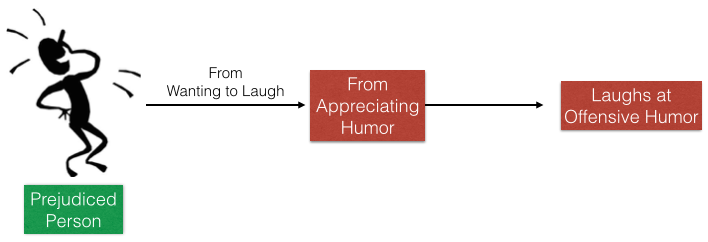
Objection 2: Introspection is unreliable.  This objection goes further than de Sousa.  Recall that for Benatar (and perhaps de Sousa), all one has to do is introspect and know whether one is prejudiced against another race, sex, religion, etc.  However, what if introspection is unreliable?  Benatar’s reply is strange.  He says (in my words), “Look, if we can’t rely on introspection because we may be biased, then we can’t tell if the prejudiced person is saying something offensive because of the bias or because it’s simply funny.”  In other words, if introspection is faulty, then we can’t tell if the prejudiced person is laughing because of the prejudice, or because the person simply finds it funny.  So one possibility is clearly this: From Malice But Benatar points out that this could also be the case: From Appreciating Humor The first is harmful, whereas the second is benign.  Benatar wants to ask how can we tell that the second doesn’t happen?  The push is to show that jokes based on stereotypes are not always coming from a bigoted person.  Likewise, offensive jokes do not necessarily come from the prejudice within the person even if that person is prejudiced. It’s hard to know what to say with this argument.  On the one hand, shouldn’t we give it the benefit of the doubt and say that since we can’t tell, why not play it safe and stop the prejudiced person from telling jokes?  After all, Benatar is relying on the theory that something is wrong if it harms.  Since we can’t tell if the joke does harm, why not give it the benefit of the doubt?  On the other hand, since we can’t tell what the motivations are of the prejudiced person, then we’re restricting the second person from telling offensive jokes when the only motivation is to appreciate humor.  But does the second person actually do that?  I don’t know the psychology of racism, but I don’t think a racist person telling a racist joke would tell it simply out of appreciating the humor out of it.
More importantly, the prejudice person is still feeding into the systemic and institutionalized forms of racism, even if the person is not laughing from prejudice.  Indeed, it could be said that laughing at racist or sexist jokes still feed into the systemic and institutionalized forms of racism or sexism even if the person was not prejudiced at all.  But according to systemic and institutionalized forms of racism and sexism, it doesn’t matter if the person is prejudiced or not.  If one laughs or racist or sexist jokes, it still forms the racism and sexism of one’s society.  Ignoring this idea, I believe, is something that Benatar needs to address.  He may argue that jokes do not feed into institutionalized racism, or he may even go so far as to say that it does not exist.  I doubt, however, he would go that far.  With jokes, there is the off chance that using slurs or perpetuating stereotypes feeds into the systemic pressures of racist or sexist norms.  After all, we could be unaware of our implicit biases.  For example, there’s a study that suggests that people who proclaim that they are not racist nor sexist can still have racist or sexist implicit biases.  The study was done when a job candidate was applying for a job.  The resume was changed from a “white”-sounding name to a “minority”-sounding name.  Whites received 50 percent more likely to get interviews and they were 30 percent more likely to receive callbacks.  Thus, the theory goes, there is still a racial bias, at least in the labor force.  Another study was done with gender where the names were replaced with a female name, and the resume was exactly the same.  The female applicants were rated lower, even though the resumes were exactly the same.  (As an interesting side note, you can take a test here to determine whether you have an implicit bias.)  In short, institutionalized racism and sexism do exist which entails some sort of privilege.

Does telling certain jokes feed into the privilege?  Based on Benatar’s answer, only if the prejudiced person is laughing from prejudice, but that does not hold.  Institutionalized racism and sexism do not depend on the intentions of the agent; rather, it is tied up to the cultural systems where various actions, sayings, and behaviors are deemed normal.  Social expectations and social constraints regarding race, gender, sex, or orientation follow from assuming the system.  It is, as one thinker put is, racism without racists.  In overt racism, the target is the person within a minority group and the source is the person.  In institutionalized racism, the target is still the same, but the source is not from an individual; rather, the source is from the system as a whole where the fault is not with the individual per se, but the institutions of society create the power dynamics of what is the norm.  If the institution is the norm, one will be criticized if one does not follow the norms.  One could say that one is “supposed” to laugh at another’s expense because it is funny.  Once it’s considered funny, then laughing at the group becomes the norm. So while Benatar is saying that since we can’t tell if we’re biased because introspection is faulty, then laughing may be permissible because it’s possible that one is laughing through non-malicious means.  But my reply is that if one can’t tell if one is biased because introspection is faulty, then wouldn’t laughing possibly be impermissible because one may be laughing through malicious means?  Benatar needs to address this, it seems. 

Objection 3: The joke itself can be harmful.  So far, we’ve been looking at the agent.  Maybe the problem isn’t within the agent, but within the joke itself.  Best example is blasphemous humor, or humor making fun of God or his prophets.  Benatar mostly writes about the cartoon depictions of the prophet Mohammed in the Muslim religion.  The religion considers any depiction of Mohammed as sacrilege because it’s a form of idolatry.  Thus, a cartoon depiction would be even more taboo.  Benatar’s reply has three very short points:

  • First, we’re assuming that God exists.
  • Second, we need an argument as to why blasphemy is wrong as opposed to simply stating that it is wrong.
  • Third, many religious people have different permissive standards as to what is considered blasphemous or not.

Because of these reasons and since critiquing blasphemous humor is hard to defend, Benatar moves on.  This is also a very short portion of the paper, so I won’t say much else too.

Contextual Criticisms

Non-contextual criticisms are harder to defend because they make more universal demands: all humor that has the property x is wrong.  So a more plausible criticism of offensive humor would be from contextual jokes: it’s wrong in some instances but permissible in other times.  Here, we’re not evaluating types of jokes, but the particular instance of when it is said.  Focus not on the type of joke but on the instances of a the joke (who, where, when, why, how, what).  For example, person P telling joke J could be wrong  because P is racist, or telling J is bad timing, or the setup of telling J can bring forth harm.  However, person Q telling joke J could not be wrong.  What sort of harms could there be? “[T]he harms are typically psychological, including offence, embarrassment, shock, disgust and the feeling of being demeaned or insulted. Humour is sometimes also thought to inculcate, spread or reinforce negative attitudes about those individuals or groups that are the butt of the humour” (p. 33). Thus, we have a formula in when humor goes wrong: person P tells joke J in situation S. It’s very general, but because the context is always different, the same joke could be offensive at one time, but funny in another.

Ok, that’s enough for this post.  In the last and final one, I’ll conclude Benatar’s article.

Posted in Article, Benatar, Ethics, Humor | Tagged , , , | 3 Comments

On the Ethics of Offensive Humor (Part One)

Preliminary note: I will mention offensive jokes for the purpose of making a philosophical point.  In philosophical parlance, I’ll be mentioning jokes rather than saying them.  If you’re easily offended, you probably shouldn’t continue reading the rest of this post.

Here’s a joke:

Question: What do you do when the dishwasher is broken?
Answer:  You slap her ass and tell her to get back to work.

Offensive?  Yes, it reeks with sexism.  But is it funny?  That’s complicated.  One question that you must ask is this: can offensive jokes be funny?  If you say “never,” then offensive humor and morality have an intimate connection.  Let’s call this view the Offensive Humor Entails It’s Not Funny Theory.

Offensive Humor Entails It’s Not Funny Theory: For all humor that is offensive, we can also say that they are not funny.  Thus, for all humor that is offensive is sufficient for it to be not funny.

But what if you said “yes?”  The question we must ask is how can something offensive (which is a negative trait), also be funny (which is a positive trait)?  More than that, how often is offensive humor, and is offensive humor really that bad?  In this post, I will be looking at David Benatar’s article: “Taking “Humour (Ethics) Seriously, But Not Too Seriously.”  He will argue that humor can go wrong, but it’s not as often as people think it is.  More than that, when humor is offensive, the offense is not as serious.  What does Benatar mean when he says “humor can go wrong?”  Does he mean that the humor itself is offensive, or does he mean that people will be offended by it?  Benatar splits this in two ways.

First, humor can go wrong in two ways: in the agent, or in the joke itself.  If it’s in the agent, the wrongness can be in the speaker or the listener who enjoys the offensive joke.  We can diagram it thus:

How Humor Can Go WrongIf the wrongness is in the joke, it’s usually because of its bad consequences.

Another way classify the ethics of humor is by looking at whether we should pay attention to the context of the humor or not.

Humor context

Non-contextual criticism will critique the joke simply because there is something inherently wrong with the joke itself.  The context of the joke doesn’t matter.  Contextual criticism, on the other hand, will criticize the joke because of of the context of the joke.  One way to understand the contextual criticism of jokes is when someone says “too soon” because the joke is inappropriate.  For example, after 9/11, Gilbert Godfried made a 9/11 joke days after and he was immediately criticized, although he seemed to save himself by doing “The Aristocrats” joke.  Recently (I’m writing this as of February 2015), Chris Rock made a 9/11 joke on his SNL monologue and some people did criticize it, but most people did find it humorous:

Combining the two diagrams, we can see how humor can go wrong in many different ways.  Thankfully, Benatar is going to look at both grounds and he nicely gives us a table:

from p. 28

from p. 28

With this in view, we can now begin our analysis to see which view is better.  Benatar starts with analyzing the critiques of non-contextual humor.

Non-contextual Criticisms

Coming back to our theory above,  who holds the “Offensive Humor Entails It’s Not Funny” Theory? One philosopher would be Ronald de Sousa.  De Sousa mentions a rape joke and argues that it’s not funny no matter what.  De Sousa would then critique humor in the non-contextual side and he would argue that to laugh at a racial or sexist joke will always reflect how the person sees the group.  Enjoying the sexist or racist joke, according to this view, is to endorse this stereotype which reveals you as a sexist or racist.  All we have to do is introspect and we can see if we actually share in the joke’s presumptions.  Benatar’s brings up a question against de Sousa: Suppose we could introspect reasonably and honestly.  What if we found someone who laughed at the joke but was not introspectively sexist?  What then?  De Sousa might say that the person is still a sexist but just doesn’t know it, but this goes against the methodology of introspection.  Here, de Sousa presumes that finding an offensive joke funny pertaining to a group makes one prejudiced against that group: finding racist jokes funny makes you a racist, finding sexist jokes funny makes you a sexist, finding anti-Semitic jokes funny makes you an anti-Semite.  Benatar argues that de Sousa conflates two ways of looking at stereotypes, thereby making the “Offensive Humor Entails It’s Not Funny” Theory false.  What Benatar points to is that one can employ a stereotype, but that does not mean that one endorses that stereotype, rather one can simply recognize that stereotype without endorsing it.

Benatar encounters possible objections.  We’ll go through them one by one:

Objection 1: Some jokes inherently endorse stereotypes.  As an example, here’s a joke that Benatar relays:

A Jew, a Scot and an Englishman have dinner together at a restaurant. After the meal, the waiter approaches them and asks to whom he should present the bill. The Scot says: “I’ll pay”. The headline in the newspaper the next morning reads: “Jewish ventriloquist found dead in alley”.

This joke is playing on the stereotype of Scots and Jews as being tightfisted, the Jew as being cunning (because he doesn’t want to pay) and the Scot—who also doesn’t want to pay—as being more prone to violence (by killing the Jew).  Now replace the ethnicity with different ethnicities.  Suppose we replace the Jew with an American.  The joke wouldn’t be as funny, even if we employ the stereotypes.  Thus, the reason why the joke is funny is because we’re not just stipulating the stereotype but we’re actually endorsing the stereotype.

Benatar’s reply is that stipulating a stereotype does not mean fully endorsing the stereotype.  Rather, one can simply recognize the stereotype, and this may be sufficient to enjoy the joke.

Here, we can see a picture being developed:

Sousa and Benatar

Recognizing the stereotype is sufficient to enjoy the joke.  And endorsing the stereotype is not a necessary condition to enjoy the joke.  Benatar argues that the joke can be funny because we see the stereotype, but this is only recognition, not endorsement.

While I can understand Benatar’s position, he seems to leave something out: the reinforcement of stereotypes.  Thus, endorsing a stereotype does entail that one reinforces the stereotype, but couldn’t recognizing it also reinforce it?  In other words, even if we can recognize stereotypes, this does not preclude the possibility that this would not reinforce the stereotype.  Go back to the Jewish joke up above.  By telling that joke, it reinforces the idea that Jews are tightfisted and conniving.  To give a personal story, when I was younger, I didn’t understand Polish jokes.  But when I hear them again and again over time, the idea is reinforced that Poles are considered stupid people.

I can anticipate Benatar’s reply.  I think he could say that even if the joke reinforces the stereotype, depending on the context, there is no harm done.  For example, there’s a controversial skit by Dave Chappelle called the “Black Pixie.”  In the skit, Chappelle plays the stereotypical African-American that enjoys fried chicken, and he’s in black face.  Thus, we can stipulate the stereotype, and perhaps the skit could reinforce the stereotype, but that does not entail that it endorses the stereotype.  Indeed, it could even undermine the stereotype.

I think Benatar’s potential reply has some credence, but how can we tell whether the joke undermines or endorses the stereotype?  On the one hand, I don’t think we can say that joke itself does it, but the agent.  Thus, the speaker and/or the audience’s prior beliefs gives us a clue whether they have biases or not.  Are they laughing at the joke because they find it ridiculous, or are they laughing at the joke because they find the stereotype true?  We can’t really tell.  On the other hand, maybe it is the joke’s fault.  Maybe there are some jokes that just automatically trigger the belief in the agent.  The Jewish joke above may do just that.  Thus, I don’t think Benatar has adequately responded to this objection.  .

That’s enough for this post.  I’ll continue with Benatar’s article another time.

Posted in Article, Benatar, Ethics, Humor | Tagged , , , | 3 Comments

Let’s See What’s in the News Today (Feb. 23, 2015)

Gender

History

Love

  • Some interesting facts about love from the latest research.  Good thing a philosopher has taken the time to investigate this stuff.
  • I mentioned before about philosopher Clancy Martin writing an essay about how it’s necessary to lie in loving relationships.  Here is an interview about how lying is necessary in a loving relationship.  The interviewer?  His wife.  From the article itself:

    Amie: What if this woman who cheated finds herself fantasizing about it a lot. She’s never contacted the guy, and she never will, but she thinks about him every time she sleeps with her husband.
    Clancy: Wow, good one. For the record, you’re my wife, and if this happens, please lie to me about it.
    Amie: Wait, that’s a good answer. Why?
    Clancy: Because I don’t think I could handle the truth, but I want us to stay married. So I’m asking you to be the strong one, since it’s your deal, your mental affair. If you feel like it’s starting to threaten the relationship—if the only way for us to continue to be happily married is for you to get the truth out—well, then I’d ask you to find a gentle, caring way to do it. Don’t just say: “I can’t stop thinking about this guy I slept with, he was fantastic and had a huge—”
    Amie: How come you didn’t go into detail about our marriage, or your previous two marriages, in the book?
    Clancy: Two reasons: respect for you and my two previous wives, and respect for my daughters. And also, I guess, fear that you guys would all love me less if I were too bluntly honest. But truthfully there are some things I would love to say, but can’t, because I know they would really hurt people I love.

Marriage

  • A new way of saying “I do”? A new book investigates.

Sexuality

Social Issues

Swearing

Posted in Children, Gender, History, Love, Marriage, News, Sexuality | Tagged , , , , , , , , | Leave a comment

Let’s See What’s in the News Today (Feb. 8, 2015)

Crime

Environment

  • Here is a chart of US Congress denying climate change: 

Epistemology

Ethics

The Ethics of Checking People Out.

Gender

Health

Mind

Philosophy

Pornography

Relationships

Religion

Science

Sexuality

Sociology

  • Sharing experiences with another person, without communication, can amplify the experience.  Good experiences seem better; bad experiences seem worse.
Posted in Environment, Epistemology, Ethics, Gender, Health, Mind, Pornography, Relationships, Religion, Science, Sexuality, Stoicism, Studies | Tagged , , , , , , , , , , , , , | 1 Comment

Triggering to Fall in Love

Is it possible to fall in love with someone by going through a sequence of activities by asking questions and then stare at each other in the eyes for four minutes?  Sounds implausible right?  In an article titled, “To Fall in Love With Anyone, Do This,” reporter Mandy Len Catron tried out an experiment designed by psychologist Author Aron.  The experiment takes about 45 minutes to 2 hours and can work with two strangers.  Here’s how it works: the people ask each other a series of 36 questions.  Some of the questions are thought-provoking, others are really personal.  The point is that as you probe deeper into the questions, you’re opening yourself up to the other person in which you explore each other’s vulnerabilities.  As Catron puts it:

We all have a narrative of ourselves that we offer up to strangers and acquaintances, but Dr. Aron’s questions make it impossible to rely on that narrative. Ours was the kind of accelerated intimacy I remembered from summer camp, staying up all night with a new friend, exchanging the details of our short lives. At 13, away from home for the first time, it felt natural to get to know someone quickly. But rarely does adult life present us with such circumstances.

Next, you stare in each other’s eyes for four minutes in silence.

Of course, this doesn’t make one instantly fall in love with the other person, but it does bring out a closeness and connection in a stronger and intimate—though not necessarily romantic—way.

This brings me to my question: falling in love isn’t a one-shot instantaneous event.  At least, that’s never been my experience.  Rather, falling in love takes time and sometimes you don’t realize you are in love until you reflect back on your time with your partner.  But can you really fall in love with anyone?  To fall in love, certain conditions have to be met: having a good time with the partner, seeing oneself having a robust concern for the partner, perhaps expanding one’s identity with the partner where the people involved see each other as a “we” instead of two individual “I’s”, or maybe seeing each other in the partner where there is an extreme compatibility.  Now can a series of questions, and then staring in each other’s eyes meet those conditions?  Well, looking at the questions, it seems that one learns what those answers are as the relationship develops.  If one answers those questions within a two hour period instead of weeks- or months-period, perhaps one can meet those conditions faster.  Staring into each other’s eyes makes one vulnerable, but it gives you a sense of the other person’s vulnerabilities too.

Of course, Aron’s study specifically talks about closeness and stronger connection rather than falling in love, but is bringing about a closeness and connection as simple as asking the right questions to reveal more about each other?  Think about a computer program.  You give it a series of commands and then it can perform a function.  In the same way, these questions are like “commands” where it can “trigger” the emotional self/brain to do something.

Posted in Love, Science | Tagged , | 1 Comment

Wonder and Knowledge

People often seek knowledge because of the wonder behind it.  But as soon as we obtain the knowledge, does the wonder go away?  Lorraine Daston has a fascinating article about wonder, knowledge, science, and inquiry:

Therein lies the paradox of wonder: it is the beginning of inquiry (Descartes remarks that people deficient in wonder “are ordinarily quite ignorant”), but the end of inquiry also puts an end to wonder. The marvel that stopped us in our tracks—an aurora borealis, cognate words in languages separated by continents and centuries, the peacock’s tail—becomes only an apparent marvel once explained. Aesthetic appreciation may linger (it is no accident that the vernacular descendants of the Latin word for wonder, admiratio, convey esteem), but composure has returned. We are delighted but no longer discombobulated; what was once an earthquake of the soul is subdued into an agreeable frisson. At least within the classical philosophical tradition, from Aristotle to Descartes (and arguably beyond, to Adam Smith and even to Kant), this negative correlation between wonder and explanation is strong and tenacious. Explanation lies at the heart of the distinction between marvels and miracles in the Latin Christian tradition. What is the difference? Thomas Aquinas answers: marvels (mirabilia) are inexplicable to most but not all people (e.g. the eclipse that transfixes the ignorant peasant but not the learned astronomer); miracles (miracula) are inexplicable to everyone. Wonder is a barometer of ignorance: the learned experience it rarely; God, never. Wonder is not only a peculiarly human passion; it is also one that, at least on this account, underscores the limits of human knowledge. The more we know, the less we wonder.

A great read.

Posted in Aesthetics | Tagged | 1 Comment

Let’s See What’s in the News Today (Jan. 20, 2015)

Death

  • What to do with our dead bodies?  Charlie Huenemann offers a nice proposal.

Feminism

  • I mentioned before about a charged incident that happened to my colleague, Cheryl Abbate.  She has posted a blog about the aftermath.

Race

Relationships

  • A fascinating article about how online dating is undermining commitment, and therefore monogamy.  From the article itself:

The positive aspects of online dating are clear: the Internet makes it easier for single people to meet other single people with whom they might be compatible, raising the bar for what they consider a good relationship. But what if online dating makes it too easy to meet someone new? What if it raises the bar for a good relationship too high? What if the prospect of finding an ever-more-compatible mate with the click of a mouse means a future of relationship instability, in which we keep chasing the elusive rabbit around the dating track?

Of course, no one knows exactly how many partnerships are undermined by the allure of the Internet dating pool. But most of the online-dating-company executives… agreed with what research appears to suggest: the rise of online dating will mean an overall decrease in commitment.

Religion

  • The boy who co-wrote The Boy Who Came Back from Heaven—not to be confused with Heaven is for Real—lied and said he made it up to get attention.

Science

Sexuality

Social Issues

  • Utah, you’re doing it right: 
  • Then again, Utah, you’re doing it wrong: 
Posted in Death, Race, Relationships, Religion, Science, Sexuality | Tagged , , , , , , | 2 Comments

Let’s See What’s in the News Today (Jan. 12, 2015)

Anti-Natalism

Decision Theory

Drugs

Economics

  • French economist Thomas Piketty was offered the top award in France.  He turned it down saying that “it is not the government’s role to decide who is honorable.”

Health

Race

Relationships

  • Recovering from a breakup is hard.  According to the latest science, the best way to recover is to reflect on the relationship, talk to someone about it, and writing about it.  It seems to distracting yourself away from the former relationship isn’t the best coping mechanism.

Sexuality

Posted in Anti-Natalism, Drug Use, Economics, Game Theory, Health, News, Race, Sexuality | Tagged , , , , , , , , | Leave a comment

Changing People’s Minds on Social Issues

We usually think that when it comes to social issues, people are usually set and it’s very difficult to change their minds, especially on a issue that’s so entrenched from their cultural upbringing.  A new study shows that a specific 20 minute conversation can change that.  Through this conversation, the person would not only change one’s mind, but would also have a spillover effect onto friends and family members.  So what do you do?  You have them converse with someone who’s directly affected by the issue.  The study was using gay marriage as an example:

Participants were randomly divided into three groups. One received house calls from specially trained LGBT Center canvassers who advocated gay marriage. Half of the canvassers were gay; the other half were straight.

A second group received visits from the same canvassers, but the canvassers discussed the benefits of recycling — not the topic of gay marriage. In these visits, the canvassers did not reveal whether they were gay or straight.

The third set was not visited by canvassers.

The gay marriage canvassers asked voters what they enjoyed about being married (if the subjects were married) or the benefits they’d witnessed in the lives of married friends and relatives (if they weren’t). Gay canvassers then revealed their own sexual orientation and explained that they longed for the same benefits the interviewees had described, and straight canvassers discussed how they hoped a close relative who was gay could enjoy the benefits of marriage.

The average length of these conversations was only 22 minutes, but the visits had dramatic effects.

In follow-up surveys three days later, the researchers found that attitudes were unchanged among the voters who discussed recycling and those who weren’t visited by the interviewers. But among those who spoke with canvassers about gay marriage, support had jumped eight percentage points.

Three weeks later, those who conversed with straight canvassers went back to their original position: gay marriage should be banned.  Those who talked with gay canvassers, however, had an total attitude shift where they supported gay marriage.  In fact, the support grew seven percentage points when the Supreme Court handed down its decision to let Californians allow gay marriage.

On a personal note, I notice that when I discuss polyamory to my classes, most of them are dissuaded, even through rational arguments.  When I bring in an advocate of polyamory where they can converse and talk to someone in the flesh, I notice that their tone has softened, and most of them actually support polyamory.  Of course, I haven’t kept up with my former students to see if they still support it, but conversing with someone who’s directly affected by the issue is the main key to change people’s minds on a social issue.

The group who did the study hopes to do another one on abortion and undocumented immigrants.


Posted in Epistemology, Studies | Tagged , | Leave a comment

Let’s See What’s in the News Today (Dec. 24, 2014)

Culture

  • Here’s an artist’s rendition of how our culture has been consumed by technology and materialism.  Note: although they are SFW, they are very edgy.

Ethics

Gender

  • When there’s a trust violation in relationships, women are more likely than men to rebuild trust and not lose it.  Why?  She has greater relational investment.  Hmm…I’m wondering if this is through nature or through cultural upbringing.

Health

  • I’ve mentioned many studies why sitting for too long is unhealthy.  Here’s a nice YouTube clip explaining why: 

Philosophy

  • For the past two weeks, I’ve been blogging about how my friend and colleague, Cheryl Abbate has been smeared by John McAdams.  McAdams is now suspended with pay.  He is relieved of his teaching and faculty duties.

Psychology

  • A study reveals that those who eat meat, don’t care about the ethics of eating meat, enjoy masculinity and don’t care about equality are more likely to consume meat.  Moreover, they are more likely to display levels of authoritarianism and social dominance.

Race

  • Roderick Long offers three thought experiments to show that reverse racism is real, but it’s not as serious as we may thing.  I find it more interesting that there are two definitions of “racism.”
  • Comedian Chris Rock has an essay about Hollywood’s race problem.  Some of the thoughts meander, but he makes some striking points.

Sexuality

Posted in Culture, Ethics, Gender, Health, News, Polyamory, Pornography, Psychology, Race, Sexuality | Tagged , , , , , , , , , , , , | Leave a comment