Martha Nussbaum’s “Taking Money for Bodily Services” (Part Three)

In part one, I discussed the first part of Nussbaum’s article “‘Whether from Reason or Prejudice’: Taking Money for Bodily Services” which brought up the six analogies that Nussbaum uses to argue for the decriminalization of prostitution.  In part two, I looked at Nussbaum’s analysis on why prostitution became stigmatized and four arguments as to why prostitution should be criminalized and Nussbaum’s responses to those arguments.

In this post, I will continue looking at the arguments for criminalizing prostitution and Nussbaum’s responses to them.  I will conclude with some general remarks.

Argument five: The prostitute alienates her sexuality on the market; she turns her sexual organs and acts into commodities.

Here we get to the meat of the arguments.  Nussbaum looks at alienation as if one gives up an essential part of who one is.  Thus, the way that Nussbaum look at this argument is this:

  1. Alienation is to give up an essential core of who one is.
  2. Giving up an essential core to another is exploiting that person.
  3. Prostitution is the act of giving up one’s sexuality (which is an essential core of who one is) to another.
  4. This action exploits the prostitute.
  5. Therefore, prostitution is morally wrong.

Nussbaum counters this by refuting premise three.  Even if the prostitute has sex, she still has her sexuality in the same way that the singer still has her voice and the professor still has her mind.  By putting these out to the market, the singer and professor still keep an essential core of who they are.  The same is true with the prostitute.  With the domestic worker, she may cook and clean her client’s house, but she can still cook and clean for her family.  No one has a monopoly on these services.  So what’s the difference?  For Nussbaum, not much.

This argument works if this is how we’re defining alienation.  However, alienation has different forms.  The most common type is where one feels isolated and estranged from one’s labor.  We can see this from Marx.  However, this feels very similar to argument two in that any working-class woman could feel alienated from her job.  The solution is not to ban any job that could alienate people, but to change the social conditions where alienation is lessened.  The same is true with the prostitute.

What about transforming one’s sexual organs and acts into commodities?  What does this mean?  Here, we have two possible interpretations:

Commodification qua gaining a fee: one accepts a fee for sexual services.

This, however, is merely descriptive.  It doesn’t tell us the wrongness of prostitution.  After all, the professor and singer also accept a fee for their services.  Even if they are done through a contract, it’s not bad.  Indeed, the contract has helped the singers and professors since they are more free to pursue their own ends instead of following orders of their employer.

Commodification qua fungibility: the unit in question can be traded or substituted for any equivalent of that unit.

This definition is what Nussbaum spend most of her time on.  The real issue is where the individual is not seen as a special, unique individual.  While this may be true, Nussbaum points out that there’s nothing immoral about it generally.  Suppose your teacher teaches you some philosophy.  If that professor was not there, some other professor would have taken her place.  Thus, the professor can be fungible.  We can’t know every person we meet in a deep or intimate level.  And most of our dealings in life with other people are morally permissible even if we don’t know them deeply.  The cashier, the cab driver, the waiter are all fungible.  We can’t know them as a unique individual, and if that person wasn’t there, another person would’ve taken her place.  If person x didn’t serve me food, person y would’ve done it.  Person x and person y are fungible.  Yet, that doesn’t mean that there’s anything wrong with it.

But what about sex?  Perhaps the opponent could respond that getting food and learning philosophy is one thing.  We don’t need to know the waiter or the professor deeply and that’s morally permissible.  But what about sex?  Are we supposed to know the other person deeply and intimately for the sex to be moral?  Is sex without deep personal knowledge immoral?

Imagine an artist knowing her work at a deep level.  She feels that selling her work would be inappropriate.  Now imagine a singer selling her work and she also considers her work as very intimate and very personal to her.  We can imagine any artist doing this with novels as well.  There’s nothing wrong with gaining money for selling intimate things.  For the prostitute her activity is not intimate, but isn’t that the point?  The problem still comes down to how she is treated and whether or not having sex without intimacy is morally wrong.

While this is helpful, I think Nussbaum is missing another definition of commodification:

Commodification qua objectification: the unit in question has been made into an object which now has a price, and is now treated as a thing.

This has Kantian and Marxist overtones, but this is still a fairly good definition of commodification.  To objectify someone is to treat that person as a mere means instead of an end.  And because this feature takes away a person’s dignity and respect, this person now has a price.  In the case of prostitution, she literally has a price.  Thus, this form of commodification is immoral which makes prostitution immoral.  I’m surprised that Nussbaum doesn’t tackle this since a lot of arguments against prostitution deals with objectification.  Still, could this definition be tackled?  I think it’s possible.  It depends on what we mean by “objectification.”  Nussbaum talks about objectification in another article which we won’t get to here.  Raja Halwani discusses it in his article about casual sex and virtue ethics which I will review in a later post.  For now, however, I will have to skip this discussion.

Argument six: The prostitutes’ activity is shaped by, and in turn perpetuates, male dominance of women.

This is another main argument against prostitution.  Again, this is shaped by the perception that female sexuality is dangerous and thus needs regulation, or that sex is dirty and degrading, or that male sexuality is rapacious and needs a “safe” outlet.  Throughout history, prostitutes have been physically abused and controlled by their pimps and these are features of male dominance, which has also had the same features for women in low paying jobs.  Here is the argument:

1.  If the activity is shaped by, and in turn perpetuates, male dominance of women, then that activity should be banned.
2.  Prostitution is an activity that is shaped by, and in turn perpetuates, male dominance of women.
3.  Therefore, the activity of prostitution should be banned.

We need to ask: how far does male dominance as such explains the violence involved?  Even if there is violence within the institution of prostitution, this does not thereby explain that it should be illegal.

If we look at other parts of the world, children have been “sold” to other families by dowries.  These children are basically forced to marry someone, usually at a very young age.  However, most countries are now recognizing the harm behind this are making dowries illegal.  Nussbaum considers this practice much worse than prostitution.  To make something illegal because of subordination is pretty weak compared to the case of making dowries illegal.

Moreover, we seem to be going into far-reaching territory if we ban something just because the institution and activities within that institution have traditionally been male dominated.  Marriage, for example, has had a history of male dominance, and the practice has had perpetuated male dominance.  We could add that to the list through the argument given above:

2`.  Marriage is an activity that is shaped by, and in turn perpetuates, male dominance of women.
3.  Therefore, the activity of marriage should be banned.

Obviously, this would be a huge infringement on people’s liberty.  Instead, we should change the laws to protect women from domestic violence within marriage, giving women equal property and custody rights, and improving their exist options.  The same should be done with prostitution.  Thus, Nussbaum refutes premise one.  Instead of banning the activity altogether, we should use the law to protect the bodily safety of prostitutes from assault, to protect their rights to their income against extortion, to protect poor women in developing countries from forced trafficking, and to guarantee their full civil rights.  The criminalization of prostitution would be an obstacle to that equality in the same way that criminalization of marriage would be an obstacle to equality.  Here is how Nussbaum looks at it:

1`.  If the activity is shaped by, and in turn perpetuates, male dominance of women, then that activity should be reformed so that male dominance of women is lessened, and that women are treated as equals.
2“.  Prostitution—and marriage—are activities that is shaped by, and in turn perpetuates, male dominance of women.
3“.  Therefore, the activity of prostitution—and marriage—should be reformed so that male dominance of women is lessened, and that women are treated as equals.

Moreover, if one gives workers greater dignity and control, this will change the perception and the fact of male dominance.  We can see this already in marriage and in many workplaces.

This debate is entrenched with politics.  Nussbaum, I think, has a good response to this.  Yet the other side of the debate is whether or not the activity is essentially male dominated and that no matter how many reforms there are, it still doesn’t change the fact that it’s male dominated.  This would not only include prostitution, but some have argued that this includes marriage and other major institutions of society.  (As another feature, pornography is also part of this debate.  Pornography has been extremely male dominated and it has also perpetuated male dominance.  Should be therefore ban it since it harms women?  Or is there a way to reform pornography itself?  Many reforms have been done.  There is a new type of porn called feminist porn where the ethics behind it has geared toward feminism.  Queer porn has challenged male dominance by showing queer performers gaining pleasure.  There is also pornography geared toward and made by women.  This has challenged the structure from within.  I think Nussbaum’s argument would apply to pornography as well.  But that would diverge me into another topic.)  I’m not sympathetic to the idea that an activity or an institution is intrinsically or essentially or inherently patriarchal.  These activities are historical; the dominance can also change but to change them, you challenge them from within the structure.  This argument itself could be a topic on its own, but I am sympathetic to Nussbaum’s strategy that to change male dominance, you must challenge that dominance from within.

Argument seven: Prostitution is a trade that people do not enter by choice; therefore the bargains people make within it should not be regarded as real bargains.

Let’s distinguish three cases:

Prostitution of women being forced into it:  In other words, human trafficking.  This type of prostitution is where the woman enters into it by some other conduct that would otherwise be criminal: kidnapping, assault, drugging, rape, statutory rape, blackmail, fraudulent offers.  We can see that this choice is not a real choice and that the law should punish the coercer.

Child prostitution:  This type is also accompanied by kidnapping or when the children are sold without their consent.  This is an obvious infringement of autonomy and liberty.  Because children cannot consent to sexual activities, they cannot give consent to a life in prostitution.

Prostitution entry because of bad economic options:  Which is better prostitution or working in a chicken factory?  It may depend on your preferences, but I could imagine many women working in prostitution, and I can imagine many women working in a chicken factory if these were the only options they had.  Autonomy has been infringed but in a different way.  Consider a story: a woman on a desert island who is constantly pursued by a man-eating animal.  Now, in one sense, this woman is free to go anywhere on the island and do anything she likes.  In another sense, she is unfree.  If she doesn’t want to be eaten, she has to spend all her time and calculate all her movements in order to avoid the beast.  It seems that many poor people’s live are nonautonomous in just this way.  Nussbaum states: “they may fulfill internal conditions of autonomy, being capable of making bargains, reflecting about what to do, and so on.  But not of this counts for a great deal, if in fact the struggle for survival gives them just one unpleasant option, or a small set of (in various ways) unpleasant options.”

So how do we ameliorate this problem?  Nussbaum offers four suggestions, and her suggestions are taken from India:

  1. Both government and private groups play a role in providing education to women and to equip them with skills that will enhance their options.  This would include skills training for children of prostitutes because they are at a higher risk of becoming prostitutes themselves.
  2. Nongovernmental organizations focus on providing credit to women to enhance their employment options and give them a chance to “upgrade” in the domain of their employment.  This could include loans to help women have an opportunity to new employment, upgrade their equipment, gain skills training, and move up into leadership roles.  These women had a much lower chance to turn to prostitution to supplement their income.
  3. Form labor organizations to protect women employed in low-income jobs and to bargain for better working conditions.
  4. Form groups to diminish the isolation and enhance the self-respect of working women in low-paying jobs.  This has worked well in India where a prostitute welcomed the prime minister of India.  That would never happen in the United States because the stigma against them is so strong.

These suggestions are a good start.  Yet, throughout this article, I think Nussbaum is focusing on a certain type of prostitution.  There are the elite call girls that can make an exorbitant amount of money.  There are the escorts, which can range in how much money they make.  And then there are call girls, street walkers, and prostitution as a “last ditch” opportunity to survive.  Throughout this article, I had a feeling that Nussbaum was focusing on the last type.  This is not to say that the other types of prostitution should be banned.  For Nussbaum, I take it that if street walker prostitution should not be banned, then neither should the high-end prostitution as well.

In the end, Nussbaum argues that the stigma against prostitution is mainly a matter of prejudicial biases that cannot be rationally defensible.  These beliefs include: the evil characteristics of female sexuality, the rapacious character of male sexuality, the belief of sexuality is linked with marital and reproductive characteristics for “good” women and “good” sex.  To correct the responses, we must aim to correct the options for working women, not criminalize them.  To start, we must realize that there is nothing wrong with taking money for the use of our bodies.  What makes it wrong is the lack of ability for women to use their body where they have a wider range of options where one can use skills and thoughts rather than just being a cog in the machinery of work.  How do we open up these options?  How we give them more dignity?  These are the questions we must deal with, even within the realm of prostitution.

The approach that Nussbaum takes in tackling stigma is the change the laws and this would thereby change the stigmatization.  In ways, this could work.  After all, it seems to have worked with the Civil Rights Movement in the 60s.  However, there are still some people who don’t agree with the Civil Rights Movement.  Thus, there is still a stigma against minorities.  On the other hand, perhaps one move is the change the stigma and then the laws will reflect that.  Lately, that has been same-sex marriage not only in America, but around the world.  I would’ve liked to have seen why Nussbaum takes the first route, but I’m guessing changing the laws would be easier than changing the cultural perception of that activity first.
Posted in Article, Prostitution | Tagged , | 2 Comments

Martha Nussbaum’s “Taking Money for Bodily Services” (Part Two)

In part one, I discussed the first part of Nussbaum’s article “‘Whether from Reason or Prejudice’: Taking Money for Bodily Services” which brought up the six analogies that Nussbaum uses to argue for the decriminalization of prostitution.  In this post, I will be going through Nussbaum’s analysis on why prostitution became stigmatized and I’ll go over a few of the arguments as to why prostitution should be criminalized and Nussbaum’s responses to those arguments.

In all of these cases, the major difference is because prostitution is widely stigmatized.  Professors, opera singers and masseuses used to be, but they’ve gained respectability.  So why is prostitution still stigmatized?

Nussbaum thinks there are two reasons:

Immoral reason: this states that prostitution is immoral itself, mainly because nonreproductive sex was immoral.  However, Nussbaum finds this a weak reason because this is an inconsistent view because many people find nonreproductive sex morally permissible.  Indeed, many people find nonmarital sex morally permissible.  Thus, there is not much need to argue against this view.

Whether or not people find premarital sex or even casual sex morally permissible, there is still a stronger stigma toward prostitution.  To simply shrug it off doesn’t seem to give this argument any closure.  After all, is there a possibility that one could argue that premarital sex and casual, promiscuous sex are morally permissible, but prostitution is not?  I think it would be difficult to make an argument, although it may be possible.  What could a possible argument be?  Suppose there was a one-night stand where the people involved consent to the sexual activity.  So far, no problem.  Now imagine the same thing except that the deal is that one expects to be paid for the activity and the other agrees.  All of the sudden, it becomes morally suspect.  But why?  I don’t see any other way out except some prejudicial basis.  However, perhaps one could make an anti-capitalist argument that this business deal seems to take lightly of the sexual encounter.  However, one could make the same argument with the one-night stand.  I, at this time, cannot think of a way to show why one-night stands and promiscuity are permissible and prostitution is not, but this is not to say that it can be done.  I think Nussbaum needs to counter this argument in a stronger way rather than shrugging it off.

Gender hierarchy reason: this is the idea that women and their sexuality are in need of male domination and control.  What is this connection?  Here, Nussbaum seems to give a brief genealogical account of prostitution and the prejudice against it.  If a women is sexual, there is something dangerous about it.  Thus, it needs to be controlled.  Moreover, the prostitute, who is a sexually active woman, is a threat to male control of women.  By making the prostitute away from the marker of a “good woman,” the wife is aimed toward reproduction which is proper sex.  This system maintains male control over female desire.  This sexual hierarchy causes the stigma.  We can see this sexual hierarchy with veiling and female genital mutilation, for example.  Part of the sexual hierarchy suggests that women’s sexuality is dangerous and immoral and that it needs to be controlled by men.  Because the prostitute is in control of her sexuality, she is seen as a threat of this control.  And because this stigma is based on a prejudice, the reasons for the immorality of prostitution are unfounded.

I’m not sure what to think of this argument.  Yes, there was, and is, a sexual hierarchy.  Suppose, however, that this was all gone and prostitution still existed.  Would the immorality of prostitution disappear with it?  I doubt it.  Even those who are sympathetic to Nussbaum’s claims of getting rid of sexual hierarchy, I could imagine someone still being against prostitution for other reasons.  Suppose we have Rachel.  She is someone who supports women’s freedom of her own sexuality.  Rachel believes that women can express their sexuality in their own way under their own terms.  Yet, Rachel thinks that sex for money as a way to demean not the sex, but women in general.  In what way?  Rachel argues that getting sex for free is seen in a better light rather than getting paid to have sex because sex for pay undermines the relationship.  As an analogy, suppose you ask me to help you on your homework and I do so.  Now, suppose you ask me to help you with your homework and I say yes but only if I get paid.  By doing that, it seems to undermine the relationship that we have.  Rachel’s argument has a good point.  However, this presupposes that we’ve already had a relationship.  I have tutored many people in the past, and they pay me to tutor them, and yet neither of us think that this somehow demeans me.  It only demeans me (and the other student) if we’ve already had some sort of relationship, even a friendly one.  To ask friends or lovers for money for some sort of service undermines that relationship.  Rachel’s argument is flawed, but it does get to the heart of Nussbaum’s argument.  The problem with this argument is that prostitution may have started with sexual hierarchy, but even if there was this genealogical account of it, arguments against prostitution does not need to rest on this.  Fortunately, Nussbaum looks at other arguments for criminalization of prostitution and responds to them.

This does not mean that the stigma entails criminalization however.  Just because the occupation has a stigma does not mean that the occupation needs to be criminalized.  There are a low castes in India known as the “untouchables” who works in very menial jobs, and they are stigmatized.  However, the jobs they do are not immoral (it’s usually toilet jobs).  If anything, it’s the structural prevailing attitudes toward the untouchables that makes the occupation a stigma thereby making the people themselves having a stigma.

The next step is to look at certain arguments for the criminalization of prostitution, analyze them, and see if they’re effective arguments.  Nussbaum looks at seven arguments and debunks them all.

Argument one: Prostitution involves health risks and risks of violence.

The argument is straightforward:

  1. Any occupation that involves health risks and risks of violence gives us clues that the occupation ought to banned.
  2. Prostitution is an occupation that involves health risks and risks of violence.
  3. Therefore, the occupation of prostitution gives us clues that the occupation ought to be banned.

Nussbaum argues against premise one.  If prostitution was made illegal, the problem is acerbated where the prostitute cannot gain adequate supervision nor adequate health care.  In any form of violence, it is better to have a sense of control and regulation and have the police on your side rather than having them as your oppressor.  Nussbaum uses boxing as an analogy, although with today’s standards, she could have easily used UFC fighting.  In these cases, the fighters are subjecting their body to harm.  Moreover, there is a stronger case for paternalistic regulation of fighting rather than prostitution because fighting involves more bodily harm and it glorifies in this harm, especially to younger people.  Yet, Nussbaum does not want to criminalize fighting: “[s]ensible regulation of both prostitution and boxing…seems reasonable and compatible with personal liberty.”  Making it illegal would make it worse.  Thus, Nussbaum’s counterargument is:

1`.  Any occupation that involves health risks and risks of violence gives us clues that the occupation ought to regulated, (such as boxing or UFC fighting).
2.  Prostitution is an occupation that involves health risks and risks of violence.
3`.  Therefore, the occupation of prostitution gives us clues that the occupation ought to be regulated.

Nussbaum’s counterargument makes sense to me.  As a way to further her argument, any occupation that we deem having health risks (such as jumping over buses with a motorcycle, firefighting, policing criminals, etc.) are not banned because of the health risks themselves.  People understand the health risks and yet, they still choose that occupation or lifestyle.  Banning the activity or occupation would not make the desire for that activity go away.  In some of these cases, we need people to do these occupations for a better society.

Furthermore, just because an activity has high health risks does not make the activity immoral.  At best, it may make the the activity imprudent.  Riding my bike without the rubber tires does carry health risks, and it’s imprudent for me to just ride on the rims, but I wouldn’t call that immoral.  The person who makes the argument is conflating immorality with imprudence.

Argument two: The prostitute has no autonomy; her activities are controlled by others.

The argument can be formed as this:

1.  Any occupation where autonomy is taken away is morally wrong since one’s actions are controlled by others.
2. Prostitution is an occupation where autonomy is taken away since her actions are controlled by others.
3.  Therefore, prostitution is morally wrong.

By using the previous analogies, Nussbaum points out that prostitution is not different than the factory worker or the domestic servant.  Indeed, they have much less autonomy than the prostitute.  And yet, these jobs are morally permissible.  Indeed, many working-class women don’t have much autonomy.  However, this does not mean that since we allow jobs A, we should therefore allow job B.  Nussbaum is concerned for the working conditions of the factory worker and the domestic servant.  What makes the jobs morally troubling is the fact that one’s livelihood is lacking a life of flourishing because the work is out of one’s control.  This, however, does not mean that the occupation is immoral; it just means that this is a problem of labor.  To fix the problem, we must promote more control over choices of activities and more variety.  It certainly wouldn’t make sense to criminalize factory jobs or domestic servitude.  Thus, Nussbaum’s counterargument is this:

1`.  If there is any occupation where autonomy is taken away, then there needs to be a structural change where one has more control over choices of activities and variety, since one’s actions are controlled by others.
2.  Prostitution is an occupation where autonomy is taken away since her actions are controlled by others.
3`.  Therefore, prostitution needs to be a structural change where one has more control over choices of activities and variety, since one’s actions are controlled by others.

This is an interesting move from Nussbaum where we don’t get rid of the activity, but to give the other autonomy.  Yet, how far are we willing to go with this?  Slavery is an occupation where one’s autonomy is taken away because one’s actions are controlled by others.  Yet, we wouldn’t say that we just need to give the slave more autonomy by having more control of activities and more variety.  Something seems incomplete in this argument.  Still, I think this is a good starting point.  Nussbaum’s counterargument needs to be developed where she needs to show how slavery is wrong but prostitution is morally permissible.  After all, they both lose autonomy.  I think the way around it is to suggest that the prostitute has a contract with the client (the same can be said with almost any working-class women).  The slave, however, has no contract because the slave was forced into this occupation.  However, what if someone chooses to be a slave?  As weird as it sounds, would we then give Nussbaum’s recommendations and say that one can be a slave but we’ll give her a free range of activities she can have?  Nussbaum’s counterargument has some merits, but it needs some development.

Argument three: Prostitution involves the invasion of one’s intimate bodily space.

Nussbaum responds by reviewing the colonoscopy artist from part one.  Both may not be to everyone’s taste, but that reason itself does not mean that prostitution—as well as colonoscopy artistry—is morally wrong.  Furthermore, just because both will not be to everyone’s taste, it doesn’t mean that the activity is wrong.  Many forms of sex don’t involve love or marriage.  If we go down this route, to be consistent, we must also find sex without love or marriage morally problematic.

Here, I think Nussbaum is onto something which she doesn’t realize.  If she’s relying on taste, then the person who makes argument three isn’t really making a moral claim but an aesthetic one.  Within the legal realm, we cannot legislate taste.

Perhaps a potential problem with this argument is her call for consistency: if we find prostitution wrong because of certain tastes, then we must also repudiate sex without love or marriage wrong as well.  But is this true?  Can we construct a moral position where prostitution is morally wrong yet noncommercial casual sex is morally permissible based on taste?  Even stranger, can we construct a moral position where prostitution is morally permissible, yet noncommercial casual sex is morally wrong based on taste?  I don’t have any answers to this, but I’m willing to bet that an argument could be made.  Still, if there is no argument, then one must concede that Nussbaum has a good point.

Argument four: Prostitution makes it harder for people to form relationships of intimacy and commitment.

Is this true?  It seems odd that we are treating preferences and desires as a zero-sum game.  One type of relationship does not remove another type.  For example, prostitution is legal in the Netherlands, Germany, and Sweden; yet the people in those countries still appear to fall in love.  Introducing Jackie Collins novels does not remove the desire to read Proust.  With any book, certain values are produced by reading them that you can’t get in another book.  By introducing new books, you actually add more availability and choices.  People who want Proust will read Proust and having Jackie Collins in the bookstore won’t remove that want.  The same is true with loving relationships.  Those who want love and commitment can get that, and they can tell the difference between that and other type of relationships.

But what if the argument means that prostitution makes it harder for the prostitute to form loving relationships?  Nussbaum argues that this is implausible.  Recalling how singers, dancers, and actors were stigmatized in Smith’s time.  I’m willing to bet that they still got involved in loving relationships.

I think this argument is trying to suggest that the prostitute is so used to having sex without intimacy that she will forever divorce sex and intimacy.  I’m not sure this is factually accurate, but at the same time, is it really a problem if someone believes that sex and intimacy are not necessarily connected?  Imagine someone living a life where sex is for enjoyment and pleasure and not for intimacy.  This may not be the norm, but I cannot find anything morally (or legally) problematic with that belief.  Nussbaum mentions this in the next argument, but she doesn’t offer a suggestion except that connecting sex and intimacy seems to be more about a personal predilection rather than an obvious fact.

In the next post, I’ll conclude the arguments and give some general comments on Nussbaum’s article.

Posted in Article, Prostitution | Tagged , | 2 Comments

Martha Nussbaum’s “Taking Money for Bodily Services” (Part One)

Inspired by Philosophical Disquisitions, I’ve decided to look at some articles that interest me.  This procedure would help me get a clearer view of the philosopher’s arguments, and this would help me make my ideas clearer.  With that in mind, I’m starting with Martha Nussbaum’s article “‘Whether from Reason or Prejudice’: Taking Money for Bodily Services.”  Because this is such a lengthy article, I’ve divided this article into three separate posts.

Nussbaum argues for the legalization of prostitution.  Her focus isn’t so much on the moral matters, but more on the legality.  Her arguments rests on six analogies where they all have something in common: these professions take money for the use of their body.  Because these professions are not considered legally (and perhaps morally) problematic, we should not consider prostitution legally (and perhaps morally) problematic as well.  Thus, the argument is structured simply as this:

Argument from Analogy:
1.  Profession X is not legally problematic.
2.  There are many similarities with profession x and prostitution.
3.  Therefore, prostitution should not be legally problematic.

Like any analogy, it works if the similarities are more frequent than the dissimilarities.  Notice also that Nussbaum is looking at prostitution from a legal realm, not a moral one.

The quote in the title of the article is meant to give us a clue as to Nussbaum’s strategy.  “Whether from reason or prejudice” is taken from Adam Smith’s The Wealth of Nations.  Smith talks about how some talents are beautiful as long as they are without pay.  These professions include opera singers, actors, and dancers.  If they do receive some benefit (such as being paid), “whether from reason or prejudice, [then these professions are seen] as a sort of publick prostitution.”  Nussbaum picks up on this and considers shows how opera singers, actors, and dancers are not seen as being stigmatized as they were in Smith’s time.  Prostitution, however, still carries a stigma.  In both cases, they are both using their body to receive pay.  The emotions and judgements about opera singers, actors, and dancers underlying the stigmatization was irrational.  With prostitution, however, there is a heavy judgement and emotional disgust toward this profession.  Nussbaum then asks the question: are our beliefs about prostitution a result of reason or prejudice?  Nussbaum will argue that it is the latter.  This is because by using her six analogies of professions where one is being paid for the use of the body, our beliefs regarding prostitution are irrational in the same way that people in Smith’s time were being irrational about singers.  In both cases, these professions have been stigmatized.  Here’s Nussbaum’s argument:

  1. Opera singers, actors, and dancers were considered “as a sort of publick prostitution” (meaning they were stigmatized) because they are paid for the use of their body.
  2. This stigma toward opera singers, actors, and dancers is based on irrational and emotional judgments that are biased.
  3. Prostitution is stigmatized because they are paid for the use of their body.
  4. Therefore, by analogy, the stigma toward prostitution is based on irrational and emotional judgements that are biased.

How did this stigma come about?  Let’s start with opera singers.  They have had a bad stigma since the ancient times.  This is because of two cultural beliefs:

Aristocratic prejudice: any work is base.  Labor is still seen as class privilege in Europe and America today.  One should not earn wages.  Earning wages is preoccupying oneself with baser things in life.  Thus, one who earns wages is base him/herself.  Even today, those with an aristocratic background frown upon working too hard at menial labor instead of gaining scholarly or athletic pursuits.

So one can be an opera singer as long as one does not get paid to do so.  But the only people that can afford to do that are those that are already wealthy.  Who are they?  The aristocratic class.

Bodily prejudice: “it is shameful to display one’s body to strangers in public, especially in the expression of passionate emotion.”

So opera singers, actors, and dancers were seen as immoral women in Smith’s time.  This irrational attitude displays a prejudice against the body.

So far, I like the setup that Nussbaum is doing.  Her approach is different in that she’s not defending prostitution by typical means.  She directly attacks the prejudice against prostitution itself.

With this in mind, let’s go straight to the analogies.

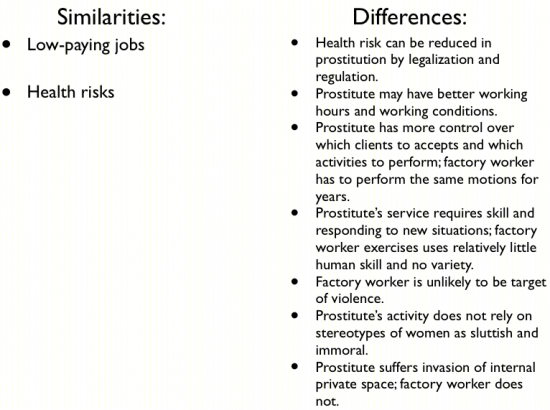
1.  The Prostitute and the Factory Worker

factory worker

Nussbaum’s strategy is interesting in this example because she focuses on the disanalogies here.  However, the disanalogies work in favor of prostitution because the prostitute has better circumstances than the factory worker.  Yet, Nussbaum argues that where the factory worker has the advantage, the way to fix this is to legalize prostitution so that the prostitute is not the target of violence and has a lower risk of health.

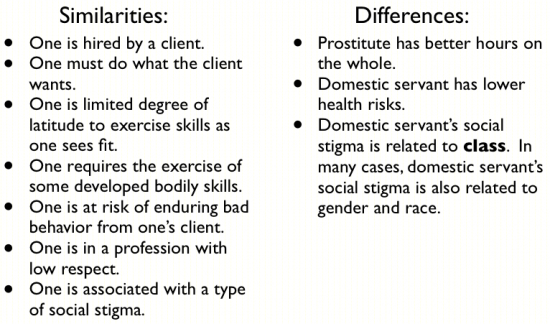
2.  The Prostitute and the Domestic Servant

Domestic Servant


The similarities shows that while if we accept one (domestic servitude), we ought to accept the other.  This strategy, however, seems pretty weak.  I think that Nussbaum was using this example to counter a common argument against prostitution: prostitution is wrong because it debased oneself by doing a lowly profession.  Here’s the argument:

  1. An occupation is immoral if one debases oneself in some lowly profession.
  2. Prostitution is an occupation where one debases oneself.
  3. Prostitution is a lowly profession.
  4. Therefore, prostitution is immoral.

Nussbaum uses the domestic servant to counter this argument because the domestic servant does debase oneself, and the domestic servant is seen in a lowly profession.  Yet, we wouldn’t say that domestic servitude is immoral.

I think this argument is ambiguous.  Domestic servitude may actually depend on the work.  With domestic servitude, there is the bad form where it is akin to slavery.  However, there are many kinds of domestic servants where we would now call them domestic workers.  These would be butlers, maids, babysitters, chauffeurs, pool boys, gardeners, nannies, stable boys, security guards, and wet nurses just to name a few.  But these occupations can be taken advantage of based on the structure surrounding them or whoever their client is.  Is it in general where domestic workers are taken advantage of?  It’s hard to say.  I don’t have the answer, but Nussbaum needs to make this case stronger if she wants to use domestic servants as part of her analogy.

3.  The Prostitute and the Nightclub Singer

Nightclub Singer

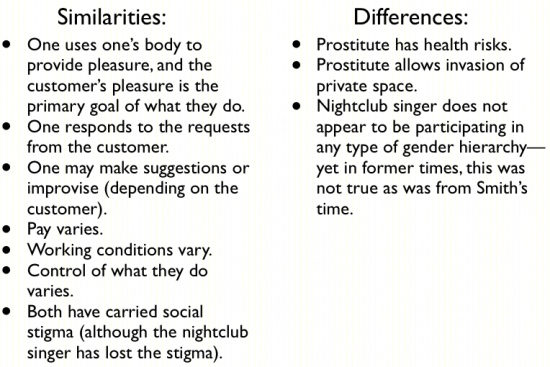
Again, both have many similarities, and we don’t find the nightclub singer doing any immoral activity nor do we find the agent participating in nightclub singing immoral or having a flawed character.  I think Nussbaum picked this analogy in order to drive the point home that this was considered a lowly occupation in Smith’s time, but no longer our time.  Thus, singing was considered low not based on reasons, but based on prejudice.  Likewise, prostitution could be considered low because it could be based on prejudice as well.  This analogy is going back to the original argument that I gave toward the beginning of this post.

4.  The Prostitute and the Professor of Philosophy

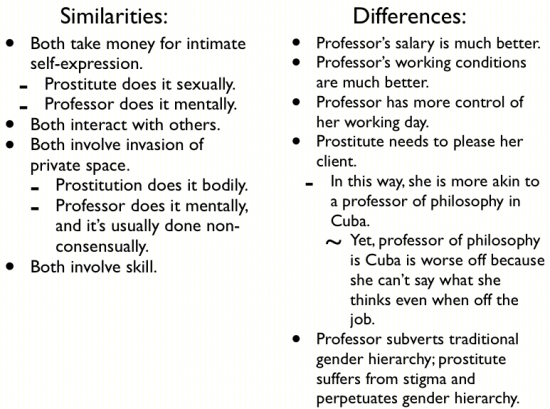
The first similarities might be odd, but we must keep in mind how the ancients considered education for pay as a form a prostitution.  The Sophists took money in order to teach their students and this was considered low.  Medieval thinkers had a moral problem about philosophizing for money.

Professor

With the disanalogies here, it seems that the occupation of prostitution is at a disadvantage.  So why does Nussbaum use this analogy?  I think the main point is to compare the prostitute with the professor of philosophy in Cuba.  While we don’t think there is anything wrong with the professor of philosophy in Cuba for speaking her mind, those around her do.  But the problem is that the professor’s profession is not immoral; she’s in a situation where the structure of society has made it appear as if her occupation has a stigma.  In other words, the professor of philosophy in Cuba has a stigma, but this is based on a prejudice, not reason.  Albeit this prejudice is structural and institutional rather than obvious, but she is stigmatized from false judgements and emotions.  This may have an affinity toward the prostitute.  Does the stigma against prostitution have an obvious prejudice, or is it structural?  The point is that this stigma is not some a priori truth regarding the professor of philosophy in Cuba.  The same is true with the prostitute.  The reason why she’s stigmatized is because people view her that way.  In other words, the problem with the professor in Cuba is not the professor, but the people perceiving her in a certain way.  Likewise, the problem with the prostitute isn’t the prostitute herself, but the people who view her.

5.  The Prostitute and the Masseuse

Masseuse


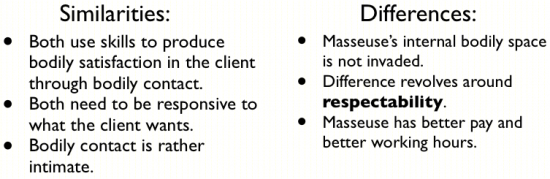
The masseuse is considered not degrading her body nor does she turn her body into a commodity by using her body to give customers pleasure.  The point is driven home from Nussbaum: “One is having sex, and the other is not.  But what sort of difference is this?  Is it a difference we we want to defend?  Are our reasons for thinking it so crucial really reasons, or vestiges of moral prejudice?”

The masseuse used to have this stigma, but now she’s gained a sense of respectability.

6.  The Prostitute and the Colonoscopy Artist

Artist

At this point, I could imagine (and I’m sure Nussbaum does too, which is why I think she includes this example) that someone could respond by saying, “but these previous professions have their internal bodily space intact.  Thus, these professions are not debased.  The prostitute, however, has sex for commercial benefit which is why she has a lowly occupation, and that is why it’s immoral.”  The argument can be formed as this:

  1. If one’s occupation is to invade one’s internal bodily space, then that occupation is immoral.
  2. Prostitution is an occupation that invades one’s internal bodily space.
  3. Therefore, prostitution is an occupation that is immoral.

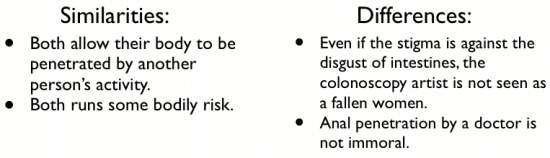
As weird as it sounds, Nussbaum uses a hypothetical case of a colonoscopy artist where her skill is to tolerate the fiber-optic probe without anesthesia to make a living.  So she allows her body to be penetrated by another person’s activity in order to test these instruments for medical use.  If this sounds strange, Nussbaum adds in a footnote that medical students need models when they are learning to perform internal exams, including gynecological exams, and young actors earn a living playing such a role.

These analogies are interesting.  What’s the upshot?  Although I have framed some of the analogies within the moral realm, Nussbaum’s point is to show that since these professions are legal and don’t have a moral stigma (or not as much when the profession started), the same is true with prostitution.  The reason why the stigma started was because paying for the usage of the body was considered base.  I appreciate Nussbaum’s strategy of using other professions to show that stigma is irrational.  However, there seems to be different kinds of stigma.  For the domestic worker, the stigma is the work itself; for the masseuse, the stigma is lack of respectability; for the colonoscopy artist, the stigma is the non-aesthetic factor of exploring a colon.  Notice, however, that there is no moral stigma with these professions.  Prostitution, however, does have this moral stigma.  For Nussbaum to make her case stronger, she needs to show that a moral stigma against prostitution is unfounded.  I think to do that, however, is to show that prostitution itself has no moral problems, or at least, that the moral problems against it are unfounded.  So far, Nussbaum has not done that.  Perhaps she could reply that opera singing and the nightclub singer did have a moral stigma in Smith’s time.  Indeed, the women were considered of low character and immoral.  If this is the case, then Nussbaum’s case makes a radical shift in what prostitution ought to be seen as: not as a moral stigma, but a stigma about respectability, about the work itself, or about a non-aesthetic factor.  It’s an issue that could still be explored about these different kinds of stigmas.

In a later post, I’ll continue Nussbaum’s article and offer an account of why the stigma against prostitution (among other jobs) has become stigmatized.

Posted in Article, Prostitution | Tagged , | 7 Comments

Let’s See What’s in the News Today (Oct. 1, 2013)

Economics

Gender

Health

Politics

Science

Sexuality

  • Porn star discrimination.  Porn star leaves porn and becomes a successful surgical tech.  She was then recognized and now no one in the hospital takes her seriously.  She is now going back to porn.

Teaching

Posted in Economics, Gender, Health, Middle East, News, Science, Teaching | Tagged , , , , , , | 1 Comment

Moral Dilemma: Consequences vs. Agenda

Suppose there’s a reputable organization that is non-profit, and any precedes it receives goes straight to the needy.  Basically, it is pure charity.  The needy are very thankful for this organization and many people regard this organization as a wonderful help not only to the needy, but to the community as a whole.  However, this organization supports a philosophy—and it even has an agenda—that goes against your personal beliefs.  It isn’t just something that you find a unique quirk.  The agenda is so bad, that you find it morally abhorrent.  On the one hand, donating resources to the charity helps the community; on the other hand, you will indirectly support their agenda which is morally abhorrent.  What should you do?

Posted in Ethics | Tagged | 3 Comments

Let’s See What’s in the News Today (Sept. 17, 2013)

Gender

Natalism

  • An article about how those who voluntarily choose to be childless are stigmatized as selfish and materialistic.
  • Another article about how women who choose to be childfree are breaking new ground about dissociating the link between womanhood and motherhood.

Philosophy

Politics

Relationships

Science

Sexuality

Posted in Anti-Natalism, Gender, Kant, Monogamy, News, Politics, Polyamory, Science, Sexuality | Tagged , , , , , , , , | 1 Comment

Can one Know that Something is Beautiful, but not Experience it?

Suppose someone approached you and said, “X is beautiful, but it’s a shame that I can’t experience it.”  Would that make sense to you?

When it comes to beauty, there are two types: sensual and intellectual.  I’ll start with the latter.

Intellectual beauties are those that deal with the mind.  Often when scientists or mathematicians look at their equations, they can’t help but wonder at the beauty behind the intricacies of what they’re working at.  They see something that grabs their mind, and those who have not had the training do not see it.  I hear this, and it makes sense to me.  Yet, when I look at these equations, I don’t see the beauty; I just see a garbled mess of equations and symbols.  Yet, I can see how there is beauty if I had the proper training and the right ideas of what I’m missing.  That, I think, is the key word.  I’m missing something.  Sure I’m missing the intellectual training and the higher pursuits of having these abilities, yet I’m also missing this aesthetic experience that these scientists and mathematicians see.  In that sense, I can say that the math and the equations of science are beautiful, and it’s a shame that I can’t experience it.

Sensual beauties are simpler to grasp.  It’s the beauty that we perceive with our senses.  The paradigmatic cases are art pieces, but they could be anything that we perceive.  So could we say that we find something beautiful, but we just can’t see it.  At first glance, this seems strange.  After all, if sensual beauty is something that we sense, and we can’t see the beauty, then it’s like saying I see the beauty, but I don’t see it.  Perhaps I’m being too quick.  I’ll give an example.

I have a lot of friends who don’t appreciate classical music.  The beauty behind the notes, melodies, harmonies, and the emotionality can really grab you.  Yet, these friends don’t get it, nor do they want to.  Yet, they understand that classical music is a “higher” art form.  (I won’t even go into what makes something “higher” or “lower”.)  By understanding this, they can see that classical music is beautiful, yet they cannot hear the beauty.  Now, they don’t lament this fact, but I do.  There were moments when I was listening to a classical piece and I didn’t enjoy the aesthetics behind it all.  Yet, some people I knew that were classically trained said that I had to listen to it again.  They pointed out to me certain notes, the configuration of the sounds, the rhythms and the beats.  In other words, they were pointing out to me that the piece was beautiful.  It was at that point that I begin to understand that the piece was indeed beautiful.  Unfortunately, I couldn’t hear it.  Perhaps knowing that something is beautiful isn’t just purely based on the senses, but it is something that reason must contribute.

Imagine witnessing an art piece but you don’t see the beauty in it.  You notice that other people are having this joyous aesthetic experience.  You cannot share their experience and you can’t understand their experience.  Imagine this possibility: instead of saying, “this art piece is dumb and those who are getting something out of this must also be dumb,” say this, “Those people are having this experience and I’m not.  I must be missing something.”  Is that possible?  I believe it is.

Posted in Aesthetics, Paper Topic | Tagged | 4 Comments

Book Review: On the Meaning of Sex by J. Budziszewski

Through these modern times, sexual attitudes have lessoned. The attitudes are littered with hedonism, individualistic goals, and simple activities that one does. The idea of taking sex seriously such as expressions of forming a union, procreation, saving oneself before marriage have slowly lost popularity. Indeed these latter attitudes are often seen with ridicule and disdain. Enter Budziszewski’s book where he makes a compassioned argument on why we have lost our (sexual) way and that our once sexual seriousness needs to come back, or else our virtues will be lost or forgotten. Does he succeed?

Not my image

In many ways, I can see what Budziszewski is getting at. Our culture is definitely different than it was in the middle of the last century. Budziszewski mainly blames this on the sexual revolution in the 60s. Yet, throughout the reading, I always asked myself, “so what?” So if this generation’s attitude toward sexuality is different, does it mean it’s worse? Budziszewski thinks it is, but I couldn’t exactly pinpoint why.

He starts with an example that he gives to his class when they read Brave New World where the characters have sex without any sort of consequences. Most of the students, unsurprisingly, say that there is nothing wrong with that. A student however, disagrees and states that the way that babies are made is disgusting because in the book, babies are grown and not made naturally. However, the same student still exclaims that there is nothing wrong with meaningless sex because sex doesn’t mean anything anyways. This confuses Budziszewski. I’m not sure why because it makes sense to me. Budziszewski’s confusion embarks him on a journey on how this student could suggest that sex is meaningless, yet also find babies made in factories disgusting. Thus, Budziszewski offers a suggestions: the student is actually confused. The student was disgusted because it’s wrong to separate procreation from the act of union. Thus, sex must mean something. Here, I think he’s giving himself too much credit. One can still hold on to the student’s disgust, yet find sex meaningless. How? Because one can be disgusted by the result of sex, but not the activity of sex itself. The disgust isn’t really a disgust at the separation of procreation and the act of union; rather, the disgust is at the notion that babies are made in factories. Suppose by some weird accident, procreation just became utterly impossible. We would be the last generation on earth. I think most people would find this appalling, deep despair, or utter anxiety. But disgust? I’m not so sure about that.

Throughout the rest of the book is Budziszewski’s argument that sex does mean something. I’ll be focusing on chapter two since that is where the meat of the argument is, but let’s just say that it’s filled with natural law, classical metaphysics, and Kant’s notion of freedom. Along the way are presumptions about gender norms, heteronormative familial-monogamous norms, and anything outside of these views are non-virtuous.

So then, what is the meaning of sex?  Procreation and forming a union.  These two, however, are not mutually exclusive for they are biconditionals, meaning that these two are together and must be together, otherwise there’s something unnatural about the sex act.

But wait?  What about the pleasure from the sex act?  The purpose of sex isn’t for pleasure, pleasure is the side-effect.  In the same way that eating is for nutrition, there is also the side effect from eating.

This is all fine and good, but why not just say that it can be both?  There isn’t much nutritional gain from eating dessert, drinking soda, or gorging ourselves on a Thanksgiving meal.  Why do we do it?  Mainly, for pleasure.  I would say that we are overdoing it, but to call it unnatural is going too far.  Like food, sex should also be in moderation.

So why are procreation and formation of union biconditionals?  “[P]rocreation requires an enduring partnership between two beings the man and the woman, who are different, but in ways that enable them to complete and balance each other.  Union, then, characterizes the distinctly human mode of procreation” (p. 25).  Thus starts the heteronormative basis.  Going from the other direction, by forming a union through sex, the act intrinsically opens up the possibility of new life.  But what about those who don’t want children?  Budziszewski responds that giving to each other wholly is part of the mechanism of potentially bringing a third person into being.

I’m scratching my head at this argument.  Even Aristotle would say that if you take an acorn away from soil, it can’t fulfill its potentiality, even if it is a potential oak tree.  Thus, those who take precautions to not have children (either permanently or temporarily) have ceased the potentiality.  I think Budziszewski’s response would be: “but then that’s unnatural.”  To which I would say there’s some weird question-begging going on.

The man and woman by themselves are incomplete.  Thus we have singlism and heteronormativity again here.  They need each other in order to be united.   If not, we are treating ourselves and others as tools, we substitute the form of a union for the real thing, or we break up the biconditional.

One thing that has a strange argument deals with the argument about body actions and bodily sex (call this “A”) and how they lead to feelings and attachment (call this “B”).  Budziszewski argues that body actions pertaining to sex produce feelings of union (30).  In other words, A causes B because that was part of the design.  Yet, if people complain that the relationship didn’t last, it was because people have detached A from B.  But wait, if A causes B, how is it possible for A to be detached from B?

Another argument Buziszewski claims is that spouses exist for motherhood and fatherhood.  This means no sex until procreation.  As soon as they have a child, then their (meaning of) existence has been fulfilled.  Yet, he allows sex if the couple are infertile.  I know there have been many arguments trying to show how this works, but they’re not adequate.

Next, having children changes us to be less selfish.  Children “are the necessary and natural continuation of the shock to our selfishness which is initiated by matrimony itself” (31).  But this just simply isn’t true.  Surely there are fathers who don’t care about their children, even abuse them.  The same is true with the mother.  Moreover, it’s true even if they’re both married to each other.  There is nothing necessary about it.  It would be nice, but there are instances where people stay within their selfish ways after having children.

This ends his main chapter about the meaning behind the sexual powers.  As you can gather, there’s a lot riding on this chapter and it would have been nice to make this chapter have more metaphysical umph to it.  Alas, there are more unanswered questions than Budziszewski gives.

Continuing on, Budziszewski looks at the nature of men and women, arguing that there are real, essential differences between them by basing it on empirical science.  After that, he takes on an Aristotelian/Thomistic account of the body and argues that men and women need each other because each of them have a lack that the other sex necessarily fills.  Indeed, they need each other in order to be.  Each sex has his or her own virtues that only that particular sex can have.  But I’m not so sure.  How do we know this isn’t just a reflection of our culture?  Maybe people behave this way because this is what is expected due to their culture.

So what is a man and a woman?  “[A] woman is a human being of that sex whose members are potentially mothers” (54).  Ah, a possible reply is that if she’s not a mother, then has she not fulfill her potential?  Budziszewski responds that we shouldn’t confuse potentiality with physical possibility.  If an infertile woman can’t have children, she still has that potentiality as a woman.  What?  How does she have that potentiality if she is physically incapable of having children?  If that potentiality is gone, even if it’s deemed as a loss, the logic of this entails that the loss is because she has lost part of her womanhood.  Such a tragedy if one holds onto such a view!  A man is a potential father.  Both mothers and fathers have an entelechy where they are called to fulfill their potentiality, namely to have children.  By the way, this is why women tend to choose careers that make it easier for them to have children.  The thought never occurs to Budziszewski that it’s maybe because our culture has discouraged women to embark on such lofty careers.

The next segment becomes really metaphysical.  He connects love and marriage.  How so?  It starts with charity, which “exults in the sheer existence of the other person” (70).  It is to delight in the good of the other’s existence.  A mode of this is erotic charity which is to say that it pertains to a single object.  In other words, strict monogamy.  The last thing is romantic charity (or romantic love) which is a mode of erotic charity.  Erotic charity is a promise, while romantic love is not.  Rather, romantic love is an attitude of the will.  Love is to be reborn again and seeks something beyond them.

Beauty is objective.  Sexiness is a mode of beauty.  Woman’s beauty deals with her humanity, her womanhood, and her unique personality.  Part of woman’s essence, as you recall, is the potential to be a mother.  Fulfilling one’s potential makes that thing noble and beautiful.  Therefore, becoming a mother makes one beautiful.  Doesn’t this suggest that women who don’t have children are less beautiful?  It seems that way.  Budziszewski defines sexiness where one can say to a woman: “this is a nice person to love, marry, and have children with” (99).  Thus, sexiness is just the outward appearance of what is beautiful on the inside.

To be pure, one must not fornicate nor commit adultery.  The presumption is that this means that one must avoid any action.  However, Budziszewski argues that one is actively doing something.  This is where Kant comes in where one is free by engaging in positive freedom.  One engages in not doing the act so that one can order one’s desires.  Budziszewski offers two analogies.  A castle with a garden, and a fable about a lion, horse, and man which has the same characteristics of Plato’s allegory of the man, lion, and three-headed beast.  Again, the key is one must order one’s desires.  The virtues behind this are decorum, modesty, and temperance.  Ok, but why marriage?  What about a committed relationship where the people involved aren’t married?  Through this reading, I didn’t see strong connection.  Why does marriage have the highest point on this relationship hierarchy?  Indeed, we have the pill.  Budziszewski responds by saying that the pill has made everyone worse off because it has caused more out-of-wedlock births.  But this is begging the question:  why is that bad?  If it’s because they’re not married, then we’re going in circles.

Finally, the book ends with transcendence.  What does all of this lead to?  Where is it all heading?  You can guess where it leads to: God.  “[H]uman love makes sense only in the light of divine love” (139).  This is because human love is imperfect, yet it seeks for perfection.  This is because our mortal love seeks for immortal love.  All perishable things aim for imperishable things.  But why not say that we project mortal fatherhood upward.  Because, Budziszewski replies, “it is the other way around” (143).  Sigh.  In the end, this God is pointing toward the Trinity.

So what can we say with this book?  This will resonate with those who are already within this tradition.  But for modern students, especially adolescents, this will seem outdated.  I suppose this book is helpful for those who want to take a look at the traditional view of sexual ethics.  So far, it’s much more compelling than other arguments.  It starts with a somewhat secular view, but you can see that it leads to some sort of religious end.  Would I recommend it?  Perhaps if you are curious about what traditional sexual ethics has and whether it has any merit.  It’s something to know about in order to see the vast array of what traditional sexual ethics has been.  Perhaps this ethic will still continue, or perhaps it will be a relic in the past.  Or perhaps it’s just a reflection of one’s age.

Posted in Book Review, Children, Culture, Gender, Love, Marriage, Natural Law, Relationships, Sexuality, Values | Tagged , , , , , , , , , | Leave a comment

Some Observations on Loneliness, Sociality, and Bars

A couple weeks ago, I drove to Utah to see a friend’s wedding and to my visit my new nephew. The drive took about 22 hours, so I decided to stop in Rapid City, South Dakota as a good half way point. I purposefully took this route so that I could see Mt. Rushmore.

When I reached Rapid City, I checked in my hotel and settled in. By that time, it was about 10:30 PM and I was starving. I really didn’t feel like driving since I had been on the road for about twelve hours, so I walked to a franchise bar/restaurant. I went in, the hostess seated me at the bar and I ordered a drink. To my right was a guy in his early 20s who was also drinking a beer and watching sports on TV. I ordered my food and I observed the people around me. There were a few groups at this time of night: a group of 20-somethings in the corner booth, a couple of guys in the center, a mixed-group more to the right. It seemed like most of them had just gotten off work and wanted to relax and hang out before they headed to their respective destinations. It made me a little nostalgic on how I used to experience going to a diner as soon as work was done with my fellow co-workers. I had fun during those times.

A little later, an older gentlemen came in and sat on my left. He order a beer and a vokda on the rocks. As I was waiting for my food, I looked around some more and noticed that the groups were really interacting with each other: they were laughing, talking, and more friends approached and they all greeted each other happily. The guy to my right kept staring at the TV, and the older gentleman looked ahead and occasionally at his drink.

The interactions were very social, but the guy to my right and the older gentleman to my left were not. Or were they? No one approached or talked to the guy on my right. He kept staring at the TV, eventually paid for drink, and left. The older gentlemen was somewhat observing the restaurant, but he mainly focused on his drinks. Eventually, the waitress came to him. He finished one of his drinks and the waitress was semi-flirting with him, either to coax him into another drink, or to inflate her tip. He was cordial. He didn’t eat up the flirtation, but he wasn’t dismissal of it either. She eventually left and continued with his second drink. My food finally came and I was focused on eating, but I could still hear people in my periphery. A while later, a male waiter approaches the older gentleman and tries to converse with him. They talk for a little bit, and the older gentleman orders another vodka on the rocks.

More people come in and greet their friends that are already sitting at their tables and booths. In the meantime, I just eat my food observing people, and the old gentleman casually looks around and drinks.

So why do I mention this? When it comes to bars or restaurants, the convention is to not be alone. There’s a social aspect to this event. Yet, the guy next to me was alone, and so was the older gentleman. Were they rebels by breaking the social norm? Not really. Did they really come in because they wanted to get some drinks and perhaps watch some tv? If so, they could easily do that at home at a much cheaper rate. So why did they do it? I can only speculate, but I think it has to do with being social.

Now, you might reply, “but wait, they just sat there doing nothing. They didn’t interact with anyone. How could they have been social?” It’s true that they didn’t actively interact with people, yet there was an observation, there was a sense of being part of the social atmosphere, even if one wasn’t part of the social intercourse. Heidegger calls this Mitsein, being-with. Part of our being is that we want to be with others. But why? I won’t speculate whether this has to do with our nature or whether this was acquired later in life. Rather, I want to discuss the experience of being social without engagement. Why do some people do it? Is it to get out of loneliness? Maybe. Is it to be recognized? It could be. I think a deeper aspect to this is that we just want to be around other people, regardless if we’re actively engaging with them or not.

Aristotle once said that we are social animals. Sometimes the quote is that we are political animals. In either case, the presumption is that we are engaged in the city-state and that we want to be involved in each other’s lives because part of our being (whether through nature or nurture) deals with being engaged in the community. Aristotle had a different conception of politics than we do in our democracy, but being social doesn’t have to do with politics, nor with an engagement with the community per se. Rather, it’s simply to be around people.

I can’t pretend to know why these two people were at the bar. Perhaps they were lonely, perhaps they were bored, perhaps they simply wanted to stop at the bar before they move on to another event. Despite all this, they chose the bar because the bar scene has a different aspect to it than other public environments. It gives one the experience of not being alone, even if one is not interacting with other people. This is what we are: we are social animals, and this means that we prefer to be around people.

Sure, they may be times where we don’t. We may want to be alone, have our alone time, or have our fill of people. But we seem to be geared toward being around other people. Perhaps this is why going to places alone seems odd. We are immediately seen as not part of a social standing. Thus, we stay home. However, the need to be social comes strong. And we reach a dilemma: have our solitude, yet not be social; or go out and be seen, even if being alone. We sometimes opt for the latter. In other words, being alone in a restaurant isn’t that great (according to social standards), but being lonely sucks!  This doesn’t necessarily have to be in bars, but it works even in places where it’s acceptable to be by oneself such as coffee shops or tea houses. In all of these activities, we aim to be social. And this doesn’t necessarily mean to be part of a political community as Aristotle thought. It just simply means to be around people, even if one doesn’t engage with them.

Being human is being social, being with other people. But this is only the bare minimum. Whether we want to engage with other people is an added feature. Perhaps the guy to the right of me left because he had his fill of being social, or maybe he wanted his alone time again, or maybe he’s going to his next event. Whatever the case, he went there for a reason, and I bet part of that reason was to be around other people, to be social.

Posted in Culture, Observations | 3 Comments

Book Review: What Do Women Want? by Daniel Bergner

This book has been getting a lot of buzz lately, mainly because the ideas go against the conventional norms of what society dictates.

Not my image

The ideas Bergner presents suggest that if we take away the cultural and societal veneer, we are left with the raw biology of how women act and react sexually. So what tests are being done, and how do women act naturally (meaning without the social conditioning)?

I: Plethysmograph Tests

This test is mainly done through a plethysmograph: a tube that is inserted in the vagina to measure blood flow, moisture, and wetness. The idea is that the more blood, moisture, and wet the vagina is, the more it is prepared for sex. The test is to have this pleythsmograph inserted while women watch various things to measure blood flow and wetness. Images varied between porn (both soft and hard), a naked man, a naked woman, lesbian porn, gay porn, masturbation (of both men and women), and a pair of bonobos having sex. In all cases, the women—both straight and lesbian—measured an increase blood flow and wetness. The presuposition is that they were all turned on by it.  In fact, comparing the images of a man with an erection or a man without an erection, the test suggested that they were more turned if the man had an erection.  In other words, for men (both straight and gay), their bodies and their psychological, subjective expressions of desire were the same.  They said they were turned on, and they had more blood flow in their penis.  In other instances where they reported not being turned on, they had less blood flow in their penis.  With women, if you ask them whether they were turned on or not, they will straight away say that there were some where they were not turned on.  Yet, the plethysmograph showed that their body was always flowing blood around the vaginal walls, suggesting that their body was turned on.  So what’s going on here? Why were women’s bodies saying “yes”, but their minds were saying “no”? Were they secretly turned on, but they were taught to keep a psychic distance from themselves?  Bergner suggests that this was “objective evidence that women were categorical after all.”  The women’s body was turned on, even if she was psychologically not.  Christopher Ryan and Cacilda Jethá suggest that some women are lying to themselves about what they secretly desire in their latest book, Sex at Dawn.  However, there is one portion of desire that is tricky to explain: rape fantasies.

How do evolutionary biologists account for some women who have rape fantasies?  Why do some women have them?  One theory is that since sexuality has been associated with guilt (especially for women), the fantasy was a way to remove the guilt and the shame associated with sex.  Another theory is that it’s breaking a taboo.  Another plethysmograph was used.  Women listed to rape scenes in a lab.  Genital blood flow spiked tremendously.  Again, the body was turned on, but the mind was not.  So why was body turned on with the male having the erection (even if the woman herself reports that she is not turned on)?  Bergner gives an insightful answer from sexologist Meredith Chivers: because the woman’s body—through years of evolution and cultural patriarchy—has geared itself to get ready for sex.  Women had constantly been sexually attacked in the past, and the ability to get ready for sex, even if the women didn’t want to, had an evolutionary advantage to protect the vagina against tearing, infection, infertility, or even death.  This, however, does not mean that the woman desires sex.  Rather, the body seems to get ready for sex as part of a reflexive system that had nothing to do with the desire for love or sex.  Indeed, there have been numerous cases where rape victims have felt their body getting ready for sex.  Some women have even reported experiencing orgasm during their rape.  But we can’t conclude that just because the body is ready for sex, the woman herself desires sex.  In other words, arousal does not equal consent.  Otherwise, we get to the weird and grotesque conclusion that women secretly want to be raped.

II: Monogamy

In another scenario, women seem to have their desires waned after being in long-term relationship. Even after marriage and kids, the women didn’t have the passion or the same level of desire as the men. The conclusion that Bergner reaches is that women’s desire—despite the narrative that they are natural caretakers and faithful to their spouses—has evolved women to be nonmonogamous.

First test: there is a famous example by evolutionary psychologists to suggest how women are more selective than men when it comes to sexuality.  The test was to have a male approach an unknown female and ask her if she would have sex with him.  The results suggested that a huge of majority of women said “no.”  Switching the sexes where the female approached the male and ask him if he would have sex with her, the males most likely said “yes.”  Therefore, according to these evolutionary psychologists, males were more lusty, promiscuous, and naturally nonmonogamous whereas females were more reserved, monogamous, and sexually conservative.  But Bergner rightfully shows that there’s a bias in these results.  If a random male approached a female, she would say “no” because of cultural or social dictations: he could harm her or her reputation could be ruined.  However, change the scenario where one would imagine Johnny Depp, Donald Trump, or Brad Pitt.  No one would know, and these strangers are more well-known.  More women would then say “yes” (more to Johnny Depp and Brad Pitt).  This suggested that if one takes away the social expectations, you have pure fantasy which leaves open for a better view of what one desires.  This bias suggests that evolutionary psychology has been reinforcing Victorian morality toward women’s sexuality.  Throughout history and even through science, women are told how they should feel.

Bergner converses with women (both gay and straight) about how they had a lusty appetite toward their partners at the beginning of the relationship, but then the lust had waned over time.  But why is that?  Some women mentioned that over time, the respected partner had grown comfortable with them, meaning that the woman slowly got to know her partner better.  Thus, there was no need to constantly express desire for the woman; rather, the relationship was more about admiration, compassionate love, and respect.  The lusty appetite had waned, so much so that simply being naked in front of each other didn’t spark up desire; rather, nakedness just spoke to their comfortability toward each other.  And yet, one woman had said that “the male without an erection is announcing a lack of arousal.”  It is as if to say that the heart of women’s desire is to be desired.  Indeed, women may choose to be in a relationship, but don’t conclude that this is the heart of their desire.

There is even a disorder about this problem: “hypoactive sexual desire disorder” or HSDD.  Is it that women really have a lower libido than normal, or is it that they are just bored with the relationship?  What’s interesting is that women who are usually diagnosed with HSDD report about the longevity of their relationships.  But this disorder didn’t seem to fit with other type of disorders.  The condition was not psychiatric, “but created by our most common domestic arrangement.”  The women were happy with the relationship, and they never stopped desiring, they just had trouble wanting their partners.  Investigating other primates, there is a possibility that monogamy may actually be cultural cages for women.  Indeed, women swiftly feel a wane of desire in their committed relationships.  Why is this?  One theory is that within fidelity, the passion and the feeling of being desired grew more remote.  But this isn’t because the partner lost interest; rather, it was because the woman felt that her partner was trapped, that the partner did not choose her, but was impelled upon the partner because the partner was in the relationship.

So what’s the solution?  There is the pharmaceutical answer.  And with money pouring into it, there is a race to find a drug to cure monogamy.  But what’s astonishing is the fact that monogamy needed a cure in the first place?  Bergner is making too much of a leap here.  Sure, the libido has lessened, but why tie this up with monogamy?  The stories that Bergner mentions come from women who already have their libido down.  This is probably why they were test subjects in the first place.  The sample is skewed then: it seems that Bergner only talked to women who have already low libidos within their relationship.  So what’s the solution?  Curing monogamy?  That doesn’t follow.  The solution, presuming everything else is valid, is to increase libido.  Indeed, that’s what the pharmaceutical companies have been trying to do.  To say that it’s curing monogamy is a stretch.  Through these test subjects, Bergner wonders why some women were affected, but others weren’t?  Why are some women affected by different oral contraceptives, but others aren’t?  It never really occurs to Bergner that it is perhaps because different women have different chemicals and different drugs affect them differently.  Bergner is treating all women like an essence by reifying them.  Indeed, he even suggests that different women have different testosterone levels and that these levels play a key to women’s desire.

III: Sexual Fluidity

Women seem to have a much more flexible sexuality. While growing up, boys will gain information through their environment and what they gain will fully inform their sexual development. Thus, men’s fetishes and sexual quirks are more or less permanent. Women’s sexuality, however, doesn’t have this permanent streak. This is why most women don’t have fetishes, but their sexual orientation seems to be flexible too.  In fact, through the work of Lisa Diamond, female desire was more about the emotional involvement.  In fact, it’s so powerful that female desire could override sexual orientation.  Thus, female desire has a sexually strong emotional component, strong enough to the point that the gender of the other person may not matter.  Diamond’s subjects didn’t stay close to the same person, their orientation changed, and their sexual fantasies were not constant.

Why are women more fluid?  Perhaps a better question is why are males not fluid?  Males have typically defined female sexuality in a way that is favorable to themselves.

So what to think from this book?  I admire Bergner for tackling the scientific studies of women’s sexuality and trying to explain them in a readable book for a general audience.  Women’s sexuality has not been researched well enough.  On the other hand, Bergner’s conclusions based on the articles are astoundingly invalid.  He reaches conclusions that do not follow from the data (especially his take on monogamy).  Moreover, the reading does make a few connections.  There were nice anecdotes to grab my interest.  Other times, however, I felt like I was reading a bunch of magazine articles.  It follows through a string of hypotheses that Bergner somehow tries to tie it all together, but it isn’t great.  It is as if he tries to capture a simple formula of what women desire.  Indeed, at one point of of the book, he mentions a scientist using the data he’s collected about women’s sexuality and reducing it down to an 11-point equation.  Imagine that.  Taking all of women’s experience and history and it can all be explained through an equation.  Yet at the same time, Bergner also mentions that women’s sexuality is so complex.  The complexity, it seems, cannot be really be captured to something neat and simple.

Tristan Taormino has interviewed Bergner in a critical, but fair way.  Her questions were really smart, and she gave some great critiques of Bergner’s insight, which has stumped Bergner in some of the questions.  But both of them shrugged it off with some good humor.  (As a side note, I asked a question on Taormino’s Facebook page so that she could ask Bergner.  Toward the end, she mentioned that I had a great question, but she ran out of time before she could ask it.  Somehow, I need my question asked toward Bergner.)

Would I recommend this book?  Maybe.  I guess you could read it for the interesting research of investigating women’s sexuality, but I’d quickly leave as soon as Bergner makes conclusions about this research.  I would suggest reading Meredith Chivers or Lisa Diamond to get the gritty details of their work, and perhaps better conclusions than Bergner does.

So then, what do women want?  Probably not to be reduced to a single homogenous category where some guy tells them what they want.

Posted in Book Review, Culture, Evolution, Monogamy, Sexuality | Tagged , , , , | 1 Comment