Let’s See What’s in the News Today: 07/30/2011

Economics

Religion

  • 50 Renowned Academics speaking about God: 

Sexuality

  • A study at Utah State University reveals that constant porn viewers don’t change their mental state.  Instead, it comes down to controlling one’s porn consumption and the results are interesting: the more they try to control their urge for sex or porn (mainly from moral or religious reasons), the more likely they were to consider their own pornography use a problem. Indeed, it might actually strengthen the urge for it and exacerbate sexual problems. The effects of pornography—positive or negative—have little to do with the medium itself and everything to do with the person viewing it.

Technology

Posted in Economics, Pornography, Religion | 3 Comments

Benatar Part Six: Concluding Remarks

Finally, we’re in our last chapter. This last one is reserved for a hodgepodge of replies and responses that Benatar encounters. Just to recap:

In part one, I went through Benatar’s argument on why coming into existence is a harm.

In part two, I went through Benatar’s argument on just how harmful coming into existence is.

In part three, I went through Benatar’s anti-natalism.

In part four, I went through Benatar’s “Pro-Death” view of the abortion debate.

In part five, I went through Benatar’s argument on why the humans should become extinct.

Here, Benatar reiterates that just because a theory sounds counter-intuitive, it doesn’t entail that the theory is wrong. Intuitions are often unreliable; they are simply prejudices for the status quo.  What makes this all interesting is that Benatar hardly uses intuitions to support his argument (aside from the fact that pleasure is good and pain is bad, which I believe are uncontroversial intuitions).

Couldn’t We Use This Argument as a Reductio ad Absurdum?

One possible objection is that if we accept the asymmetry that Benatar proposes in part one, this leads to a reductio. Therefore, one must make a choice between accepting the conclusion or rejecting the asymmetry. With the reductio, people choose the latter. But Benatar points out many problems if we reject the asymmetry. Let’s look at some possibilities:

Absent pleasures–switch “not bad” to “bad”. This leads us to an absurd conclusion that we have a (strong?) moral reason, and thus a duty, to create people because they are missing out on these pleasures. This would also lead us to say that not creating people is something that is regrettable.

Absent pains–switch “good” to “not bad”. This commits us to saying that there is no moral reason to avoid creating a person. Moreover, “[w]e could no longer regret, based on the interests of a suffering child, that we created that child. Nor could we regret, for the sake of miserable people suffering in some part of the world, that they were ever created” (p. 204). So we could embrace the reductio by giving up the asymmetry, but could one seriously embrace the conclusions of rejecting the asymmetry?

Based on evolutionary patterns, those who hold on to pro-natalistic beliefs pass those beliefs down to their children, which, in turn, passes those beliefs down. It becomes a meme. And those who have anti-natalistic beliefs eventually die out. To say that there is something still wrong with the argument but without giving any justification as to why is embracing dogmatism.

Responding to the Optimist

Benatar endorses the idea that there is more pain than pleasure in the world, and also that the pain is not worth the pleasure. But the optimist has a response: “cheer up.” In other words, we already do exist, so why not make the best of it?

In a sense, I honestly don’t think this is what the optimist would say. The optimist would totally disagree with Benatar’s pessimism by suggesting that there is more pleasure than pain in the world, and/or that the pain is worth the pleasure. The “optimist” that Benatar is talking about is, I believe, still a pessimist, but decides to “move forward” with one’s life. It’s the pessimist that regrets the beginning of existence, but still continues with it. Benatar mentions that one can regret one’s existence without being self-pitying, but we are still being deceptive into thinking that coming into existence is a grateful thing. “It is like being grateful that one is in a first-class cabin on the Titanic as one awaits descent to one’s watery grave. It may be better to die in first-class than in steerage, but not so much better as to count oneself very lucky” (p. 210). Besides, one can still take on a compassionate attitude by showing others to not procreate because it will harm those that could come into being.

Suicide

One may conclude that if coming into existence is a harm, the ceasing to exist would be better. However, that is too much of a logical leap. Keep in mind that there is a difference between beginning to exist and continuing to exist. The existent still has interests in continuing living whereas the non-existent has no interests. Beginning to exist is a harm. But continuing to exist may be preferable than suicide. So even though beginning to live is a harm, it’s still worth continuing one’s life (unless it goes below a certain threshold). Below is a figure illustrating Benatar’s point:

Above the plus sign is where life is worth starting and worth continuing.  However, there are no such lives.  Below the minus sign, life is not worth starting.  This is where all lives are.  No one is interested in coming into existence. But once one exists, one now has an interest in continuing that existence. If the interest falls below a threshold (at the threshold line), one loses interest in continued existence.

As long as one does not fall under a certain threshold (and this threshold may actually be subjective; Benatar doesn’t give a criteria for a threshold), then one may have interests in continuing one’s life. E.g., life is so bad (and Benatar means the quality of that life) that taking away a life may actually be better than continuing it.

Benatar actually holds suicide in high regard. Many cultures regard suicide as cowardly or selfish. (Ironically, suicide was considered as one of the most courageous activities in the ancient world.) But Benatar sees suicide as a rational decision. Yet, to cease to exist by voluntary suicide still makes loved ones suffer, which is a harm. As Benatar notes, “We find ourselves in a kind of trap. We have already come into existence.” And this is a great harm, but “to end our existence causes immense pain to those we love and for whom we care” (p. 219).

Therefore, one must consider what suicide may affect to loved ones because it will cause suffering to loved ones. However, if the quality of continued existence has been lowered to a certain threshold, then suicide may be permissible. I think the paradigm case for this would be end-of-life scenarios.

Harmon, however, is not covinced of this answer. She thinks that if one accepts Benatar’s argument, then one must commit suicide.  But I’m not so sure about this.  While thinking about this issue, I wonder if this could be true in general.  Are there activities where it’s worth starting x and worth continuing x?  Obviously yes.  For example, many people view their relationships with others valuable that was worth starting and continues to be valuable.  Are there activities where it’s not worth starting and not worth continuing?  Sure.  Joining a group that one has no affinities would be an example.  Now, are there any activities where it’s not worth starting but worth continuing?  I think the answer is yes.  Suppose I join a class and I later find out that it wasn’t what I expected it to be.  I would like to drop out but it’s past the deadline.  Thus, I continue with the class.  There, the class was not worth starting but worth continuing.  Now, if it goes below a certain threshold, I may just not show up and end up with an “F”, and I’m sure there are people who feel that way, but with this example, I want to show that Benatar’s logic is still sound: there are activities where it may not be worth starting, yet worth continuing and life falls under this example for Benatar.  I find Benatar’s logic consistent.

To sum up, Benatar’s argument would be thus: Coming into existence is a harm. However, once we exist, we have an (unfortunate?) interest in continuing our existence. If one considers suicide, one must consider how this would affect loved ones. Yet, if quality of life goes below a certain threshold, it may be rational to commit suicide.

This has a tragic ring to it if we accept Benatar’s argument. But I would add more to Benatar’s argument–some evolutionary argument about how evolution has made suicide against our interests.  Once we do coming into existence–which is a great harm–nature has instilled in us a desire to continue our harmful existence. It is as if we have Stockholm Syndrome and nature is our kidnapper.  The “unfortunate” in parentheses seems to be something that Benatar needs. If nature didn’t instill us with an interest to continue living, then we could be free of this burden of an interest to continue living and leave our existence. Maybe a qualifier that Benatar needs is that not only do we have an interest in continued existence, but this interest is so strong that we will instinctually do anything to keep our continued existence, unless that interest goes below a certain threshold.

Death

Coming into existence is bad in part because it invariably leads to the harm of ceasing to exist, namely death. That we are destined to die is itself a great harm.

There is a view that counters this: it’s the Epicurean view. Basically, the Epicurean view’s argument towards death is something like this:

1. If one exists, one is not dead.
2. If one is dead, one no longer exists.
3. One cannot experience death.
4. If one cannot experience x, one cannot judge that x is bad.
5. If one cannot experience death, one cannot judge that death is bad.
6. Therefore, one cannot judge that death is bad.

I’ve always found premise five problematic. To me, the consequent should read as “one cannot judge that x is either good or bad.” So the conclusion should read as, “one cannot judge that death is good or bad.” There’s more to what Epicurus says about death, but this is how Benatar presents Epicurus.

Lucretius, a follower of Epicurus, advances the argument:

1. To regret x means that one has at least experienced x in order to regret it.
2. I have never experienced anything before my birth.
3. If I have never experienced anything before my birth, then I cannot regret my non-existence before my birth.
4. Therefore, I cannot regret my non-existence before my birth.
5. Death is to become non-existent.
6. By analogy, if I cannot regret my non-existence before my birth, then I cannot regret my non-existence after my death.
7. Therefore, I cannot regret my non-existence after my death.

Let’s start with Lucretius’ argument. Benatar attacks premise 6. It’s a false analogy because there is a difference between pre-vital and post-mortum non-existence. Any of us could live longer; none of use could have come into existence earlier. Why couldn’t we have come earlier?  As Benatar points out, coming into existence earlier may have been have resulted in a completely different person than you, which stems from Parfit’s non-identity problem.

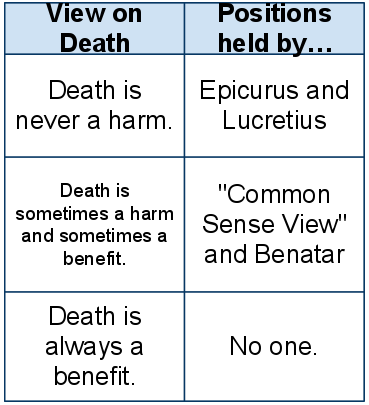
With Epicurus’ argument, Benatar looks at what it means to be deprived of something. Can the dead still be deprived of something? Surely, those who are murdered seems to be deprived of something rather than those who die of natural causes. For the dedicated Epicurean, neither of them are deprived and they have good arguments for doing so. Benatar splits the middle and argues that death is sometimes a harm, and sometimes a benefit, which he calls the “common sense view” of death. Now, we have three pictures of death:

Religious Views

By now, I’m sure you’re wondering when the topic of religion would come up. The religious argument, basically, is that we are commanded to “be fruitful and multiply and fill the earth” and so we must procreate. Benatar has four arguments against religious views, which I consider somewhat weak:

1. Many Biblical Commandments are no Longer Binding.   For example, no religion endorses killing a rebellious son even though Deut. 21:18-21 has that injunction. There are many laws and rules in the first five books of the Bible that many people, including religious people, no longer see as binding.

My response: but how do we know that this particular commandment falls in the category of bound commands or not? I’m not a biblical scholar, but neither is Benatar. He has not given much of a theological reason as to why this commandment is no longer binding. Thus, it seems that, at best, we must remain agnostic on whether this commandment is still binding.  If, however, religious commands are more of a social phenomena rather than a divine ontological phenomena, then he may pull some weight.  Still, if we go this route, we’re only describing what people do rather than giving a normative claim.

2. Most Religions no Longer see this Command as Absolute.  Catholicism, for example, gives priests and nuns an exception to this rule. Shakers even advocated celibacy for everyone.

My response: The exceptions don’t prove the rule wrong. In order for there to be an exception, there must be a reason for that exception. If there is a reason for it, then we can look at it. But Benatar has not given us the reason.

3. This Assumes a Too Monolithic View of Religion. There are various and divergent views on just one topic, even within religion itself.

My response: this is true. But certain elements cannot be too divergent or else if falls out of religious belief. For example, there are a variety of views of how to view science and religion on how (if ever) they are compatible. But within the Christian community, one must accept Jesus Christ as the Son of God. Denying that is to deny the Christian religion entirely. There are certain beliefs that remain dogma and if one denies that, one is denying an essential element of that religion. Is the command to procreate dogma? Again, this is stepping into the bounds of theology and I don’t know the answer. But Benatar doesn’t provide one either.

4. Various Religious Texts Do Show an Argument that Coming into Existence is a Harm. Jeremiah and Job rued the day they were born, indicating that they wished they had never existed. Even the author of Ecclesiastes seems to indicate that it would have been better if nothing had gotten started. In the Talmud, there was a debate between two houses. The question was whether or not if was better for humans to have been created. The house that usually set Jewish precedent lost the debate. It’s noteworthy because the house that usually loses won this debate.

My Concluding Remarks

At the same time, I’m reminded of a famous quip: one man’s modus ponens is another’s modus tollens. Let me explain.

Modus Ponens is a logical move like this:

1. If P, then Q.
2. P
3. Therefore, Q.

So a classical one is this:

1. If I don’t know that I’m in a Brain in a Vat, then I don’t know if I have hands.
2. I don’t know that I’m in the Brain in a Vat.
3. Therefore, I don’t know if I have hands.

Now, Modus Tollens is a logical move like this:

1. If P, then Q.
2. Not-Q
3. Therefore, Not-P.

Using the classical one above works like this, (which was used by G.E. Moore):

1. If I don’t know that I’m in a Brain in a Vat, then I don’t know if I have hands.
2. I do know that I have hands.
3. Therefore, I know that I’m not in a Brain in a Vat.

Notice that they are both logically valid.

So now, let’s use this in our case. Let P = Humanity is worth going. Let Q = Life is Worth Starting.

May people may see it as:

1. If humanity is worth going, then life is worth starting.
2. Humanity is worth going.
3. Therefore, life is worth starting.

Benatar may see it as:

1. If humanity is worth going, then life is worth starting.
2. Life is not worth starting.
3. Therefore, humanity is not worth going.

Is this what it boils down to?

Overall, Benatar argues that this is actually a very philanthropic argument: in order to relieve the suffering of existence, it would be better to get rid of that existence. Moreover, humans cause a substantial amount of suffering. The suffering would be reduced if there were no more humans.

Now many will find these arguments silly and so they will be ignored or dismissed. I, however, cannot stop thinking about this issue. After all, I have blogged on this book for six posts. I will continue to think about these issues and I hope people do take these seriously.  I may even blog on the replies against Benatar.  If anyone would like to follow along, here is a site (from Benatar) on replies against Benatar and Benatar’s responses to them.  He continuously updates his site.

Posted in Anti-Natalism, Books, Epicurus, Religion | Tagged | 6 Comments

Let’s See What’s in the News Today: 07/23/11

Economics

Law

Lifestyle

  • Living the Dink life (dual income no kids).  (Now on Blogroll)

Philosophy

  • An interesting article on a less-known existentialist pessimist philosopher who borders toward anti-natalism: Peter Wessel Zapffe, which shares many Benatarian themes: a globe without people wouldn’t be so bad.

Religion

Sex

Teaching

Posted in Anti-Natalism, Culture, Economics, Education, Law, Religion, Sexuality, Values | Leave a comment

Benatar Part Five: Population and Extinction

In part one, I went through Benatar’s argument on why coming into existence is a harm.

In part two, I went through Benatar’s argument on just how harmful coming into existence is.

In part three, I went through Benatar’s anti-natalism.

In part four, I went through Benatar’s “Pro-Death” view of the abortion debate.

Here, I will look through Benatar’s argument on what to do about human population and extinction. In short, we should gradually dwindle our population until it becomes extinct, and the sooner the better. Here is the argument:

  1. Coming into existence is a harm. (from part one)
  2. If coming into existence is a harm, then there shouldn’t be any beings coming into existence.
  3. Therefore, there shouldn’t be any beings coming into existence.
  4. If coming into existence is a harm, and there shouldn’t be any beings coming into existence, then the sooner we become extinct the better.
  5. Therefore, the sooner we become extinct the better.

Thus, if you asked Benatar how many people should there be? His answer is simple: “zero” (p. 164). Even one person on earth is considered overpopulation. All things considered, it would be better if there were no more people. There is a caveat in 4.  Benatar states that “the creation of a limited number of new people may be justified” (p. 164) but for the purpose of helping the human population become extinct.

So how do we solve it? Well, first what is the exact problem that Benatar wants to face? He first looks at Derek Parfit’s non-identity problem and see what could be various solutions to it.

Parfit compares whether it is better to live a poor life than to not exist at all but brings up an interesting problem: how can one compare the quality of life to that which doesn’t exist?  We can’t compare two qualities of life because the non-existent person has no life.  Therefore, Parfit thinks that the quality of life must have some impersonal, objective standard.  Along with this, Parfit examines different ways on maximizing the well-being of future generations.

Possible Outcome 1:  Maximize the well-being of the total population in the future.  Problem: this could lead to a “repugnant outcome” where it’s better to have more people that have a lower quality of life than a smaller number of people who would not.

Possible Outcome 2: Maximize the average well-being of everyone.  This leads to a smaller population, yet with a greater total of well-being.  Problem: this leads to the idea that it would be better to maximize the well-being of two people in the future, rather than aiming for a smaller population who has a smaller, yet has a good qualitative life.

Now, Benatar argues that the reason why these problems come up is because we forget to make the distinction between lives worth continuing and lives worth starting.  What I want to point out is that on p. 179-180, Benatar uses Rawls’ original position as a way to flesh out his argument by talking about hypothetical people, which is what I mentioned in part one.  Given that the people are in the original position are rational, they would seriously consider the arguments that Benatar have made. They would conclude, Benatar thinks, that no one would choose to exist.

Ok, but now, people do exist. So how can we phase ourselves toward extinction? One would assume that ideally, the present generation just stops procreating. However, Benatar notes that it may be possible that simply decreasing the population may be correlated with decreased quality of life. How so? Let’s call the present generation PG. Once PG stops procreating, then no one would take care of PG once PG gets older. PG cannot attain the same skills with rapidity or eagerness because of advanced age. Thus, the quality of life for PG will be lowered. The last generation would have a heavy burden of simply living out their continued lives. In this case, we need some kind of ratio of young to old people where we can have a slow decrease of the population over time. That’s the first problem.

The second problem is when the new generation falls below some thresholds. Benatar gives an example: Adam and Eve are living. Adam dies so Eve’s quality of live is reduced because the human population is reduced by fifty percent. She has fallen below a threshold of necessary company. Thus, “[b]ringing people into existence always inflicts serious harm on those people. However, in some situations failing to bring people into existence can make the lives of existent people a lot worse than they would otherwise have been” (p. 184). But just to make sure we don’t fall into an absurd conclusion, Benatar states that the only purpose of creating new people would be to eventually phase out human existence. It’s an interesting question whether it’s justified to bring new people into existence in order to improve the quality of existent lives. Here’s Benatar’s statement: “we may start new lives in order to improve the quality of existent lives if the harm suffered by existing people in the absence of new people would be greater than the harm done to the new people” (p. 187). But under what conditions? It gets tricky because it seems that we may be violating a deontological principle: we are using (future) people as a means in order to relieve the suffering of present people. Benatar brings up four possibilities and eventually concludes that one form of negative total utilitarianism–which states that creating new people is permissible as long as the total amount of harm is equal or less than the harm that would be suffered by existing people if the new people were not created–and a less stringent view of a deontological view is compatible with anti-natalism–which states that creating new people may be justified by substantial (but not mere) reduction in total harm. It’s because they have the least moral costs. If we go toward a more robust or stringent view of the deontological view, then it becomes incompatible with Benatar’s argument.

Frankly, I find the argument flowing from his argument.  However, it falls apart when Benatar says that the creation of a limited number of new people may be justified.  See especially Objection 4.

Objection 1: This seems like he’s trying to fit an idea into a theory that works for him. Ordinarily, one first finds a theory that is correct, and see the implications of that theory. What if it turns out that a robust deontological view is indeed true? Wouldn’t this suggest that Benatar must give up his anti-natalism? It seems he must first have an ethical theory and then see where that leads one in the ethical applications, not the other way around.

Objection 2: Wouldn’t there be some sort of regret if the human species went extinct?

Benatar’s Reply to Objection 2: The human species will eventually become extinct sometime in the future. But this actually leads to an optimistic conclusion: “Although things are now not the way they should be–there are people when there should be none–things will someday be the way they should be–there will be no people” (p. 193). This doesn’t lead to pro-mortalism: that we should kill off the species. Killing off the species is wrong for the same reason that killing a human is wrong. But why? “Although it may be bad for anyone of us to die, it is still worse to die earlier than we need to” (p. 194). A wrong has been done when there is a killing. But if we delay the extinction, we continue the suffering. Therefore, the sooner we become extinct, the better.

Objection 3: Suppose we all became extinct.  Even though it would take a great amount of time, another rational species will eventually evolve and would continue the cycle.  Because they have limits, they were harmed by coming into existence.  Thus, nature is harming those coming into existence.  In order for this to work, Benatar must assume some sort of metaphysical framework (perhaps through Schopenhauer or Buddhism) that suggests that simply existing is wrong.

Objection 4:  Under this rubric, I don’t think humans will ever become extinct.  If most economists are right, then increasing the human population actually creates competition thereby making everyone better off.  By decreasing the population, the well-being of future beings (until extinction) would be worse off, which goes against Benatar’s claim.  The only way out of this is to say that PG must stop procreating now and forget the criteria where there may be justification to create more people.  Otherwise, I find Benatar’s views on this inconsistent.

Posted in Anti-Natalism, Books, Environment, Ethics | 6 Comments

Let’s See What’s in the News Today: 07/16/2011

Sex

  • The Onion never ceases to amaze me: How to Get a Guy to Notice You While You’re Having Sex.
  • A debate about pornography in England.  I thought the opposition did a horrible job, which is why the house was in favor of porn.
  • A new strain of gonorrhea is resistant to antibodies.  Doctors are now finding a way to fight it.
  • New male contraception is on its way.  It basically injects a gel in the vas deferens to chemically change the sperm so that they can’t penetrate the ovum.
  • American sex lives are as exciting as “a peanut butter and jelly sandwich.”  See here on why.  A lot of interesting statistics too.  In other words, the stuff we hear and see in society is hyped up and inflated.
  • California Governor signs law to teach gay history.
  • The Science of the Cougar.  (Really, that’s the headline.)  Why do women from ages 26-45 have a higher sexual frequency?  Various answers have been:
    • Their answer is that their biological clock is ticking, but in a complex evolutionary way. 
    • Older women are just more sexually comfortable.
  • Apparently, Hitler ordered sex dolls for his troops so that they wouldn’t contract any dieases.  However, the idea was abandoned later and the dolls were blown up in the bombing of Dresden. 
  • Dan Savage on Colbert Report about how monogamy is overrated.

Marriage

Philosophy

Politics

Technology and Science

  • You can know print in 3D and even use the products: 
  • Science mutates and breeds an orange where it’s now the perfect orange: skin is easier to peel, low seeds, and the perfect sweetness.
  • Excellent source for videos on science.  I think my favorite is below:
  • Belief in Evolution vs. national wealth.  Notice that the US is a fringe data point.

Posted in Education, Evolution, Free Will, Gender, Health, Humor, Marriage, Monogamy, Politics, Pornography, Sexuality | Leave a comment

Benatar Part Four: The “Pro-Death” View

In part one, I looked at Benatar’s argument for why coming into existence is always bad.

In part two, I looked at Benatar’s argument on how bad coming into existence really is.

In part three, I looked at Benatar’s anti-natalist position where he argues that having children is always unethical and any sort of coitus that leads to procreation is unethical.

In this post, I will be looking at Benatar’s argument on abortion. As you can imagine, he’s for it, but up to a certain point. And this is where he talks about the pro-death position. Typically, the burden of proof has been on the defender of abortion on the justification of abortion. Benatar flips this: abortion should be the standard; those who don’t have an abortion must give justification on why they don’t. The failure to abort may almost never be justified.

In short, here is his argument:

1. Procreation is wrong. (This is argued in part three.)
2. If procreation is wrong, then one must prevent oneself for another to come into being.
3. Among other things, abortion is a way to prevent another to come into being.
4. If abortion is a way to prevent another to come into being, then abortion is permissible.

So we’ve covered the “why” and the “how”, now we can talk about the “when.” Exactly when does one morally come into existence? Benatar argues that a being comes into existence biologically at conception, but one morally comes into existence much later. A moral being has interests. Here, Benatar looks at the philosophy surrounding “interest.”

Four Kinds of Interests:

1) Functional: “Those things that facilitate an artefact’s functioning are said to be good for the artifact, or to be in its interests, and those things that compromise its functioning are said to be bad for it, or against it’s interests. Thus, rust is bad for a car and having wheels is good” (p. 135).
2) Biotic: Much like functional interests except these beings are alive. Plants are a good example.
3) Conscious: These are interests that only conscious beings can have. Examples would include an interest of avoiding pain.
4) Reflective: These are higher-order cognitive capacities such as self-awareness, language, symbolization, abstract reasoning.

These interests are incremental. So what type of beings have interests? After looking at four philosophers’ view of interests, Benatar concludes that having an interest in something is a necessary but not a sufficient condition for moral standing.

Another question: what type of interests are morally relevant? Benatar argues that “conscious interests are the minimum kind of morally relevant interest” (p. 139). His argument is as follows (from p. 141, I also change the numbers to letters to avoid confusion with the numbered argument above and the continued argument below):

(A) To say that an interest is morally relevant is to say that it matters (morally).
(B) If an interest is to matter morally, it must matter to the entity whose interest it is.
(C) For an entity’s interest to matter to it, there must be something that it is (that is, feels) like to be that entity.
(D) There can only be something that it feels like to be a particular entity if that entity is conscious.
(E) Therefore, only conscious beings can have morally relevant interests.

Benatar argues that fetuses only become conscious late in the gestational period, meaning that fetuses gradually gain moral interests.

Objection 1: It seems that pro-lifers would object. Their complaint is that biotic interests should count. Thus, abortion is wrong in all stages.

Benatar’s Reply to Objection 1: If we’re going to be consistent, then the interests of plants, bacteria, viruses should also count.  Pro-lifers will not embrace this view.

Objection 1.2: Biotic interests should count only for humans.

Possible Reply to Objection 1.2: This seems arbitrary.  Why is it that only human life has biotic interests and that has bigger prominence?

Next, Benatar gets at the heart of the problem by answering when consciousness begins.

To test this, we must look at this empirically and Benatar offers evidence from an EEG. In short, an EEG records electrical activity of the brain and it provides the main element that I think Benatar finds the essence of consciousness: wakefulness. However, he stresses that they are not equivalent: “While consciousness is supervenient on the function of the [cerebral] cortex, it is only possible in the wakeful state. In this sense, the brainstem and thalamus only support consciousness indirectly. Since arousal states–wakefulness and sleep–are states of the brain stem and thalamus (even though they usually have cortical consequences), and consciousness is a function of the cortex, wakefulness and consciousness are separable” (p. 144-145).

One can obviously be conscious but not awake, but can one be awake but not conscious? Yes. They are people in persistent vegetative states. Thus, being awake isn’t a sufficient condition for consciousness, which again shows that they are separate things. It seems that Benatar gives his definition: “a being that lacks the capacity for wakefulness will also lack the capacity for consciousness” (p. 145). Benatar also uses evidence of studies where researchers induces pain to fetuses. Those beings which were older than 28 weeks had certain facial characteristics that exhibited pain behavior. It’s much too complex to be a simple reflex. Benatar, along with the scientific studies he has looked at suggests that neonates become conscious around 28-30 weeks of the gestation period. Therefore, one exists morally around that time. Prior to that, abortion is not only permissible, but obligatory. Continuing the argument, then:

5. If abortion is permissible, then one is allowed to have an abortion.
6. Coming into existence is a harm. (This is argued in part one.)
7. Doing an unnecessary harmful thing is wrong.
8. If coming into existence is a harm, then coming into existence is wrong.
9. Therefore, coming into existence is wrong.
10. One has an obligation to prevent an unnecessary harm if it is within one’s power.
11. If coming into existence is wrong, and abortion is a way to prevent another to come into being, and one has an obligation to prevent an unnecessary harm if it is within one’s power, then one is not only permitted to have an abortion, but one is obligated to have an abortion.
12. Therefore, one is obligated to have an abortion.

After that time period, it gets tricky but Benatar suggests killing the fetus after that time period is only prima facie wrong. Moreover, Benatar is a gradualist, it seems, when it comes to the abortion debate but after 28-30 weeks of the gestation period. As one becomes more interested in existing, the harming that interest becomes more severe. Late-term abortions and perhaps even infanticide may be permissible if it prevents a continuation of an unpleasant future existence.

R.M. Hare’s Argument Against Abortion and Benatar’s Replies

Benatar looks at two possible arguments against abortion. I’ll look at them separately and see how Benatar answers them.

The first is from R.M. Hare with his “Golden Rule” argument. Basically, Hare’s argument is that we should do to others as we are glad was done to us. Because we are glad that no one aborted us, we have a duty not to terminate a pregnancy which will result in the birth of a person having a life like ours.

Benatar’s Objection 1: Not everyone is glad not to have been aborted. Even if there are those who are glad to have been born, this still assumes that this preference is the standard which Benatar has challenged. Those who are glad to have been born are mistaken, as was shown in part two. Being ignorant on an issue doesn’t make the action justified. Benatar brings in a nice analogy: “Imagine, for example, a widespread preference for having been introduced to cigarettes, which was based on ignorance of the risks of smoking. Employing Professor Hare’s rule, people with such a desire could reason: ‘I am glad that I was encouraged to smoke, and thus I should encourage others to smoke'” (p. 154). Thus, just because one is glad to have come into existence isn’t a good reason for bringing others into existence.

Benatar’s Objection 2: Even if we are mistaken that the potential person was glad to have been born, we must err on the side of caution. If the person is born and that person was not glad to have been born, then that person will suffer their whole life. If the person was aborted and it turns out that the person would’ve been glad to have been born, there would have been nobody who suffers. Either way, it’s better not have existed.

Don Marquis’s “A Future Like Ours” Argument and Benatar’s Replies

Marquis states that abortion is wrong because it destroys a future like ours. Generally, Marquis allows abortion up to fourteen days after conception. Anytime after that is to take away a future like ours.

Benatar’s Objection 1: Benatar agrees with Marquis on that account except he extends the permissible time period up to 28-30 weeks. However, Marquis notes that this is because of the value of those future experiences that are going to be had by the person. But of course, Benatar finds the value of future experiences not valuable overall. Thus, “for killing to be wrong, the future must be a valuable one, but it must also be the future of a being that already counts morally” (p. 157), which fetuses don’t count as moral beings until 28-30 weeks in the gestation period.

Benatar’s Objection 2: If we follow Marquis’ thoughts, it leads to an odd conclusion: killing a fetus is worse than a thirty-year old because the fetus would have a longer future and would be deprived more. This is an absurd conclusion. Typically, we consider the death of a thirty year old much worse than the death of a fetus and the typical reason is because the thirty year old has a vested, deeper interest in existing than the fetus does.

Possible Response from Marquis 2: I think Marquis does have a reply to this.  There is more than one reason why killing is wrong. It is worse to kill an admirable person than one who has never done anything for anyone. The very young have not done anything admirable. By this standard, it is usually worse to kill the elderly than the young. Also, even if it’s true that killing some people is worse than killing others, it is just too complicated to figure out each person’s likely future. So legal prohibitions against killing should treat all killings as more or less the same.  Now this is an odd response.  Frankly, I think Benatar has a good point.

Overall, Benatar wants to show that even though one is obligated to have an abortion, this does not entail that women should be forced to have an abortion since that would go against their right to reproductive freedom that was shown in part three.  Instead, Benatar recommends that women abort and if she doesn’t, she needs an excellent reason not to, which Benatar thinks there aren’t any reasons.

Posted in Abortion, Anti-Natalism, Books, Values | 33 Comments

Let’s See What’s in the News Today: 7/9/2011

A lot of stuff has been happening.  Let’s check it out:

Sex

  • In the New York Times, Dan Savage talks about different forms of relationships in an interesting article about how non-monogamous relationships may not be so bad.  Keep things honest!  Re-draw boundaries on what one can do in the relationship, not have hard-line rules on monogamy.  It’s because monogamy is actually harder than we think.  Around page 4, there’s a critique suggesting that women may go along with it just to please their partners.  This may lead to a more diverse society with various forms of relationships.  We can’t have a one-size-fits-all approach when it comes to romantic relationships.
  • As a response, Stephanie Coontz-whom I adore, as you can see from this post–has sympathetically understood Savage’s point, but disagrees.  She suggests that monogamy will still be the major institution of relationships and it’s not going away anytime soon.  Any why not?

    It’s because we’re not the kind of society that has lots of very close, tight-knit relationships with a sense of interdependence that exists across the life cycle. So, we put more of our commitment eggs in the basket of our significant other. As long as that occurs, allowing sexual dalliances, which sometimes become invested with big emotions, will threaten that one source of obligation and altruism. Because we put this emphasis on the dyadic bond, it is a fairly rare couple that can go into [an open marriage] absolutely confident that [these other relationships] will not turn into something more threatening and permanent.

    In other words, the notion of equality in marriages has made monogamy stronger.

  • Penis size has been linked by comparing the ratio of the index finger with the ring finger on the right hand.  The lower the ratio, the longer the penis.  How so?  Prenatal hormones.
  • A blog about using the tools of economics to investigate love and sexuality.

Ethics

Information

Media

  • A huge smashup of Daft Punk songs.
  • Anyone want to play Lady Gaga’s “Bad Romance” on the piano as a fugue?  Or you can just listen to it:  

Economics

  • Samoans lose a day in order to gain an economic stronghold.
Posted in Ethics, Love, Marriage, Music, News, Sexuality | 1 Comment

Benatar Part Three: His Anti-Natalist Position

In part one, I looked at his argument on why coming into existence is a harm. In part two, I looked at why always coming into existence is always a harm and how harmful coming into existence really is. In this post, I will look at his next chapter and concentrate on his anti-natalist views. If you accept his arguments in the previous chapters, then you must conclude that having children isn’t that great. However, Benatar argues that even if you don’t accept the conclusions, you must admit that most lives are still pretty bad, which should lead one to a conclusion about having children or not.

In short, we do not have a duty to procreate. Moreover, we may even have a duty not to procreate. Benatar doesn’t specifically say this, but it seems that he’s heading towards this direction. This is what the argument looks like:

  1. Coming into existence is a harm. (This is argued in part one.)
  2. Procreation is a route to come into existence.
  3. If procreation is a route to come into existence, and coming into existence is a harm, then we do not have a duty to procreate.
  4. Therefore, we do not have a duty to procreate.

Given the asymmetry argument, existence is always going to be negative.  Thus, procreation is also going to be negative because it’s bringing someone into existence.

Premise one was argued from previously. Premise one seems to simply follow from one. Obviously, we have a deep human drive to procreate. To be clear, Benatar wants to show a distinction on the interests of having sex, and he shows that there are three possible interests in doing so:

Procreative Interests: “interests in bringing new people, one’s genetic offspring, into existence” (p. 96).

Parenting Interests: “interests in rearing a child as well as interests in the relationship established with the (adult) children one has raised” (p. 97).

Coital Interests: “interests in a kind of sexual union–coitus” (p. 96). Of course, a lot coital interests brings about procreation. What this means is that many people came into existence not because of parental or procreative interests, but because of the coital interests. In any event, the reason why children come into existence isn’t for the sake of the child. Thus, having a child is to serve the parents (or others’ interests). However, this doesn’t automatically show why procreation is wrong. Serving one’s interests isn’t a sufficient condition for wrongness.

Objection 1: This may all be valid, but the harm isn’t that great. In other words, we may accept part one of the argument, but not part two. The harm doesn’t outweigh the benefits.

Objection 2: A parent may feel that his/her life is relatively comfortable and is happy that s/he came into existence. Thus, the children of that parent may feel this way as well.

Benatar’s Reply to Objection 2: This is assuming too much. If the offspring does regret his/her existence, this is very tragic. The parents cannot foresee this. Thus, given the asymmetry, it would be better not to procreate.

If we cannot attain a desired good, then we don’t want to desire that thing anymore. Benatar suggests that the reverse is also true: if people are in unfortunate circumstances, people will adapt based on their predicament. Thus, we could all be under a great self-deception about how wonderful things really are. Benatar gives some examples to this: if we had a good argument against slavery, we wouldn’t take the word of slaves that they have a good life even if they had psychological contentment. Thus, widespread contentment isn’t justification on whether one’s life is good. Otherwise, this harks back to PP mentioned in part two.

As mentioned before, one has a natural inclination to procreate. However, Benatar points out that it seems that it’s a given that if one could foresee that a person’s life would be harmed, one has a duty not to create that person. Thus, if one could see that one has a duty not to procreate under those circumstances, then it’s not a huge burden to not procreate at all. This seems to be in line with “ought” implies “can.”

Objection 3: There seems to be a huge gap between procreating where the offspring will suffer vs. not procreating at all.

Benatar’s Reply to Objection 3: If we accept premise one, then a duty not to procreate isn’t too demanding.

But I’m not so sure about this. It seems like a non-sequitor. It may be that not procreating is not demanding, but that still doesn’t answer whether there is a huge gap between not procreating because the offspring will suffer as opposed to not procreating at all.

Legal Ramifications

If one does has a duty not to procreate, does this enter to the legal realm? In other words, even if it’s not preferable to procreate, does one still have a right to procreate? After all, if I have a duty not to do x, it seems that I don’t have a right to do x. (E.g., if I have a duty not to harm you, then I don’t have a right to harm you.) Benatar looks at this from a purely negative rights position. In the end, he argues that, “Having children may be morally wrong, but it may still be the case that there ought to be a legal right to do this wrong” (p. 103). This wrongness may come from standard libertarian viewpoints. For example, prostitution may be morally wrong, but one still has a legal right to visit a prostitute. Under this view, one has a legal right to do a moral wrong. Of course, this, itself, isn’t enough to show that one has a legal right.

Possible Scenario 1: Make procreation illegal. If procreation were made illegal, this would drive pregnancy underground which would cause more problems. If pregnant people were caught, then the state would have to force abortions. This is just too immense and there are hardly any benefits resulting from this.

Possible Scenario 2: Sneak in a contraceptive substance widely administered to the population without them knowing. Benatar, however, appeals to Mill’s Harm Principle by using the abortion case. There are those who consider themselves as pro-choice, meaning that they see abortion as a moral wrong. Yet, these same people may see abortion as a legal right. Now with Benatar’s argument, there is surely going to be disagreement. This disagreement isn’t enough to restrict the Harm Principle. What is enough? It has to be reasonable disagreement. Ok, so what is that? Benatar doesn’t give a straight answer, but says that “until my position has been adequately tested against the very best objections one cannot assess whether my claim is one about which reasonable people can disagree or one with which it is unreasonable to disagree (or, for that matter, to agree!)” (p. 108). So what does this mean? Let’s go back to the abortion analogy: there are some people who believe that abortion is morally wrong because it’s killing a person. Now if these people are right, then this may be justification to make abortion illegal. However, there are some people who argue that the fact that there is reasonable disagreement on whether abortion qua moral wrongness does not entail abortion abortion qua illegal action. By analogy, if there is a reasonable disagreement about whether procreation is always a great harm, then we cannot make laws prohibiting procreation.

But in the end, Benatar argues that one could have reasonable disagreement about premise one, and thus, procreation is a legal right, even though it’s a moral wrong. Plus, it seems unlikely that governments would implement this anyway. So even though making procreation legal is regrettable, making procreation illegal may be more regrettable.

Now this, to me, seems to be a big weakness on Benatar’s part. Why should he follow the whims on whether there is a reasonable disagreement or not? Unless Benatar is a conciliationist, I don’t see why he must follow a reasonable disagreement. If the argument holds, and he himself agrees with the argument (which he does), this it seems that this entails that he would want to make laws forbidding procreation. If he’s holding back because of some liberal principle, then I would say he’s being too dogmatic by holding onto some ideology. If he’s holding back because of prudence, then he may have a foothold, but I wouldn’t call it reasonable disagreement.

Still, there is some uneasiness if we follow my objection. I wouldn’t want to intrude into the private lives of people procreating. Is there a middle road? There is one possibility, but it’s only one option among many, I’m sure. Hugh LaFollette has proposed of licensing parents. That doesn’t solve the problem of harming those coming into existence, but it may be a start. I’m sure there are other opportunities, but I can’t think of any off the top of my head now.

Benatar’s Reply to Objection 1: So how serious is this harm? Well, if we followed the arguments from part two, the harm is quite detrimental. If we’re following the Harm Principle, the government is needed to stop the harm from happening. Benatar also quotes Mill suggesting that the government does have an obligation to make laws against those who reproduce children where the children will be better off. But for Benatar, if we follow the implications of part one, everyone is made worse off by being born. Overall, I still feel that Benatar could make a better argument or somehow make his argument stronger as to why there shouldn’t be any laws made against procreation.

Disabled Lives

Most people think it wrong to bring existing people to the world who have serious disabilities. But Benatar relooks at how “disability” has been defined and he defines it through the “social construction” viewpoint. This viewpoint says that disabilities are inabilities based on societal norms.

For example, we all have the inability to fly. But this isn’t a disability because we can all access buildings. All wingless people have access, even though not having wings is an inability. However, if buildings don’t have wheelchair ramps for paraplegics, then that inability of not walking becomes a disability. If most people had wings and the only way to have access was on the top of buildings, then the wingless becomes a disability because they can’t access buildings. “Thus the reason why those with impairments are disabled, where they are indeed disabled, is not because they have some inability, but rather because society is constructed in a way that excludes people with that inability” (p. 116).

So the reason why the blind and the deaf have worse lives isn’t because they can’t see or hear respectively; rather, it’s because society doesn’t accommodate their particular inabilities. It’s the discriminatory social environment what makes their lives worse. This is a very controversial view and I’m not sure I buy it, but we’ll continue.

Now if the social construction of disabilities is correct (as Benatar seems to hold), then this has many ramifications for those without disabilities. In short, Benatar’s argument goes as follows:

  1. The social construction viewpoint of disabilities is defined as thus: Person P has a disability if and only if society and social constructs have institutionally (and perhaps purposefully) excluded P in the social norms of society.
  2. If the social construction view is correct, the mere in abilities are not seen as inabilities at all; but rather the norm.
  3. Everyone has inabilities.
  4. An inability is still a harm.
  5. If everyone has inabilities, and some people have disabilities, then those with disabilities are seen as worse off and those with inabilities are seen as the norm.
  6. If those with inabilities are seen as the norm, then this undermines what an inabilities is and inabilities go unnoticed.
  7. If we don’t notice our inabilities, and inabilities are harms, then we are blind to the harms of our own lives.

What this means is that disability rights have the correct view, but they don’t go far enough. They want to be treated as equal to the norm. But as Benatar argues, the norm is simply those who have inabilities. But this is an odd standard because of 3. So instead of looking at all disabilities, we should look at all inabilities to assess the quality of lives. We should consider not flying as a bad thing. It’s an inability that we have. We are susceptible to hunger, thirst, heat, cold, and so on. All of these inabilities that we have makes our lives very bad–worse than we realize or recognize.

Objection 4: Aren’t you setting the bar too high?

Benatar’s Reply to Objection 4: Aren’t you setting the bar too low? You were born and raised in a situation which you consider “the norm,” but you didn’t realize that your inabilities actually made your life worse. Imagine if you didn’t have any inabilities, you’re life would be much better off. “Many [people] without impairments tend to think that lives with impairments are not worth starting (and my even not be worth continuing) whereas many of those with impairments tend to think that lives with these impairments are worth starting (and certainly worth continuing). There certainly does seem to be something self-serving about the dominant view. It conveniently sets the quality threshold for lives worth starting above that of the impaired but below normal human lives” (p. 120).

More than this, children who were born into bad lives and unhappy about being brought into existence should be able to sue. Why not? If procreation is a right (and that right encroaches on another life), then the other life should be able to sue if the offspring was unhappy about being brought into existence. Of course, this is hard to do because this right rest on reasonable disagreement, whatever that means. At the same time, current judges and juries are already biased on their wrongful prejudices and standards.

Sexual and Reproductive Ethics

In terms of reproductive and sexual ethics, there are many positions.

One position is what he calls Sexual View of Reproductive Ethics. This position states that reproduction is unethical unless it is expressed as mutual love within the confines marriage. Taken strictly, Benatar points out this ethics entails that “[t]he couple’s mutual love, expressed sexually, must be the proximate cause of the child’s conception” (p. 124), which Benatar thinks cannot be defended adequately. He asks, “What is so important about a sexual expression of love that is a necessary condition for the ethically acceptable production of a child?” (p. 124) Many people who hold on to this position also hold on to what he calls the Reproductive View os Sexual Ethics: sex can only be acceptable morally if it is directed towards reproduction. (Note: Benatar realizes that this is a necessary, but not a sufficient condition. After all, rape and adultery can still produce children, but this sexual act is still considered unethical.)

Benatar flips both of these views on its head: the only acceptable and ethical sexual act is where it does not lead to reproduction. Benatar calls this the “Anti-Reproductive View of Sexual Ethics.” Any sort of sexual activity which purposefully leads to reproduction is unethical. This also includes any person or institution that helps with the reproductive processes. I know, it’s shocking.

Posted in Anti-Natalism, Books, Children, Ethics, Values | 6 Comments

Bleeding Heart Libertarian Blog is Reading Nozick’s Anarchy, State and Utopia

There’s a reading on the Bleeding Heart Libertarian blog.  I’ll index below and update it as the blog goes forward.

  1. Correcting One Big Misreading of Nozick: On The Structure of Anarchy, State, and Utopia
  2. Strange Absences in Anarchy, State, and Utopia
  3. Nozick on Philosophical Explorations: There is Room for Words other Than Last Words
  4. Why State of Nature?  (This is starting on Chapter One.)
  5. Re-reading Nozick: Two Definitions (the definitions are “legitmacy” and “authority”)
Posted in Books, Economics, Libertarianism | Leave a comment

Some Transparency in Congress Please

A while ago, I wrote about J.S. Mill’s view of representative government and how Congress should be a true representation of the population.  Now there’s a graph representing this:

Click on the pic above.

Posted in Government, Politics | Leave a comment