Book Review: Chew on This by Eric Schlosser & Charles Wilson

This is exactly like Fast Food Nation except this book is for Jr. High Students.  (Little do my students know, I’ll still use some chapters for their classes.)  Some of the chapters and wording is very similar to Fast Food Nation. This will be a short review then since I’ve already covered this in a previous post.

The book starts talking about how McDonald’s got started by Ray Kroc.  Eventually, advertisers marketed to kids and then the toys came out so that it would entice the kids to buying more food in order to get the toy.  It’s the branding of children, which almost seems like brainwashing, into mini-consumers.

Along the way, however, the jobs at fast food places aren’t that great.  One particular chapter I’ll go into detail about how they treat their workers.

These little towns thrived on their own.  But through industry, McDonald’s, Burger King, and KFC came roaring in.  With this, the suburbs came in.  What’s so significant about those?  They’re all the same.  There’s no uniqueness, or special about these towns anymore.  Fast Food thrives on new suburban sprawl, and they encourage more sprawl.  Interestingly enough, McDonald’s became the world’s largest purchasers of satellite photos in order to see neighborhoods and see where a good location for the next McDonald’s should be.

A teenager wakes up at 5:30 just to go to work.  Now, fast food restaurants usually put pretty girls up on the front.  Why?  To deal with the customers.
The teens usually don’t feel really awake until about 11:00.  Indeed, the fast-food workforce thrives on teens.  Why?  They aren’t that skilled.  So

“instead of relying on a small, stable, well-paid, and well-trained workforce, the fast-food industry seeks out part-time, unskilled workers who are willing to accept low pay.”

Think about it.  Teens usually don’t have families to support, and their inexperience makes them easier to control.  The fast-food companies don’t need skilled workers.  It just needs people to do what they’re told.  They can be hired cheaply.  And you are substitutable.  You don’t want to work here?  Fine.  We can easily replace you.  Indeed, fast-food companies are the first to fight Congress that the minimum wage doesn’t need to be raised.  Between 1968 and 1990, the years in which the fast-food chains grew the fastest, the real value of the minimum wage fell almost by half.

“The real value of the US minimum wage is lower today than it was 50 years ago.  The fast-food chains earn large profits as wages fall, because it costs them less money to hire workers.”

Think about all these layoffs.  Why are there so many layoffs, yet the CEO’s get a huge disproportion of the profits?  Being on part of the “crew,” you are employed “at will.”  If business is slow, you’re sent home.  If it’s busy, you’re asked to stay longer.  The managers’ job is to basically encourage “team spirit” and to work hard.  Indeed, the word “McJob” has meant “a job that’s low-paying and offers little opportunity to get ahead.”  There’s not much of a future.

Jobs always seem fun at first.  Why not quit?  You need the money!  You work so hard at a job that pays so little.  These type of jobs become so monotonous and they don’t teach any real skills, that eventually it makes people hate jobs, and there’s skepticism that honest work will get them anywhere.  Schlosser writes:

“Studies have found that kids who work twenty hours or less a week during the school year usually benefit from the experience and gain self-confidence from their jobs.  But kids who work more than twenty hours a week are much more likely to cut classes and drop out of high school.”

On some occasions, teens have to stay until 2AM, even on school nights.  With these jobs, when your shift is over, the managers ask you to stay and work for a few more hours.  It’s because of the failure of other people not showing up.  A particular teen worked a 19 hour shift.  The manager gave her a thank-you gift: a bag of candy.

A teen gets a job in a McDonald’s in Canada.  A teen, Pascal, got the job and worked hard.  Indeed, Pascal would even show up when other workers failed to show up.  He was even employee of the month.  Later on, he got a worker evaluation.  Pascal only got a 2 out of a 4.  Why?  It turns out that the hardest workers get low grades.  That’s because a worker’s pay is increased based on the grade.  If the grades are kept low, then the company doesn’t have to pay that much.  Workers had to stay late, and the workers were being treated with disrespect.  Suddenly, Pascal and a friend decided to start a labor union.  Eventually 75% of the workers signed the cards (you must get at least 50% to have an effect).  However, one of the workers snitched.  The snitcher got a promotion.  All the sudden, McDonald’s hired 24 new crew members.  Thus, Pascal didn’t have 50% of the workers.  McDonald’s was blocking the union to form.  McDonald’s spread rumors about Pascal (it sounds so high school, doesn’t it?) and McDonald’s promised workers free meals if they left the union.
About a month before a court decision, the owner of the restaurant announced that it was going to be shut down.  He claimed that the rent for the building had grown too expensive.  The odds of a McDonald’s going out of business in Canada is 300 to 1.  Amazing coincidence?

The food is mainly derived of chemicals.  The flavor of the fries is actually a chemical to smell (and taste) good.  Some of these chemicals were really surprising.  Methyl anthranilate is the grape flavor in Kool-Aid, for example.  A lot of these chemicals are added to Pop Tarts, Hamburger Helper, Tang, Filet-O-Fish Sandwiches and thousands of other products.  The strawberry flavor is a strawberry shake has about 64 chemicals (no strawberries).

There are Bugs in the Candy.  Adding color to foods isn’t just dye anymore.  Cochineal extract (or carmine or carminic acid) is made of dead bugs from Peru.  These bugs are collected, dried, and then ground into a coloring additive.  Dannon Strawberry yogurt gets its color from carmine, so do many candies, frozen fruit bars, fruit fillings, and Ocean Spary grapefruit juice.

Why add color?  Adding color influences how you’ll taste or drink the product.  Would you eat strawberries that weren’t red?  However, these colorings have confused people.  Kids drinking Windex for example.

Yellow #5: studies have shown that it can cause hyperactivity, headaches, rashes, and asthma.  Where is this located?  Mt. Dew, Gummy Candies, Jell-O, Lucky Charms and other foods.  It’s been banned in some countries but still used widely in the US and Great Britain.

With meat,  ranching and the cowboy life are being left behind by a new kind of ranching: factory farms.  Ranchers are facing economic problems.  McDonald’s is America’s largest beef purchaser.  A while back it bought ground beef from 175 local companies.  Today, it buys their beef from five companies.  A lot of the ranchers have argued that the corporations have used unfair tactics by strangling the market which forces the price of the cattle to go down.  Early in history, the trusts could stop these corporations from taking advantage; it was the beef trust.  The purpose of the trusts was to break up companies that had grown too large, protect small companies from unfair business tactics so that the prices were set by the free market, not by corporate executives meeting in secret.  Eventually, the beef trust was broken.  Today, the top four meatpacking companies are: Tyson, Swift & Company, Excel, and National Beef.  They control about 84% of the market.  But because the companies have grown bigger and more powerful, independent ranchers can’t make a good income anymore.

In another place, Greeley, Colorado, the smell is a combination of live animals, manure, dead animals being turned into dog food, it’s basically an invisible fog.  By gaining a profit, the meatpacking firms cut their costs by cutting the wages of the workers.  Meatpacking used to be the best-paying factory jobs in the nation; now it’s one of the lowest-paying jobs.  Usually, they hire poor immigrants.  Why?  They don’t have much power, and they’re easy to manipulate.  The cows don’t roam in pastures, but they’re in feedlots.  They’re given a special grain to fatten the cows along with growth hormones.  But with all this manure, it’s dumped into these lagoon pools which can be 15 feet deep.  Sometimes, they leak sending it to rivers and streams.  But they also emit gases which can be deadly.
With chicken, it really took off when McDonald’s invented the Chicken McNugget.  Interestingly enough, they have more fat per ounce than a hamburger does.  Through this, Tyson company became the world’s largest chicken processor.  But the farmer doesn’t get paid that much.  Usually chicken farmers quit after about three years.  Inside a chicken house, the building is as long as a football field, more than 30,000 chickens packed together.  They would never see the outdoors.  Their diet consisted of a mixture of old pretzels, cookies covered with fat, leftover meat, fat, blood and bones from chicken slaughterhouses.  Basically, the chickens become cannibals.  And chickens aren’t even meat-eaters!  Chickens prefer grass but these chickens will never see grass in their entire lives.  Chickens try to gain about 5.5 lbs. in about one month.  That’s like a child weighing 286 lbs. by the age of six.  But because these chickens get fat so quick, they can’t walk.  Their legs are filled with fluid that they’re in constant pain.  Indeed, most have heart problems.  They can’t even exercise.  Chickens are having heart attacks.  If you open up a chicken, there’s a thick layer of fat around the chicken’s heart.  The purpose is to fatten the chickens as much as possible.

How were chickens killed in the old days?  The farmers just grabbed them and chopped their heads off with an ax.  Nowadays, you hang their legs from an overhead chain. The chickens try to wriggle free that they sometimes break their legs. What happens is that the chain moves and then it dips the chickens in water that’s charged with electricity?  This is supposed to knock the chickens unconscious. However, there are some chickens that aren’t knocked out.  So what happens next means that they feel it. Even McDonald’s has admitted that one or two out of every hundred chickens aren’t knocked out. The chain moves to a sharp rotating blade that cuts their throats.  Now if the chickens aren’t stunned, they’re going to feel it. However, there are still some chickens that can avoid the blade, which means what happens next is even more painful. The chain then dunks the chickens into boiling hot water so that the feathers can be removed.  This isn’t just boiling water, it’s scalding hot.  Indeed, no chicken has been known to survive it.  So the chickens who are still alive are basically boiled to death. A video was released showing what happens inside this chicken factory farm. Some of the workers would throw the chickens (like a football) against the wall.  In other cases, the workers would jump on the birds or throwing them up against the wall again.  One has said, “I like to hear the popping sound they make.” Why this cruelty?  The production line is moving too quickly.

Now you might say, “but that’s the only way to get the meat out quick.” Well, in Europe, they don’t have this process.  They are kept in crates, then placed in a sealed chamber, then forced to breathe a gas that painlessly kills them unconsciously.  So chickens never get boiled alive. A study has shown that this was more efficient than the electrified water, better welfare for the birds, and better for the workers in the plant, without affecting the quality of meat.  However, it’s more expensive.  Going back to Pollan, he checks out McDonald’s and was surprised with some of the foundings.  (I was too.)  For example, a chicken McNugget contains dimethylpolysiloxene.  It’s a carcinogen.  The McNugget also contains tertiary butylhydroquinone (TBHG).  It’s lighter fluid!  Ingesting five grams of lighter fluid and kill.  About 0.02 percent of TBHG is in the McNugget.  With fast food, it’s doesn’t have that great savoring moment.  After all, which would you rather have: fast food or a home-cooked meal?  A home-cooked meal just feels (and tastes) more satisfying.  Thus, people eat more and more fast food to try and get that “savory” feeling (and taste) that they once had.

So much cattle comes in that human error can cause unnecessary pain for the animals, injure workers, and contaminate the meat.  The workers are basically cogs. In the 1950s, unions had a lot of influence: they were the highest-paid jobs, got good medical care, they could speak their mind, and it provided a good wage. In the 1970s, fast-food became popular, so wages had to be cut, moved the companies to rural places to weaken the unions, and mainly hired immigrants (usually illegal).  The production line was sped up. Nowadays, meatpacking is one of the lowest-paid jobs in the US.  It’s now become the most dangerous. The line moves so fast that the workers who cut the cattle from an overhead chain sometimes accidentally stab another co-worker or themselves with the knives and hooks. In the old days, plants slaughtered about 50 cattle an hour.  Thirty years ago, it was 175 cattle an hour.  Nowadays, it’s about 400 cattle an hour.  That’s about 7 cattle per minute.  With the increase in pace, the chances of injuries goes up. Faster pace means higher profits. If a worker dies on the job, the maximum fine is $70,000.  But these companies make billions every year. An executive has a better chance of winning the lottery than facing criminal charges for causing injury of a worker. However, the workers can’t complain.  Why not?  They’re illegal immigrants. If workers are injured, usually, you let them go.  They usually quit, become injured, or cannot do manual labor.  Thus, these workers often become trapped in poverty.

In 1993, nearly 200 people were hospitalized, 4 people died from contaminated meat from Jack in the Box.  Most of them were children. Other fast-food places were contaminated.  McDonald’s in 1982. About 200,000 people are sick from something they eat everyday, 900 are hospitalized, 14 die. These increases in sickness is due to the way American food is produced. Usually, food poisoning was from a small outbreak: church gathering, family picnic, wedding receptions.  Only one area of people got sick.  But now, food is produced en mass that millions can get sick.

What’s interesting is that if toys causes major harms to children, the government can demand that all of those toys be removed.  But the government cannot order a meatpacking company to remove contaminated beef.  The government can’t even fine the companies. Lobbyists are close to Congress. Cattle don’t get much exercise.  They mainly stay in a certain place and live among their own manure. To slaughter the cow, you have to really careful about cutting the hide off.  But because everything is moving so fast, sometime the job isn’t the efficient. The digestive system is pulled out by hand.  A single worker pulls the guts out of sixty cattle every hour.  That’s one cattle per minute.  Doing it right takes a lot of skill; doing it wrong means you spill all of the contents everywhere.  But we’ve already learned what the meatpacking companies hire?  Are these skilled workers?  No.  Therefore, meat gets contaminated a lot. With ground beef, it’s usually old dairy cows, cows which are already sick and diseased in the first place. Cows can live up to forty years.  Guess when they get slaughtered?  Around the age of four.  That’s when their milk production begins to fall. One patty at a fast-food restaurant can come from hundreds or even thousands of cattle.  However, germs can easily spread.  And E. Coli gets spread too because it mainly comes from one source: poop. That’s right.  There’s poop in the meat!

How many of you would eat dog?  Why not?  Pigs are actually more intelligent than dogs.  The sows are confined in crates that they can’t turn around. Once the piglets are born, it’s even more crowded.  The piglets, who are friendly by nature, start to bite and they bite off each other’s tails.  Thus, the farmer chops off their tails. At the slaughterhouses, the ramps are really high and the path curves.  Why?  It’s so that the cattle doesn’t see what’s coming up.

There has also been talks about gaining massive weight.  The authors talk to two kids who have gained weight by eating fast food.  One has already had gastric bypass surgery, the other was contemplating it.  In high school, these kids usually go across the street and eat fast-food.  Indeed, most fast-food companies have an “80-20 rule.”  About 80 percent of their money that McDonald’s earns comes from just 20 percent of its customers.  With this, the industry encourages people to eat bigger portions.  Along with the health problems, the heart is full of fat, arteries are clogged, the spine isn’t as strong (because of osteoprosis) and the blood vessels in the brain is constricted.  High schoolers are more likely to break their bones if they drink soda constantly.  With sodas, some cities have their soda cheaper than water.  Their teeth aren’t that great though.

It seems like a great idea, but at the same time, the major critique has been: isn’t the individual in charge of whether s/he goes to a fast food place.  If you don’t like fast-food, don’t go!  So where’s individual responsibility in all this?  The authors reply that while individuals should have the responsibility, it’s a different story when it revolves around children.  With so much fast food around, and with the advertisements, it’s considered exploitation of children.  Marketing to kids by bringing only fast-food and soda to schools doesn’t give the kids the full details about the problems behind these things.

“But won’t McDonald’s go out of business if their whole system changes?” you might ask.  No.  The authors contend that there are a few places that treat their workers fairly, animals without suffering, and without the whole marketing campaign.  In-N-Out Burger is one example.

Finally, it talks about the globalization of fast food.  When Iraq fell to the Americans, guess what was the first thing installed in Iraq?  A Burger King.  Imagine that.  You bring democracy and freedom to a state, and you’d probably want the first thing there to symbolize the struggle, but it’s a fast-food joint.  Throughout the world, everything is becoming part of the fast-food industry that political scientist Benjamin Barber has called it a “McWorld.”

In the end, I think it’s a good book even though it’s written to a younger generation.  There’s still some questions that can be brought up to the table, but I’ll let this review pass as is.  Wow, I thought this would be a short review but it’s longer than I thought.

Posted in Book Review, Economics, Health | 3 Comments

Should I Show “Meet Your Meat?”

I’ve been thinking of showing this video that’s online called “Meet your Meat” to my ethics class.  You can google it.  Basically, it shows videos of how animals are being treated in farms.  They’re confined in small compartments, the chickens are thrown up against the wall, the cows and pigs are hanged upside down waiting to be slaughtered, the pigs and turkeys are literally thrown out of trucks, chickens are being debeaked, cows and pigs are having their tails cut off, and on and on.  It’s pretty brutal.  I only glanced at it.

So here’s my dilemma: I don’t like it because I find it just as bad as what some of the pro-lifers do to the abortion debate.  These pro-lifers bring images of aborted fetuses (which are gruesome and bloody) to make an argument.  Now, to me, it’s not an argument.  They’re trying to appeal to the emotions and appealing to the emotions is a fallacy.  BUT IT WORKS!  That’s the main thing.

So with animals, it’s basically the same thing: it’s not an argument but it appeals to the emotions.  BUT IT WORKS!  However, the disanalogy is that the abortion debate doesn’t rest on what the fetus looks like, but rather the status of the fetus.  With animal rights, the argument does rest on the suffering of animals, so it does seem apt to show the video about the suffering of animals.  Again, this is to present it to my animal ethics class.  What does anyone think?

Posted in Ethics, Teaching | Leave a comment

Book Review: The Ethics of What We Eat by Peter Singer and Jim Mason

I’ve mentioned this book in another blog about demi-vegetarianism that relates to other books and issues if you want to check it out.  Out of all the books that deals with food, this is the must have book to read!  I have been trying to find some chapters or segments that I can use to teach to my class about animal rights, food politics, and the environmental concerns dealing with food.  I was expecting to only find a chapter or perhaps a segment to use. To my surprise, the whole book is worthy to be taught in class.

The Ethics of What we Eat by Peter Singer

The Ethics of What we Eat by Peter Singer

Peter Singer is well-known in philosophical circles as an ethicist and utilitarian.  He has written many books about animal welfare and the farming industry.  What I like about this book is that you don’t have to be a philosopher to understand the principles behind this book.  Indeed, this book was written for the common person.  What I also like about the author’s is that they are intellectually honest about their results.  They aren’t coming from any perspective and try to defend it any way they can.  They look at the results and determine “this is the most ethical thing to do in this situation.”  So there are times where eating local is actually harmful, and there are some fish in Wal-Mart that’s actually better than buying it wild.

The book takes you on a journey through three families.  Each of these families has a different philosophy of eating food.  In order, the book starts from (1) the conventional American diet, (2) the conscientious omnivore, and (3), the vegan lifestyle.  I’ll go in that order and display any interesting tidbits of information along the way.  The book follows a simple formula where we explore a family’s eating habits and then the author’s trace the food to the original source.  So if a family bought Tyson Chicken, the author’s find out where this chicken is produced, how it’s slaughtered, how it’s raised.  There were even moments where the author worked on a turkey insemination farm for a day.

The Conventional American Diet

Where does the typical family do their grocery shopping?  Usually, it’s Wal-Mart.  Singer and Mason tag along with a family to Wal-Mart to see what this family buys.  What do they buy?  Oscar Meyer bacon, Tyson chicken, eggs, Gordan’s fish. . .

  • The Chicken: The authors bring up some interesting tidbits about chickens.  With Tyson chicken, it’s a factory farm.  While visiting the farm, they mention that the chickens are cooped up in a cage that’s barely enough space for their body mass.  (Imagine being in an airplane bathroom for 24 hours a day.)  Chickens naturally peck at the ground, but because there is no ground, they can’t peck which causes them stress.  Thus, they peck at other birds.  This can’t happen, so their beaks get cut off!  The workers barely get paid.  It’s one of the biggest turnover rates at Tyson chicken.
  • Eggs: The label “Animal Certified Care” doesn’t mean much.  It’s the same as above with the chickens.  The label was just a way for more people to buy the eggs if they thought the eggs were cared for.  But it’s a misnomer.
  • Pork: Pigs are actually intelligent creatures.  The sows, however, can’t move around because they’re in crates for their whole lives.  As soon as they give birth, they are impregnated again.  Their whole lives are basically pregnancy after pregnancy.  Inside, pigs spend their lives in small concrete and steel pens. They can’t turn around, roll, root or exercise. The stench from their excrement is so sharp that people wear masks, while the pigs suffer damaged lungs and eyes.
  • Beef and Milk: Cows are given steroids to bulk them up for bigger beef.  With milk, you have to impregnate the cows because they can’t have milk unless they give birth.  As soon as the cows give birth, the calves are basically discarded.  After all, economically speaking, you don’t need the calf (unless you’re going to use it to sell veal), you just need the mother for the milk.
  • McDonald’s: McDonald’s has been getting a lot of flack lately because of their high fatty foods.  Over time however, the authors do contend that they are striving to get better with their environmental impact.
  • Wal-Mart:  The employees live off of almost minimum wage.  They can’t form unions and advancement in the company is so bureaucratic that it feels like being a peasant in a corporate world.

Again, it’s the idea of these factory farms that evades our knowledge.  Singer and Mason believe we tolerate the sins of industrialized food production because these practices aren’t known to the public.  As Pollan puts it: “Much of our food system depends on our not knowing much about it.”

(Note: I could talk more about these chapters, but to be honest, I remember the end of the book more vividly.  So if I give a bigger review about the vegan lifestyle, it’s not because I’m short-shifting the conventional American diet or propounding the vegan diet.  It’s basically because, like all books, you remember the ending better.)

The Conscientious Omnivores

In a previous blog, I stated that I was a demi-vegetarian.  However, after reading this part, this applies to me more effectively.  Thus, I may go back and change my position from demi-vegetarian to “Conscientious Omnivore.”

It’s the same procedure again.  The authors find a family and go shopping with them.  Where do they shop?  The family goes to a Trader Joe’s.  This is what the family buys:

  • Niman Ranch Bacon: This bacon comes from pork that is raised in humane ways.  No crates, no stress.  The sows can take their time and they can actually build their own bedding if they want.  Singer and Mason visit an organic pig farm, revealing that pigs are sentient and delightful, at least as intelligent as domestic pets.  So the pigs are treated humanely.  However, feedlots to feed animals thrive on corn.  But the corn for feedlots requires chemical fertilizers.  In other words, oil.  Based on this, how much oil does it cost to feed a 534 lb. to a 1250 lb. steer?  284 gallons of oil just to fatten the steer.  To know more about it, check this out:
  • Certified Humane Eggs”: I was actually surprised by this chapter.  The chickens are raised a little bit better than on a factory farm, but according to the authors, the floor was just a “sea of brown hens, so crowded that the shed floor was visible only down the center of the shed.”  They sometimes practice debeaking the hens if it gets to the point where they get stressed.  But if they are raised humanely, why are they still stressed, I thought?  Nevertheless, the eggs are laid in nesting boxes.  The hens are fed organic grains which makes them considered organic.  But the “certified humane” is what really surprised me.  The hens aren’t in their own personal cages, they were free to roam in the barn.  But the authors were “disturbed by the fact that there were so many of them in a single shed, effectively unable to go outside, and certainly never able to enjoy scratching around in grass, or to be part of a normal-size flock in which they get to know each other as individuals.”  Detailing the cruelty in factory chicken farms, the authors conclude that organic or free-range poultry products are the only ethical choice.
  • Seafood: Fish is depleting heavily around the world.  Interestingly, however, the authors showed that buying the Gorton’s Fish Fillets from Wal-Mart is actually environmentally better than buying it wild.  It’s mainly because the fish is Pollock.  Thus, Horizon seafood (Horizon is known for selling organic foods) is worse than Gorton’s Fish.  Crab imported from other countries are the worst, thus it should be avoided.  For farmed salmon, about five liters of diesel fuel is used to catch about one kilogram of salmon.  Indeed, since salmon is the most popular, it causes the most amount of pollution.  Shrimp, as well, is the seafood that causes the worst environmental hazards.  Overall, the authors recommend to avoid shrimp (unless it’s from Canada).
  • Fruits: Ask yourself this.  Isn’t there something weird about buying apples from China when you can easily get it from Iowa?  You would assume that eating local food would be better.  However, the authors want to show that usually that is the case, but not always.  If you’re buying a local tomato (especially in the winter), then that farmer needs fuel to make the tomato.  The authors calculate how much fuel is used compared to buying a tomato somewhere else in the country and then shipping it here.  It’s actually better, environmentally speaking, to buy a tomato in Florida than it is to buy it locally (unless to tomato is in season).  With rice, it requires a lot of energy to grow it.  Indeed, you would save energy by buying rice from Bangladesh, rather than buying it form San Fransisco.  A better policy would be to buy locally and in season.
  • Fairtrade: Fairtrade is becoming popular and the idea behind it is to help out the farmers instead of the corporation.  Chiquita bananas is better than Dole, for example.  The farmers who don’t have fairtrade usually make about $7500 a year.
  • Eating Out: Where could the conscientious omnivore go out to eat?  Chipotle seems to be the best option.  Too bad there’s none in Utah.  I had some in Texas.  It’s actually pretty good.
  • Whole Foods Market: Of course, this is the market for these types of eaters.

The Vegans

These folks eat purely organic stuff and they don’t use anything that deals with animals products.  With this family, it’s because they still see it as part of the system.  Organic food contains less pesticides, it keeps the quality of the soil better without relying of fossil fuels for synthetic fertilizer.  Of course, it’s more expensive, but in the long haul, it’s actually not.  The manure from the factory farms spills off into the streams which makes the people unhealthy.  The air becomes so strong that it can actually ruin your lungs (and the animals are living in it).  Combined with other things, you’ll have to go to the doctor eventually.  But with health care, the taxpayers will have to cover some of it.

  • Milk: A problem is that you’ll need more cows to make more milk.  But this also means that it produces more methane.  Thus, just nip it in the bud and stop drinking milk.  Vegans usually drink soy milk or rice milk.  Indeed, the cows at Horizon are still crowded in pens and a dry landscape.  What does this mean?  Organic just simply means you were fed organic things.  It doesn’t mean that you were treated humanely. The authors conclude to avoid Horizon and go for Organic Valley, (which is nice considering that I don’t buy from Horizon anyways from luck).
  • GMO (Genetically Modified Foods): This is to be avoided because it’s seen as unnatural.

Are Vegans missing something in their diet?  Vitamin B12 is the main culprit.  With protein, they actually get plenty of it from nuts, seeds, beans, and lentils.  It seems odd that we’re feeding 21 lbs. of grains just to produce one lb. of beef.  It takes 1,584 gallons of water to produce beef.  However, the authors do contend that eating chips actually uses up more water.  Beef, however, is the meat that requires the most amount of water.

In the end, the authors present these three families and let you judge their own conclusions.  However, the authors do want at least one thing.  It’s as if they’re saying, “If you can’t go vegan, try becoming a conscientious omnivore at the very least.”  The reason is because factory farms are simply unethical.  They present arguments that factory farming is completely wasteful and immoral.  To see why, go here.  (It’s not gross, I promise.)  The ending is mostly philosophy, but it’s presented with readable ease.

Freegans

If you don’t know what freegans are, go here.  I didn’t know this lifestyle was politically motivated.  Basically, you go through dumpsters searching for food.  The philosophical idea is to get away from the industry altogether.  If you’re not buying food, then you’re not supporting it.  They avoid spending their money to those who exploit animals.  But once something is thrown out, it makes no difference to the producer.  If you oppose the abuse of animals, but still like eating meat, cheese, or eggs, get it from a dumpster.  When the authors talked to these individuals, two of them were in college.  Neither one uses their money to buy food because they can easily get it from a dumpster.  Indeed, the authors point to studies that 40% of the food that’s thrown away could’ve been safely consumed.

In the end, one could reply that eating the conventional diet is cheaper.  In actuality, it doesn’t fare out.  Because the manure slides to the rivers, taxpayers’ dollars are spent cleaning up environmental damage, building infrastructure, and subsidising fodder production (itself unsustainable).  It’s actually more costly to be on the Conventional American Diet.   Even economists agree: Cheap, industrial agriculture is false economy. “Economists – even those who are loudest in extolling the virtues of the free market – agree that the existence of such externalities is a sign of market failure.”  Unless you pay the real price of production with local certified organic (in which case the pig has roamed, was not fed antibiotics or hormones and had limited transport), eating pork products is ethically (and economically) indefensible.

Singer has written books about the suffering of animals, and while he does mention that briefly, the authors aren’t focused on that.  Instead, they want to point out the environmental and economic aspects as well.  It’s as if to say, “You’re eating this particular diet, well look how your eating habits are affecting the environment, animals, or the economy.”  They drive home the consequences of what we eat.  We don’t pay attention to that, and Singer and Mason point out that these are issues to think about, but more precisely, these are issues that we should think about.

I will finish with these last words.  If you eat food–whether it’s conventional American diet, a consciousntious omnivore, a vegetarian, or a vegan–you owe it to yourself to read this book!

Posted in Book Review, Culture, Economics, Education, Ethics, Health, Peter Singer, Politics, Vegetarianism | 9 Comments

Libertarianism and Property

Libertarians are big on individual rights.  Anything that helps the group at the expense of the individual is considered theft.  A good example would be taxation.  Taxes are theft because I work for my money and the government steals it so that someone else can benefit.  In a way, this is a form of slavery.  Therefore, libertarians aren’t a fan of taxes.

Two main tenets of Libertarianism is that one of the purposes of taxes (or maybe the only purposes) is to protect private property and to prevent harm.  This got me thinking: how do taxes protect my private property?  It can’t be a police force because the police protect all forms of property, not just mine.  So according to Libertarianism, that’s theft because my money is protecting someone else’s property and preventing someone else from getting harmed.  It can’t be the military because that’s not protecting my private property, although it is protecting me from being harmed, but this also includes everyone else.  Thus, my money is protecting everyone else.

So how can the government protect my private property without interfering with anyone else’s?  I don’t think it can.  Not unless it taxes everyone for the benefit of everyone.  But if this happens, doesn’t this undermine the whole philosophy of individualism?

Posted in Libertarianism | 2 Comments

The Utah Junto

One of my former students, Jory Francis, has started a blog which brings up interesting discussions and debates about anything and everything you want.  You can even start your own posts.  His contribution is get a lot of people in Utah involved in these discussions.  A Junto was a club established Benjamin Franklin debate questions of morals, politics, and natural philosophy, and to exchange knowledge of business affairs.  The idea is that this blog will be like a Junto but for Utah.

Posted in Teaching | 2 Comments

Osama Bin Laden: Found

I got this from a blog:

Geography Professor Thomas Gillespie of UCLA has employed a technique typically used for tracking endangered species in order to pinpoint the most likely location of the world’s most wanted terrorist.

Someone should go there and check it out.

Posted in Experts, Government, News, Soldiers, War | Leave a comment

Gay Animals

People have said that animals only have sex for reproduction.  That may be the case.  But what about homosexual animals (or animals that engage in homosexual activity)?  What can we say in those cases?

It seems that we can only say one of two things.

  1. These animals are confused and they don’t know what’s going on.  They’re not normal.
  2. Perhaps there’s more to animal sexuality than we realize.  With this, maybe animals don’t have sex purely for reproductive purposes.

Think about this.  We are considered to be the most intelligent beings on Earth.  Things like worms, bacteria aren’t intelligent because they can’t reason.  However, it’s not purely black and white.  Dogs are much more intelligent than bacteria and worms, but not quite as intelligent as humans.  Pigs are considered intelligent creatures.  Chickens would certainly be considered more intelligent than worms, but not quite as intelligent as pigs or dogs.  In other words, there are different shades of intelligence that we could put on a scale.  Humans would be at the top of the scale, and plants or perhaps even rocks would be at the bottom.  All other living creatures would be somewhere in between.

The same thing could be said about Ugly and Beauty.  There is a definite scale and there are some things that aren’t totally ugly nor beautiful, but somewhere in the middle.

What if the same thing could be said about sexuality?  With humans, our sexuality isn’t just for biological purposes, but we have sub-categories that has its own niches for all sorts of groups and sub-groups.  There are myriads of sexual cultures: S&M, homosexuality, orgies, even sex toys has it’s own niche within human sexuality.  It’s all part of this culture.  I don’t think we can assume that non-human animals don’t have a sexual culture.  Now, it may not be as fully enriched as ours, but it isn’t a pure deadless culture either.  Bacteria don’t have a sexual culture, but other species like dolphins, pigs, prairie dogs, peacocks, monkeys have a range of activities.  But we say they only have sex for reproduction.  I think this is a false dichotomy.

Based on the alternatives above, number one seems to be false.  Out of all the animals in history, it seems unlikely that billions or even trillions of animals were simply “confused.”  I think number two seems to be the best option.  They have their own sexual culture and it isn’t purely for reproductive purposes.  Of course, it isn’t fully advanced or detailed as ours, but just like the scales of intelligence and the Ugly/Beauty have gray areas, I think sexuality can have gray areas too.

Who knows?  Perhaps some species have their own niche where humans aren’t even aware of, just like we have our own niches that animals could never comprehend.

Thus, I think it would be to biologists’ and zoologists’ benefit if we give up the idea that the only purpose of sexuality is for reproductive purposes, for all species.

Posted in Paper Topic, Sexuality | 6 Comments

A Conflict in Hume’s Ethics

Hume has famously said that “Reason is, and ought to be, the slave of the passions.”

Later on, he also said, “You cannot get an ‘ought’ from an ‘is.'”

Doesn’t the second statement contradict his first statement? Any Hume scholarships out there that can explain this?

Posted in Epistemology, Ethics, Hume, Language | 1 Comment

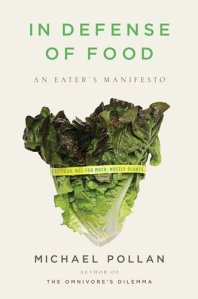
Book Review: In Defense of Food by Michael Pollan

I have finally read this book and in some ways, I’m glad I read it, but in others, I wasn’t blown away by it.  I’m starting to read books about food culture and the ethics revolving around it because my ethics class wanted to discuss the ethics surrounding animals.  I’ve never taught that before so I thought I’d quickly do some research and learn as much as I can.  But I was also hoping to see if I could use some books for the class.

Although this is a good book, I’m not going to use it for my class.  Perhaps if the class topic was concentrated solely around food I would.

In Defense of Food by Michael Pollan

In Defense of Food by Michael Pollan

So what’s this book about?  I can summarize the book in  seven words.  It’s the same seven words that Pollan uses:  Eat Food.  Not too much.  Mostly plants. What does he mean by these simple words?

Pollan starts off by describing the history of the food industry.  Basically, starting in the 1950’s, scientists began to look at food at a microscopic level and understood what vitamins and certain minerals are.  They understood what each vitamin does to each body and how it affects us.  This view is what Pollen calls nutritionism.  Basically, it’s a form of reductionism where the food can be broken down to its barest elements.  So are you sick?  No problem, you’re probably deficient in some sort of mineral.  All ailments can be reduced down to some vitamin or mineral.  Pollen critiques this view.  He says that we cannot eat our food based on what it has.  That’s because each of us are different, and the foods we eat react to each individual.  The scientists study bagels, tomatoes, and cottage cheese.  The problem with this is that we just don’t eat these by themselves.  Sure we eat bagels, but spread some peanut butter and our body will react totally differently.  Indeed, if you study bagel and how it reacts to the body, then study peanut butter and how it reacts to the body.  You can’t combine these two studies because the combination of bagels + peanut butter has a totally different reaction to the body.  It’s the same thing with tomatoes and cottage cheese.  In other words, the sum of the parts is less than the whole thing.  We must look at food holistically instead of reducing it down to its bare elements.

So what does this mean?  Our food science has reduced our foods into the simplest quantities, but they leave out quality.  Whenever we’re deficient in some vitamin, we can say, “No problem.  I’ll just buy some bread that’s fortified with Vitamin C.  That way, I’m getting m vitamin C.  Problem solved.”  The problem with this is that even though you’re getting your Vitamin C, you’re still missing the “stuff” that you would be getting if you ate the orange.  Indeed, Pollan goes on to say that your Sara Lee loaf of bread isn’t actually bread; it’s “bread-like substance.”  Indeed, I’ll agree with him and say that the Go-gurt isn’t really yogurt, but it’s “yogurt-like substance.”  Real yogurt is milk, whey, and cultures.  Thus, this is what Pollan means when he says Eat Food.

What does Pollan mean by Not Too Much?  There’s an interesting paradox that’s happening in France.  People have dubbed it the “French Paradox.”  The paradox is how can Americans be so concerned with being healthy, yet they’re the fattest nation in the world?  At the same time, how can the French eat all of this chocolate, eat foods filled with saturated fat, and drink gallons of wine, yet they are realy healthy?  Pollan looks at various studies and the results are remarkable.  If you went to France and asked them, “when do you stop eating?”  The French answer is, “when I’m full.”  It’s seems like common sense right?  Well, Americans give a different answer.  The answers range from “when my plate is empty,” “when there’s no more seconds,” “when the TV show is over,” “when everyone else has stopped eating.”  Pollan points out that when it comes to food, the food scientists are missing something that can never be reduced to its bare minimum, and that’s food culture.  Americans typically continue to eat in response to the environment; the French eat with internal feelings.  I admit, I’m guilty of this.  When I go to a restaurant with some friends, I order something even though I just recently ate.  When I’m at some gathering, I still eat something from the snack table even though I’m full.  We eat when there’s food around, which could explain our expanding waistlines.  Pollan suggests we must look at our food culture, (perhaps this will eventually become a subject in college?), and this is the key to eating well.

Finally, his last bit of advice: Mostly plants.  Meat, compared to vegetables, has little nutritional quality: protein, iron, and a few vitamins and minerals.  Vegetables and fruits pack in more quality, mainly antioxidents.  Also, it’s because studies show that if your diet consists of mostly red meat, your chances of getting heart disease and cancer are higher.  Thomas Jefferson noted that meat shouldn’t be the main dish of our meals; rather, it should be more like a side dish or a complement to the vegetables.  It’s the vegetables that makes us healthy, not our meats.  This isn’t to say that Pollan is defending vegetarianism, he’s saying that we shouldn’t rely so much on meat.  Finally, he says drink a glass of (red) wine with our meals.

Overall, it’s a good book.  He gives some nice advice in the end about how to shop and what to look for in grocery stores.  He also provides some links which I’ll provide on the blog roll.

CRITICISM: My only problem with this is that I can’t but help but think that Pollan has this idea of, “Wasn’t the good ol’ days the best?  We had good food back then, but now, we’re bombarded with food that really isn’t food.”  Now I’m young, so I can’t compare our foods with the food they had in the 50s, but this seems to be nostalgic.  Perhaps I’m missing something, but Pollan’s arguments seem to be saying, “The days before nutritionism were good food.  We must go back to that time period.”  Now of course, he isn’t saying we should reverse technology, but I’m willing to bet that one can still find good food in our ubiquitous market that is still healthy but what Pollan would consider nonhealthy.  Perhaps someone out there who’s reading this can shed some light onto this.

I really enjoyed his view that food just isn’t a biological thing, but it’s also a cultural thing too.  Maybe one day, our universities will teach food culture as a class.  Until then, I say that if you want to look  at how our food culture and industry has changed within the last 50 years, read this book.  3.5 stars out of 5.

Update 2/22: I’ve mentioned this book from another blog about demi-vegetarianism that relates to other books and issues if you want to check it out.

Posted in Book Review, Culture, Health, Vegetarianism | 11 Comments

Why is Global Warming a political issue?

I can understand why these big issues become political.  I understand why abortion is a political issue.  I get that.  I understand why the war in Iraq is a political issue.  And I can certainly understand why freedom of speech is a political issue.  What I don’t understand is how global warming became a political issue.  Global warming, it seems, is an ecological issue.  Whether it’s true or not, it’s something that’s debated among experts which are the scientists.  So why is this now becoming a political issue?  Why are political pundits talking about it?  I don’t get it.  Liberals are saying it’s true; conservatives are saying it’s being blown out of proportion.  Well, isn’t the best way to settle the issue is to go straight to the experts, namely the scientists who study the global effects?

Please tell me!  Why is this a political issue?

Posted in Ethics, Experts, Global Warming, Politics | 7 Comments