Who’s a Good Pick for VP in the 2008 Election?

Ok, it’s time to get political.  Who would you say is the best VP candidate for the presidential candidates this year?

For the Republicans, I think the best choice that McCain can do is Mitt Romney.  He’s pretty popular in the polls, he’s young which might offset McCain’s old age, he could take some voters in Michigan, and he was governor in Mass. which means he may obtain some votes from that state.  Not much, but he may.  He’s Mormon, so he’ll definitely get the Mormon vote, and he’s had political experience before which will boost McCain’s experience as well.  I think McCain is going to pick him anyways.

For the Democrats, it’s a tough call.  I think the best candidates out there that have really spoken out are Hilary Clinton, Joe Biden, and John Edwards.  An Obama-Clinton ticket is very black and white (no pun intended here): it can be the dream ticket, or it can be the worst ticket.  Clinton is considered very liberal, but this may actually help out because from what I’m hearing, Democrats don’t want to be middle of the road: they want to hold a certain position in the same way as Republicans are holding on to a certain position.  At the same time, however, this may alienate moderate voters and they may go towards McCain.  Clinton would help with the women vote, and if people liked Bill Clinton in the past, then people will see this connection and try to bring the Clintons back to the White House.

Joe Biden is tough.  He’s had many years of experience and so he could definitely help out with Obama’s lack of it.  However, not many people know him outside of the political arena.  He may be a possibility, but I just don’t know what more to say about him.

Edwards would be interesting.  Edwards would help get the Southern vote for Obama.  Edwards is very vocal about health care and I would consider health care one of the big issues for this election.  I know many people are wanting the government to think about it and so Edwards may help out in that direction.  However, with him revealing of the affair, it may be a backlash and people may not want that.  So in the Democratic VP selection, I still say it’s a toss-up.

Posted in 2008 Election, Government, Health, Mormons, Politics | 14 Comments

The Worst of Crimes?

I’m thinking about what is the worst possible thing one can do.  I think there’s a disconnect between acting morally and acting legally.

Legally speaking, the worst that one can do is murder.  Depending on the circumstances, one can get 20 years to the death penalty.  That’s because from a legal perspective, you have taken a life away and that is the worst that can possibly happen.

Another bad action in legal terms is rape.  Rape is not only coercion, but it’s coercion of the worst kind.  It’s a crime that really transforms the victim and it really traumatizes the victim as well.  The consequences could also be disasterous (a pregnancy could come about).

Another bad action in legal terms is any violation of children under sexual means.  This would be child rape, children pornography, and child sexual abuse.  It’s similar to what I said above but it deals with children.  Since children are so maliable, they can hardly recover from these crimes and they live the rest of their lives without their full potential as a human being.  They live out their lives out of tune with the world and it seems almost impossible to lead a normal life again.

So in terms of the law, murder is the worst crime, which follows by rape being really bad, but not as bad as murder.  And then any child crimes are bad.  In the court of law, the people who commit murder usually end up in prison and usually get life in prison.  With sexual crimes against children, it can range to being in prison but hardly does it come down to life in prison.  Usually it’s probation and if there is a prison sentence, they usually can be let out for parole.  In short, the order goes:

Child sex crimes–>bad

Rape–>worse

Murder–>worst

Are there exceptions?  Of course, but I think that in general, this is how the law generally looks at these laws.

I claim that there’s a disconnect between these cases as they are treated legally as opposed to being treated morally.

In terms of murder, I think we would all agree that murder is wrong.  However, I think there are cases where one says to oneself, “man, I really hate that person.  If I could get away with it, I would get rid of that person.” Certain shows are popular that seems to present murder as no big deal: The Sopranos is one example.  We as the audience see this and know that we could never do this in the real world, but I bet if The Sopranos was about sexually abusing a child, that show would never get off the ground.  We often hear people say they would love to kill their worst enemy.  In the obvious case, there are many people that would love to get Osama bin Laden.  On the wanted posters, we often see them portrayed as “Dead or Alive.”  So murder is one of those things that I would consider “understandable but disagreeable.”  It’s something that we don’t want to do, but if provoked, I think many would consider it.

With rape, it gets a bit tricky.  I think in general, people don’t like the thought of raping someone, nor desiring it.  But I bet there are cases where people look at someone who’s attractive and they think to themselves, “if I could have sex with that person through any means necessary without any of the consequences, I would do it.”  Granted, rape usually has to do with displaying power rather than fulfilling sexual desires.  At the same time, I think there would be people who do think like that, but I think people would have the murderous thoughts much more frequently.  As mentioned before, force and coercion is the principle moment.  I think people do coerce people sexually most of the time and think nothing of it.  I’m not talking about violent coercion, but enough subtle coercion and some sort of pressure to “force” the person to have sex with the other person.  It comes to a moment where the victim wakes up the next morning questioning, saying to herself, “was I just raped last night?”  To ask oneself that question means that the lines have been blurred about whether the encounter was consensual or coerced.  But I think people do this sort of coercive sexuality and don’t think anything of it.  But again, I think this is an issue that some people can relate to, others cannot.  When it comes to murder, I think a huge majority can relate to it morally speaking.  Thus, rape is also one of those “understandable but hugely disagreeable” as well.

With regards to sexual crimes with children, this is something that I don’t comprehend.  If I try to imagine having sex with a child, my mind immediately flees away to something else.  I have no desire to think about having sex with a child, I don’t even want to have the desire to have sex with a child.  These are the worst of all crimes morally speaking.  I can’t even think of a way to justify this: it’s too coercive, manipulative, and just plain wrong.  It’s too much for me to comprehend.  I can’t even try to think about it.  In terms of child pornography, I don’t have a desire to look at a child in sexual terms.  It doesn’t fill me with desire; on the contrary, it fills me with disgust and then remorse for thinking why or how a child can be convinced into doing such things.  With these types of crimes, I find them the worst morally and anyone who commits these crimes is someone whom we can never comprehend.  I can understand the person who murders, it’s one of those “understandable but disagreeable” actions.  Rape is harder, but it would still be one of those “understandable but hugely disagreeable” actions.  So in terms of murder and rape, we share some commonality, namely the understandableness behind those actions.  We get it, we comprehend it, but we disagree with it.  Sexual crimes against children, on the other hand, is something that I consider totally “unagreeable.”  Because the person who commits these crimes are “unagreeable,” we will never understand this person.  It’s too “out there” and too much for anyone to try and understand this type of action.  Because we will never understand these types of criminals, maybe they should be locked up and punished even more so than the murderers or the rapists of adults.  (By the way, when I say sexual crimes against children, I’m talking about obvious examples of children, say 9-14 year olds.  I’m not talking about a seventeen year old who’s two weeks away from an eighteenth birthday.)  Since sexual crimes against children are the worst morally, there’s the disconnect.

In short, when it comes to moral actions, the order is:

Murder –> bad

Rape –> worse

Child sex crimes –> worst.

Now if this is true, then actions from a legal point of view is backwards from a moral point of view.  Why the disconnect?

Posted in Ethics, Government, Law, Paper Topic, Politics, Sexuality | 10 Comments

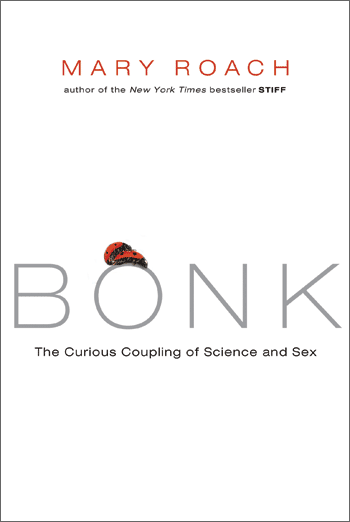
Book Review: Bonk by Mary Roach

I just finished Bonk by Mary Roach and what an interesting look at the technologies of science!  As some of you know, my specialty in philosophy is the philosophy of sex, love, and human relationships.  When I grabbed this book, I was expecting this to be purely scientific, abstract, and looked at from a distance.  The author actually gets involved in the research and takes you through a journey to the interesting (and weird) displays of how sex and science come together.

The author’s involvement was a little distracting at first (I guess because of my expectations) but after a while, I got used to it.  It was fun to read about her misadventures of trying to gain sexual research, being somewhat embarrassed when people found out what she was studying, and we’re learning along the way.

This book is part history, part science, and extremely readable.  However, don’t expect for Roach to discuss the scientific aspects of what goes on in the body during sex (although she discusses a little of it as a side note).  This book is mainly about the eccentric aspect of sexuality: how vibrators got started, studying orgasms by watching pigs (apparently, they’re the only other species that fondles breasts during coition), Masters and Johnson’s penetrating machine, clitoral pumps to cure FSAD (Female Sexual Arousal Disorder), 4-D MRI’s (which I was amazed that Ms. Roach and her husband Ed volunteered to do this study, in the name of science), Da Vinci’s diagrams of the penis (apparently, he was the first to figure out the correct anatomical framework of a penis), insertion of penile rods for paralegic people (that chapter was a little squeemish for me to read), and countless others.

All in all, it’s a fun read.  It’s not academic, but it’ll certainly whet you’re appetite about the synthesis of sex and science.  I should point out that if you’re expecting a straight out scientific outlook of sex, it’s best to go straight to the experts: Masters and Johnson.  Roach’s book seems to talk about the eccentricities of sexuality, but when it comes to the standard stuff, she seems to mention it in passing (or maybe I was just skimming it because it was rephrasing Masters and Johnson and I’m already familiar with it).

All in all, if you’re interested in sexuality in general–and even the eccentric quirks about sexuality–this book is for you.  It’s an easy read and surprisingly bold in some places, (like I said, I cringed during the penile implants, and I raised my eyebrows about the sixtysomething year old women who wanted to try the “Thrillhammer”).  Roach also brings in some humor with it which adds a nice human touch.

Posted in Book Review, Health, Sexuality | 2 Comments

Reparations for Slavery

This is posted at PEA Soup (a site dedicated to philosophy, ethics, and academia).  I will just present the argument here but if read the rest of the comments on the site, it’s interesting what the replies have been towards this argument.

David Boonin, a professor at the University of Colorado, presents an argument in favor of reparations. Now this argument has been around for a while, but this is the first time I’ve seen it presented in a deductive fashion.  Here’s the argument:

(1) The United States federal government (hereafter, the govt) performed unjust, harmful actions pertaining to slavery.
E.g., not only failing to stop slavery but legally protecting and enforcing slave ownership.

(2) These past actions are a cause of certain harms suffered by many present-day black Americans.
E.g., blacks have much lower socioeconomic status, higher rates of incarceration, illegitimacy, and a host of social problems. It’s plausible to think that this is at least partly a consequence of slavery, and of the govt’s unjust slavery-related acts.

(3) If someone performs an unjust action that causes harm to someone else, then the perpetrator normally has an obligation (prima facie) to compensate the victim.

(4) The principle in (3) also applies to organizations such as governments.
E.g., suppose a company illegally buried some toxic waste in a populated area 40 years ago, and the waste is now causing current residents to suffer from cancer. Then the company would owe compensation to the current residents, even if the leadership of the company has changed during the last 40 years. A similar point applies to governments. (This case also illustrates that the victims of the unjust action need not have existed at the time of the action.)

(5) So it looks like the govt owes compensation to present-day black Americans, for its earlier slavery-related actions.

This is just a simple argument, but for the full reading of the argument, you can check out Boonin’s website on the book.

What do you think?

I’m still unsure when it comes to the reparations aspect, but I’ll explain it when the comments come in.

Also, I’m sure that people are going to be against it, but I’d like to see which part you find suspect.  In other words, which premise do you question?

Posted in Economics, Ethics, Government, Politics, Race | Tagged , , , , | 4 Comments

Teaching Methods

Some professors–particularly where the subject is open to interpretation like philosophy, humanities, ethics, or literature–push their views onto students.  I’ve also read that doing so helps the students to think for themselves because if the teachers pushes a viewpoint that the student disagrees with, then this forces the student to think.

Perhaps I’m the minority and but I don’t like that type of teaching.  The problem with that is what if the students agree with the teacher?  Then the students aren’t thinking, they’re just agreeing with a teacher.  That’s not learning!

When I teach philosophy for example, I explain what a particular philosopher said and then I defend it in class because I know there’s bound to be some students that will disagree with the philosopher.  So everyday, I’m defending a new position because each new philosopher has something different to say.

In ethics, I’m more critical.  I start off by explaining what the article is about, then I open it to the floor and let the students discuss whether the ideas in the article has merit.  It can get to really interesting discussions because there’s bound to be disagreements.  On those rare occasions where everyone agrees (or disagrees) with the article, I spice it up by playing Devil’s Advocate and it makes them think.

It’s funny because I’ve had many students come up to me at the end of the semester and they thought that I was biased towards a pro-choice position on abortion (we usually start off with a pro-choice article) and then the next day, we read a pro-life position and I defend that (or at least explain what the author’s getting at).

To me, the best teacher isn’t one pushing his/her philosophical or ethical ideas onto the students.  The best teacher is one who explains the ideas, let’s the students figure out what they believe themselves, and the teacher’s role from there is to push the students into why they have these beliefs.  The teacher should start off as non-biased.  Is it hard to do?  Yes!  There have been times where I really wanted to say why this article is wrong, but I try my hardest not to let my bias show.  I don’t know if it’s successful or not, but I believe that is the best teaching method.

I’ve had both types of teachers.  One of my teachers was teaching religion and he definitely had an agenda which made the class miserable.  My other teacher who teaches religion and theology took the non-biased approach and for the longest time, I thought he was an atheist (or at least an agnostic).  It turns out he was a believer.  I was amazed at that teaching skill!  He made me think more about religion and theology than anyone and I really worked hard on my religion papers as an undergrad.

To me, a non-pushing agenda teaching method is the best.  However, I’m sure some of you had the other kind.  Which type of teaching did you like best?  Which made you learn more?

Posted in Teaching | Tagged | 10 Comments

Experts and Economics

Why do we trust experts?  I think the obvious answer is that it helps us live our lives practically.  We trust the doctor’s advice on medicine because we don’t have the time or the knowledge to know which medicines to take.  We don’t have time or the energy to check to see if the doctor has got it right.  Thus, we say that a degree is enough to constitute an expert in that field.  We put our trust in experts because they are seen as knowledgeable in that field.  Thus, we go about our lives putting trust in these experts and we have no reason to doubt them (unless something’s fishy).  This works not just in medicine, but in other fields like law, engineering, science, computers, food, and countless others–including philosophy.  Even ideas are given to experts and if there’s something wrong with the idea, then we scrutinize it, critique it, and demur it to make sure that it’s on the right path.  Now we don’t just doubt everything that’s given to us.  But the point here is that trust is the important key element.  We trust these experts because without experts, there would be no progress and we would spend the majority of our lives figuring out if these other people did their job correctly rather than living out our own lives doing our own specialty.

Many of you know that I mainly listen to lectures on my mp3 player.  I usually listen to The Teaching Company.  I highly recommend getting them.  They’re a bit pricey, but I don’t know any library that doesn’t have them.  I have learned a lot since listening to them and it has certainly increased my knowledge of the world.  The last lecture I listened to was Modern Economic Issues.  I can’t stand economics!  I tried to take some classes in college, I really did but I just found it so boring.  Yes, I understand that economics is something important to know.  That’s why I wanted to listen to this lecture so that I can actually learn about it.  At first, my expectations were pretty low.  I thought I’d be extremely bored with it.  I thought I had to concentrate harder just to understand the material.  To my surprise, I actually liked it.  It’s made me gain a new economics perspective.  So what does this have to do with experts?  The last lecture dealt with how to be happy and tying it up with economics.  However, I was actually more intrigued with what the lecturer said about how professional economists recommend something, yet the public is ambivalent to do so.  Alan Blinder states that, “Economists have the least influence on policy where they know the most and are most agreed; they have the most influence on policy where they know the least and disagree most vehemently.”  So here’s what I’m getting at.  These professional economists are experts.  They know the field more than anyone and so it seems logical to put their trust into these people economically in order for us to progress and have better lives.  So what issues were they?

1.  Get rid of the penny: There is a consensus among economists for many years to get rid of the penny.  The reason is because Americans don’t find value in it anymore.  (We often tell the clerk that they can keep the penny, and there are pennies in the little compartment next to the cash register virtually everywhere.)  Also, zinc makes up the majority to make the penny but the US Treasury says that zinc is getting so expensive that to make a penny costs more than what it’s worth.  It costs more then one cent to make one cent, in other words.

2.  Let bodily organs be open to the market: In 2007, about 97,000 patients waited for kidney transplants.  Because the demand for these kidneys are so high, 70% of the patients will die just for waiting for a viable donor.  The average wait time for a kidney is three years.  Our economic system is based on supply and demand.  We obviously can’t lower the demand for new kidneys (unless there’s some miracle that would cure these kidney disease), so the other option is to raise the supply.  Now we do have people that donate their kidneys.  But think about it, would you donate your kidney?  Even though it’s a kind gesture, I’m sure most of you are thinking “no.”  So the only incentive to donate your kidney is pure altruism.  However, what if you donated your kidney for $10,000?  (This is just a number I made up.)  I think most of you would probably think about that option for a while.  70% of professional economists think this is a good idea.

3.  Limit Subsidies to Sports Arenas: People say (or perhaps think) that having a sports arena will actually increase the local economy because it’s a nice tourist attraction and it puts the city on the map, it will have a multiplier effect where the economy will grow.  However, professional economists are suspicious of these arguments.  A study shows from 36 cities that have sports arenas and 12 other cities that don’t.  There was no personal income growth for the cities that had the sports arenas.  Another study shows that new stadiums and sports franchises actually reduce per capita income a bit in these cities.  This is because the players, owners, and coaches–who receive the most money–don’t actually spend the money in that city.  Thus, the economy won’t go up that much because they’re spending it elsewhere.  85% of professional economists agreed to limit subsidies to sports arenas.

So what gives?  These are experts.  They are supposed to know their stuff, but it seems that the public doesn’t want to follow this advice.  Any reason for that?  Or are we just too stubborn?

Posted in Economics | Tagged | 8 Comments

Banning Trans Fats in California

Last Friday, Gov. Arnold Schwarzenegger signed a bill to make California the first state to ban trans fats from all restaurants and bakeries.  This would affect about 88,000 food outlets.  Last October, he also signed a bill banning trans fats from the public schools.  It will be phased in California by 2010.

Trans fats are the partially hydrogenated oils that extend the shelf life of products, its what gives fast food that crisp and flavorful taste. Experts say just a 2 percent increase of trans fat intake can result in a 25 percent increase in the likelihood of developing coronary artery disease—a condition that can lead to sudden cardiac arrest and death.  It’s the worst kind of fat.

I, myself, won’t buy anything that has trans fat in it.  Even if it has a small ounce of it, I won’t buy it.  So what’s the philosophy behind this?  Well, I have mixed feelings about this ban.  The purpose of government is to (a) protect other people from doing harm to other people–basically making sure that people don’t infringe on other people’s rights (if you want to use rights terminology), and (b) making sure that society progresses, or at the very least, doesn’t regress.  Unfortunately, these two purposes can come into conflict.  So what about the trans fat ban?  It seems that it violates principle (a).  As long as the individual is doing it to him/herself, the government cannot intervene.  After all, if we have to look out for people’s health, why not ban smoking?  This is where it gets sticky.  Part of a corollary in part (b) is that people aren’t educated in some areas, thus the government has to look out for these people.  An example is that people need an education.  Thus, it’s law that you must go to school and become educated because it benefits society regardless if you want it or not.

It’s an interesting issue, but I found some pros and cons with this ban:

PROS:

  1. Society will be healthier: Ok, so with people not consuming trans fat, perhaps our obesity problem will shrink and can become a healthier society.  Sounds like a good deal.  However, we have to admit that trans fit isn’t the only problem to obesity, overeating is definitely a major contribution.
  2. It’s cheaper in the end: How so?  A recent study in Health Affairs finds that annual medical spending in the late 1990s was about $732 higher for obese adults than for those in the healthy range, estimating that obesity’s medical costs reach about $35 to $62 billion per year in year 2007 dollars.  Also, by law, insurers providing group health plans have almost no leeway to individualize insurance rates based on differences in risk factors like obesity; thus, if an obese person (spending an extra $732 annually) joins an insurance pool covering 732 people, each member will see their insurance rate rise by $1.00 unless the employer makes another adjustment.  Obesity reduces some workers’ productivity, as it is associated with higher rates of absenteeism and disability leave.  And many studies have found that heavier women are especially likely to have less economic success and to have husbands who earn less.
  3. It seems to work in other places: Advertising regulations seem to have real potential. Shin-Yi Chou, Inas Rashad, and Michael Grossman (they are professional economists) find that a ban on fast-food restaurant ads reduces the number of overweight children and adolescents by 10% to 12%.

Cons:

  1. Why not ban smoking if we’re going to be consistent? The reason for this ban is so that the citizens will become healthier.  But if we’re going to be consistent with our reasoning, then why not ban smoking as well?
  2. Couldn’t education be a better substitute? We’ve all learned as children that smoking is bad and unhealthy, but we’ve never really learned about eating healthy or these different kinds of fats in school.  I didn’t learn about them until I was in college and that was because another student told me about them.  After that, I started researching on my own.  Have a class in public education that deals with food and eating healthy.  Increase our physical education classes.  Make people more aware of what they’re eating and drinking.
  3. Doesn’t this seem to violate individual autonomy? Can’t people have a choice on what to eat?  So they learn about trans fats and proper diet, but they still eat it out of their own choice.  Why should the government have a say on what we should or shouldn’t eat?

These are the ideas I’ve thought up.  Anything else we want to add to the list?  What are the overall assessments?  Do you agree with the ban?

Posted in Economics, Ethics, Government, Health | Tagged , , | 5 Comments

“Herd” Believers

When it comes to faith and religion, I agree mainly with Kierkegaard (as was stated in my previous post) but I also agree with Nietzsche as well.  The way I see it, there are three different types of people when it comes to faith and religion:

  1. Practicing believers: these people genuinely believe and they consider serving God as the basis of their lives.  Indeed, God is the meaning in their life.
  2. Non-practicing, non-believers: these people hold on to a religion but for cultural or traditional purposes.  A good example of this are the Jews.  I myself have relatives that were part of the pioneers with the Mormons, and so I find myself within that heritage, but I myself don’t believe in the Mormon Doctrine but I don’t condemn them either.  Also, these people may do religious things not because they believe, but because it’s part of their culture.  For example, my relatives come from Vietnam and they’ll do “Buddhist” rituals, but no one understands Buddhism.  They just do it because it’s part of their tradition.
  3. Non-practicing believers: People who genuinely believe but do not practice.  This is just a guess, but I would imagine this is the majority of religious people (at least in the US).  So they believe in the doctrines of the religion (which includes sins and religious duties), yet they fail to perform this duty.  However, they don’t consider themselves to be sinners, they don’t repent, nor do they find anything that they did wrong even though their religion says it is wrong.

So here’s what I don’t get: I honestly don’t understand how people in number three can do this. How is it possible to believe in something, like God, yet continue to act and think as if there is no God, for example?

Posted in Epistemology, Paper Topic, Religion | Tagged , | 6 Comments

The Dark Knight and the State of Nature

I saw The Dark Knight in theaters last night and it was pretty good.  What really struck me was that each of the main characters took on a different position of each different philosopher.

To start, the Joker was all about Chaos.  He structures mankind so that they will inevitably destroy themselves.  I won’t give away the details of the movie, but the Joker sets up a situation where two sets of people have a choice to destroy the other group of people.  And so you would think, “I’d rather kill them because if they don’t, then they can kill me.”  Indeed, the ending really surprised me because I expected one set of people to do something.  Batman tells the Joker that it’s because of the goodness of people.  The Joker replies, “you really are incorrigible Batman.  The reason they are good is because they havn’t been pushed hard enough.  All they need is one push.”  This push will change any person from good to evil.  But I think the Joker’s main point is that it’s not a simple push to become evil.  I think being evil, selfish, and desire for power is easy.  Trying to be good and helpful actually requires work.  In the state of nature theory, this resembles Hobbes.  Hobbes asks, “what would happen if there was no government?”  Or more precisely, “what was the situation like before there was a government?”  I ask my students this and the answer is always the same: chaos, anarchy, everyone is looking for themselves.  Then I ask them this: “and what does that tell you about human nature?”  The Joker is Hobbesian, but a more sadistic version because he is always pointing out that we are naturally selfish, cruel, and perhaps evil.

Batman is the hero; he is considered the good person.  Indeed, his reply to the Joker is that people are naturally good.  The reason why people become bad is because of perhaps environmental reasons.  This resembles Rousseau.  Rousseau says that before there was a government, we were actually good people; we were the “noble savages.”  We didn’t naturally go out and pick a fight.  Nature was full of abundance and so we just happily go our merry way and don’t get in each other’s way.  According to Rousseau, society has messed us up.  For example, in nature, we naturally just seek shelter.  In society though, we are taught that the bigger the house, the better.  In nature, we just naturally just want clothes to keep ourselves warm.  In society, we are taught to get the best clothes and the more expensive or fashionable it is, the better.  Society has kept us aloof and has made us out of touch with our real selves.  This could possibly be the reason why Batman doesn’t really hang out in society; he’s always hiding and only gets involved in society when there’s trouble.

Everyone was raving how great Heath Ledger’s performance was.  It was actually a good performance, but I was actually more impressed with Aaron Eckheart’s performance.  To me, the most interesting character in the movie was Harvey Dent/Two-Face.  As Harvey Dent, he was the hero of Gotham by fighting crime, locking up criminals, and ridding the streets of mobsters.  He lived by rules and the law.  Rules and laws were there to establish justice.  As Two-Face however, he only thinks of himself and it doesn’t matter who gets in the way.  If getting rid of that person helps him achieve his goal, so be it.  Rule and laws don’t apply to Two-Face.  Instead, it’s chance.  This is why he uses the coin toss: his philosophy is randomness and chance.  That’s his view of justice.  To me, this resembles John Locke.  According to Locke, we aren’t naturally evil or naturally good, we are naturally. . . well, neutral.  However, we are rational creatures.  Living in the state of nature, we all end up like Two-Face because people can still break the laws of nature because there’s no incentive to keep the rules.  Indeed, we are aloud to have retributive justice in the state of nature for Locke.  When we enter society however, we live by rules and laws: we become Harvey Dent.  And with that, we give up our right to retribution when we enter society and give up this right to a judge.

So in a sense, there are three alternate ways of looking at the world.  The Joker/Hobbes pushes the civilized Harvey Dent/Locke into a state of nature Two-Face/pre-Locke.  Batman still believes that everyone is naturally good, he just needs to get to Two-Face and “convert” him back to Harvey Dent.

What makes it change in the end is that I think the Joker got to Batman.  At the very end, the community needs a hero and so Batman must let everyone believe that a certain person (I won’t tell so that I won’t give away the movie) is the hero.  If the community doesn’t believe it, then society will turn into chaos.  But wait a minute, Batman can’t believe that because he originally thought that people were all good.  But the Joker got to him: people can easily change to evil just by a simple push.  The Joker is lurking within us all and sometimes it’s screaming to get out–a simple push, if you will–or perhaps it’s buried so deep that people don’t have it.

You can see this with people you see on the street: a slightest thing can piss them off, or perhaps it doesn’t phase them at all.

Posted in Politics | 6 Comments

US is falling on Development Index + Economics and Religion

We are living shorter lives, spend the most on health care than on any other nation, and a 25% of 15 year olds are at or below math skills internationally.  The article is here.

The shorter life span has to do with the obesity rates which doesn’t surprise me.  Interestingly enough, the shortest life spans are in the south: Mississippi is rated the lowest in the United States whereas Connecticut is rated the highest.

I won’t even pretend to offer any solutions because it’s too complex.  But it is something to ponder about.

Another thing: I’ve been listening to lectures on tape and these lectures deal with economics.  There was an interesting statistic: the higher the gdp (Gross Domestic Product) in the country, the less likely the country will be religious.  France, Germany, Japan, and England have high gdp’s, yet they are usually rated low on religiousity.  Brazil, Afghanistan, other Middle Eastern Countries and a few South American countries have a low gdp, yet they have a high religiousity.  This correlates with every country–with the exception of one: the USA.  We have a high gdp and a high religiousity rate.  Interesting stuff.

Posted in Economics, Health | Tagged , | 16 Comments