Let’s See What’s in the News Today (Aug. 11, 2013)

Art

  • Touching Strangers is an art project where total strangers embrace each other as if they knew each other, but they are total strangers.

Economics

Fashion

Justice

  • Wanna donate to charity but aren’t sure which charity is the best, or the most efficient?  Check out Maximin.org.  It’s a website that looks throughout the world and using statistics and maps, it shows the most impoverished areas and which charity would be the most beneficial.  Interestingly, the site was created by a philosophy professor.  It’s still in the beginning stages, but it looks promising.
  • The USA is not a police state.  Saying that it is undermines real police states.  A lot of comments on this one.

Natalism

Philosophy

Relationships

Science

  • Check out these trees around the Chernobyl incident.  You can tell when the incident happened too.
  • Don’t know if this counts as science, but a researcher has claimed that there’s a link between wealth and, well, being an asshole:

Sexuality

Posted in Aesthetics, Anti-Natalism, Economics, News, Polyamory, Relationships, Sexuality | Tagged , , , , | Leave a comment

Book Review: Sex at Dawn by Christopher Ryan and Cacilda Jethá

Not my image.

I’ve wanted to read this book for a while, but it was always at the back burner.  However, a friend recommended this to me and so I quickly read this.  I’ve now read it twice.  Most of it was interesting and the authors present a radical thesis: early humans used to be promiscuous and nonmonogamous, much like our evolutionary cousins, the bonobos.  However, what ruined this lifestyle was agriculture.  They even have a website for more updates and contact info.  I’m glad that I’ve read the book, and I’ll be teaching a few chapters of this to my class.  It’s worth the read for its provocative thesis and their arguments for it.  However, I’m not fully convinced of their justification.  The book breaks up into five parts, but for simplicity, I’ll break it into three parts.

I. Questioning the Standard Narrative

We are relatives to the great apes: chimpanzees, bonobos, gorillas, orangutans, and the “lesser ape” gibbons.  Our closest relatives are the chimps and bonobos.  Chimps and bonobos are the most hypersexual of the great apes.  And since we are closely related to them, we also share this hypersexual tendency as well.  Before agriculture, everything our hunter-gatherer ancestors was shared—including sex.  We can still see this with chimps and bonobos.  In terms of humans, our consumption of pornography and our difficulties with long-term monogamy should give a clue.  Indeed, the authors contend that both humans and bonobos find nonreproductive sex “natural.”  What makes this funny is that “we look to chimps and bonobos for important clues [about our evolutionary development]: language, tool use, political alliances, war, reconciliation, altruism…but when it comes to sex, we prudishly turn away from these models to the distantly related antisocial, low-I.Q. but monogamous gibbon?  Really?” (p. 246)  A huge majority of animals only have reproductive sex.  Humans have recreational sex.  Thus, when the claim suggests that we are like animals.  This isn’t true.  We are far more hornier and have sex much more often then the animals.

The standard narrative is thus: men and women are monogamous to each other, but they secretly try to find other partners.  Thus, there is a sexual contract with an economic game theory where there is a desire to cheat but they don’t because of the risks.  However, sometimes they take the risk and try not to get caught (women are much better at this).  Why?  For the men, it’s to spread his seed and father many children as he can.  His genetic material is spread out.  For women, she wants a relationship with a settled man, but she wants to have a child that is very manly and rugged.  Thus, she sleeps with rugged men, but comes home to the nice guy because this nice guy gives her resources and protection.  Studies have even shown that during her most fertile moments, she makes herself more attractive and finds more rugged men more attractive.  These dark secrets that men and women keep from their spouses seem to make each other miserable.

Another feature of the narrative is that men share their food and resources with the women, and in return, the women gives her sexuality to the men.  So women are trading their sex for stuff.  The authors argue that this narrative didn’t enter into human consciousness until agriculture came about, which was about 10,000 years ago.  Furthermore, there are too many contradictions behind this narrative:

  1. Females are and are not sexual creatures.  Just quoting from the book itself: “[D]espite repeated assurances that women aren’t particularly sexual creatures, in cultures around the world men have gone to extraordinary lengths to control female libido: female genital mutilation, head-to-toe chadors, medieval witch burnings, chastity belts, suffocating corsets, muttered insults about ‘insatiable’ whores, pathologizing, paternalistic medical diagnoses of nymphomania or hysteria, the debilitating scorn heaped on any female who chooses to be generous with her sexuality…all parts of a worldwide campaign to keep the supposedly low-key female libido under control.  Why the electrified high-security razor-wire fence to contain a kitty cat?” (p. 39)
  2. Men and women love each other and mutually exploit each other.  Again, quoting from the book: “Conventional evolutionary theory assures us that all you scheming, gold-digging women reading this are evolved to trick a trusting yet boring guy into marrying you, only to then spray on a bunch of perfume and run down to the local singles club to try and get pregnant by some unshaven Neanderthal as soon as hubby falls asleep on the couch.  How could you?  But before male readers start feeling superior, remember that according to the same narrative, you evolved to woo and marry some innocent young beauty with empty promises of undying love, fake Rolex prominent on your wrist, get her pregnant ASAP, then start “working late” with as many secretaries as you can manage.  Nothing to be proud of, mister” (p. 58).
  3. Females have hidden fertility in order to reassure and confuse males.  With other animals, they go into heat and the male sex can tell that it is time for sex.  With humans, however, females have concealed ovulation and they can have sex any time.  This is also true of bonobos.  Recall that part of the narrative is that women aren’t interested in sex.  If so, then why did she evolve to have this sexual capacity?  Helen Fisher’s explanation is that since her fertility was hidden, he would have to stick around just to make sure that her progeny was also his, making sure that no other males mated with her.  However, Sara Hrdy suggests that this sexual feature wasn’t to reassure males, but to confuse them.  The female would have sex with many males so that none of them could be sure which one was the true parent.  Fisher’s model may work but only if the male was interested in having sex with one female, which already contradicts the standard model.
  4. One should be jealous of any infidelity because the parents don’t share DNA with the offspring, yet any infidelity with anybody related to the parents is off limits too.  The standard narrative suggests that jealousy would come about if there was any infidelity.  This is because it has an evolutionary advantage.  If there is any infidelity, then the offspring don’t share the same DNA with the original parents.  Thus, according to the standard narrative, jealously is a natural thing.  However, “if it’s a question of genes, a man should be far less concerned about his wife having sex with his brothers–who share half his genes–than with unrelated males.  Gentlemen, would you be far less upset to find your wife in bed with your brother than with a total stranger?  Ladies, would you prefer your husband have an affair with your sister?  Didn’t think so” (p. 141).  Indeed, I recall Shakespeare’s Hamlet where Hamlet’s father died and so his uncle married his mother, which no one was bothered by.  Of course, Hamlet was bothered by his uncle, but not because it was his uncle being with his mother, but because of the intricacies of his uncle killing his father.  Even within 600 years, relations of one parent marrying a relative of the spouse was normal, whereas by today’s standards, it’s not.  This suggests that jealously isn’t natural, but cultural.

Not only is it rationally unsound, but there are empirical examples to suggest that the standard narrative is false.  Many tribes and cultures have a promiscuous attitude about sex where jealousy isn’t there.  Indeed, the men in these cultures are more bound to one another because of a shared paternity.  There are some cultures where not only is adultery mandatory, but one has a moral duty to respond to these sexual advances, whether one is married or not.  There is another tribe where the see the growth of the fetus as accumulated semen from many men.  The more men the women has sex with, the stronger the fetus will be.  The Romans celebrated a marriage with a wedding orgy where the husband’s friends has sex with the bride.  The Mosuo don’t have a language for “husband” or “wife.”  Indeed, we consider any infidelity with shame.  The Mosuo consider fidelity with shame.  Vows of fidelity is considered inappropriate, so is jealousy.

Speaking of jealousy, this is not a natural emotion; rather it’s cultural.  We learn how to express emotions and when it’s proper to express them and what should be expressed.  It’s a social phenomenon.  Indeed, jealousy toward a possible sexual partner has been a major obsession.  When it comes to having many children or many things, we find no problem.  “We seem to manage [love] with parental love…, love of books, of food, of wine…, love of composers, poets, holiday beaches, friends…why is erotic love the one exception that everybody instantly acknowledges without even thinking about it?” (p. 148)

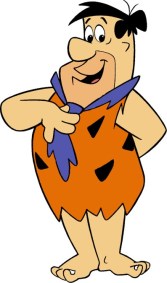
Thus, the standard narrative already claims that both males and females deceive each other and that we are by nature liars and cheaters to our partners.  This, says the authors, is a mistaken narrative and should be challenged.  This is how things are currently but not what it was back then.  Indeed, to project any sort of current experiences and cultural proclivities into our prehistory is what the authors call “Flintstonization.”

Not my image.

The other assumption is a neo-Hobbesian account of human nature: everyone is out for themselves and any sort of shared cooperation makes one the loser in any economic game theory.  After all, to have the offspring survive assumes this neo-Hobbesian outlook because the offspring survives through assured paternity and resources for the offspring.  The father knows that it’s his offspring; the mother gains protection and resources from the father.

Again, the authors contend that this assumption is a mistake.  We are assuming that our current conception of what the family is all about is a universal aspect of human nature.  Again, this is Flintstonization.  What if instead of each this every-man-for-himself narrative, there was a general sharing?  What if there was a group-wide sharing, which would offer more protection and have a much more effective way to mitigate the risks?  Indeed, what if paternity uncertainty actually helped the child, because all the men would share in parenting instead of just one?  Indeed, egalitarianism is found in nearly all hunter-gatherers.  This wasn’t because it was moral or noble, but it was because this generalized sharing was the most effective way to survive.  Thus, “the standard narrative is exposed as contemporary moralistic bias packaged to look like science and then projected upon the distant screen of prehistory, rationalizing the present while obscuring the past” (p. 149).

Women actually had as much access to food, protection, and social support as men did.  But then came the advent of agriculture and then women had to barter their reproductive capacity to have access to resources and protection.  Now, all of the sudden, women were seen as the lesser of the sexes.

The authors contend that we are mostly related to chimps and bonobos.  Indeed, we are equidistant from both of them.  So how to chimps and bonobos look at sex?  Chimps use violence to get sex; bonobos use sex to avoid violence.  Chimps have a very aggressive and hierarchical order where the dominant males take control of the food.  Thus, there’s much more aggression, warfare, rape, infanticide, and a Hobbesian type of nature.  With bonobos, it’s female centered.  There has never been a murder, rape, or infanticide since people have been studying bonobos.

Now when it comes to sexuality, humans are closer to bonobos.  Bonobos have sex face to face, they tongue kiss, they can look into each other’s eyes.

OBJECTION: How do you know?  Throughout the book where the authors mention how agriculture messed things up, they don’t offer much linkage.  There are nice graphs and quotes, but nothing concrete in terms of evidence.  They seem to extrapolating a lot by suggesting that by being related to the bonobos, we must be life them too.  If we are relatives to both chimps and bonobos, and chimps are more like Hobbesian creatures whereas bonobos are more like Rousseauian creatures, why lump humans closer to the bonobos, at least in terms of their sexuality?  Overall, I see the argument as such:
1.  We are related to species x.
2.  Species x does activity S.
3.  Therefore, We are more inclined to do S.

II. The Anatomical Evidence

It is here that the authors give 12 bits of evidence:

  1. Body-size dimorphism
  2. Sperm competition
  3. Testicle size
  4. Penis size
  5. Pornographic visualization
  6. Shape of the penis creates a vacuum in the female’s reproductive tract
  7. Growing infertility among males
  8. Time length for each sex to reach orgasm
  9. Female Copulatory Vocalization
  10. Genital Echo Theory
  11. Female’s body can reject sperm, even if the female is attracted to the male
  12. The structure of the cervix

With body-size dimorphism, it has been correlated with male competition with mating.  The bigger the dimorphism, the stronger the competition.  In the great apes, gorillas have the strongest dimorphism (males are about twice the size as females) whereas gibbons are virtually identical in size.  For humans, males are about 10-20% bigger.  Oh, and guess who else has a similar body-size dimorphism?  That’s right, our promiscuous cousins chimps and bonobos.

With sperm competition, if there is sperm of more than one male in the reproductive tract of the female, then the spermatoza themselves compete within the vaginal tract to fertilize the ovum.  Part of the sperm competition is that the first spurt contains chemicals to protect any other chemical attack such as chemicals from other mens’ sperm.  The final spurts contain a spermicidal substance to slow down later sperm that might come in.  Along with this, studies have shown that a man’s sperm production increases when he hasn’t seen his partner in a few days, regardless if he’s ejaculated during the absence.  Thus, that absence could’ve been an opportunity for the partner to see someone else.  Nature has equipped men to increase the sperm production just in case the partner was seeing someone else.

With testicle size, “[m]ales apes living in multimale social groups (such as chimps, bonobos, and humans) have larger testes, housed in an external scrotum, mature later than females, and produce larger volumes of ejaculate containing greater concentrations of sperm cells than primates in which females normally mate with only one male per cycle (such as gorillas, gibbons, and orangutans).  The theory behind this is that the more one has sex, the larger the testes will be.  And if there are several males with a lot of sperm competition to one ovulating female, they’ll need even bigger testes.  For monogamous apes (e.g. gorillas, orangutans, gibbons), the males have smaller testes.  This also happens with birds, butterflies, reptiles, and fish.  We have more sperm-producing tissue than any monogamous or even any polygynous primate would need.  It’s as if we were built to be promiscuous.

With penis size, it’s also correlated with promiscuity.  To have the sperm be delivered to the ovum, the longer and thicker the penis needs to be.  Indeed, out of all the great apes, humans have the longest and thickest penises.  Gorillas, since they keep a harem of females only have an inch long penis with testes the size of kidney beans, which are tucked up inside the body.  The promiscuous bonobo has a three inch penis with testicles the size of chicken eggs.  Humans are somewhere in between in terms of testicle size.  To have an illustration of this, go here.

OBJECTION: I can understand the length of the penis, but why thickness?  How is that an evolutionary advantage, especially with being promiscuous?  Unfortunately, the authors don’t talk about it.  However, this could just be a side-note.

With pornography, heterosexual men get really turned on where there are groups of guys having sex with one women.  Why?  The authors suggest it’s because this is the best environment where sperm competition is at play.  I was skeptical at first, but there is empirical studies that suggest multiple-men-one-girl porn is far more popular than one-man-multiple-women porn.

The shape of the penis is to create a vacuum in female’s reproductive tract, this vacuum pulls out any previous deposited semen away.  It’s as if the penis was a plunger to pull out other fluids, including other sperm.  And as soon as the man ejaculates, the head of the penis shrinks so that the suction of the vacuum isn’t in effect.

With growing infertility among males, infertility can be passed on.  If you have an infertile man vs. a fertile man, no doubt the fertile man is going to win in the sperm competition.  Infertile men wouldn’t have fathered any children under promiscuous species.  But because our culture has been brought up with monogamy as the norm, there are no fertile men to win out the infertile men; there’s no sperm competition.  Eventually, when the infertile men does impregnate a women, genes with reduced fertility won’t be reduced from the gene pool.  Thus, “sexual monogamy permits fertility-reducing mutations to proliferate, causing testicular diminishments that would never have lasted among our nonmonogamous ancestors” (p. 239).  In other words, monogamy has made males’s sperm weaker.  Infertility seems to be a growing phenomenon as well.  It could be that sexual monogamy may be a significant factor in contemporary infertility that we’re seeing today.  More than that, imposed monogamy may help explain why men’s testicle size has gotten smaller than the chimp and the bonobos.  In short, “[s]exual monogamy itself may be shrinking men’s balls” (p. 240).  As a related issue, monogamy seems to have drained away testosterone.  Married men show lower levels of testosterone than single men.  Fathers of young children have even less.

With time length for each sex to reach orgasm, it seems odd that if we are truly monogamous by nature, then why is it that men generally reach orgasm quicker than females do?  Yes, there are “mixed strategies,” but this gets us back to the standard narrative.  Instead, there is one other possible scenario on why humans evolved like this. It seems that when a man ejaculates, he’s done but the woman is just getting started.  Thus, another man can enter the picture and the woman can presume toward orgasm and more sperm, hence having sperm competition.  Indeed, female humans aren’t the only species to have orgasms.  Gibbons, the monogamous ape, do not have obvious signs of female orgasms.  Indeed, “[i]t’s worth repeating that primate species with orgasmic females tend to be promiscuous” (p. 268).  Now listen to that: orgasms are clues that we were promiscuous.

With female copulatory vocalization, when it comes to hearing people having sex, it’s typically the female that we hear.  Why is that?  If sex is considered a private matter, why do we hear the moans of other people having sex (especially the female)?  The authors contend that it doesn’t make sense for the female to call attention to herself during sex.  Other primates, do the same and this calls other males to come forward.  Hence, this call is a potential invitation for other males to come to this female.  It’s as if the female is saying, “Hey, I’m having sex right now.  Anyone who can hear me can join in?”  Thus provoking sperm competition.  These calls are hardly in monogamous or polygynous species.

OBJECTION:  I’m extremely skeptical with this bit of evidence.  It seems that a woman’s call during sex isn’t meant for other people to hear; rather, it’s for her partner.  The call is a way for the man to get aroused quicker and easier so that he can ejaculate.  The side-effect of this call is that other people hear it.  The authors seems to have this backwards.  Moreover, bonobos and chimps function in a hierarchical relationship where there are alpha males and alpha females.  Suppose a beta female was with an alpha male.  Couldn’t the call be more about bragging rather than calling more males to come forward?

With genital echo theory, it seems odd that female humans have breasts as soon as they hit puberty.  Other primates don’t develop breasts unless they’re nursing.  It seems that having breasts constantly would be a huge evolutionary disadvantage.  So why have them?  Going back a bit, early primates walked on all fours usually and their buttocks were the spot that aroused males.  However, when humans started walking upright, they couldn’t see the full range of the buttocks that well, so they needed to look at something else that resembled buttocks.  Genital echo theory suggests that as soon humans started walking upright, females developed breasts because the cleavage resembles the buttocks. This is why males are more attracted to a bigger bust, even though breast feeding has nothing to do with breast size.  Sounds good.  But why always?  Recall that human females have a hidden fertility.  Thus, “[a]s the human female is potentially always sexually receptive, her breasts are more or less always swollen, from sexual maturity on” (p. 261).

[T]he female’s body can reject sperm, even if the female is attracted to the male, the female may not be the best judge of the best potential contributer to her offspring.  This is why 35% of females reject sperm by perceiving them as antigens and the female can produce anti-sperm leucocytes.  At the same time, part of the women’s body can assist other sperm.  This suggests that the female reproductive system is capable of making some sort of judgment based on the chemical signature of men’s sperm.  Not every ‘high quality’ male would be a good match for any specific woman–even on a purely biological level.  Because of the complexities of how the two sets of parental DNA interact in fertilization, a man who appears to be of superior mate value (square jaw, symmetrical body, good job, firm handshake, Platinum AMEX card) may in fact be a poor genetic match for a particular woman.  So, a woman (and ultimately, her child) may benefit by ‘sampling many males’ and letting her body decide whose sperm fertilizes her.  Her body, in other words, might be better informed than her conscious mind.

Thus, paternity wasn’t dictated by external factors; rather, it was determined by the inner world of the female reproductive tract and every women has certain mechanisms to choose a potential father at the cellular level.  It’s as if the cervix is a filtering device for sperm, which suggests that it had evolved from a promiscuous ancestry.

III. The Upshot

Usually, the end of the book has an extremely generalized take on what we now know and what can we do from here perspective.  The authors contend that the standard narrative has made the sexes mutually exploit each other where they are designed to make each other miserable, predators to each other’s interests.  Instead, “[t]he assertion that human beings are naturally monogamous is not just a lie; it’s a lie most Western societies insist we keep telling each other” (p. 270).  More evidence suggests that women’s sexuality is much more malleable than men, and that both sexes seem to have dissatisfaction more often once they are within a monogamous relationship.  There may be a correlation with the increase of depression and violence lately, especially in the United States.  So what are you options if you hold on to monogamy?

  1. Cheat and try not to get caught.  This may be the worst option, however, because, well, it’s simply lying.
  2. Stick with it but resort to porn and anti-depressants.  Yet, with anti-depressants, one of the side effects is a decrease of libido so it seems to feed into this cycle.
  3. Serial monogamy.  This seems to be the most popular solution, but this seems like a cop-out.

So what to do?  Unfortunately, the authors don’t offer any positive advice, except for a generic “follow what you want to do and be true to yourself” sort of philosophy.  One cannot force people into a certain expectation, especially if it’s something that is not essential to us.  “What isn’t debatable is that conventional marriage is a full-blown disaster for millions of men, women, and children right now.  Conventional till-death-(or infidelity, or boredom)-do-us-part marriage is a failure.  Emotionally, economically, psychologically, and sexually, it just doesn’t work over the long term for too many couples…couples with “open marriages” generally rate their overall satisfaction (with both their relationship and with life in general) significantly higher than those in conventional marriages” (p. 308-310).

So what can I say with this book?  We need to understand what it means to have a fluidity of sexual fidelity, perhaps to what Dan Savage has called for monogamish.  Or at least accept the idea of nonmonogamy as a genuine lifestyle for people who accept it.

My questions have to do with whether Ryan and Jethá are right.  They’re specialties are in psychology and medicine.  Evolutioary psychology can’t really be varified, and so there is a lot of speculation.  The questions I have are whether the biology and evolution is correct in this book.  Since I’m not proficient in either one of them, I can’t say for sure.  There is another book that questions the whole argument of this book, which I’ll read and review later for this blog.

An evolutionary biologist has also questioned the premises of this book by stating that the evidence that Ryan and Jethá make is weak, and that they have left out some counterevidence for their claims such as the !Kung and Canela tribes.  Moreover, even the most liberal sexual societies and tribes still experience jealousy.  Even in these tribes, the word “promiscuous” still has a negative connotation, and is usually portrayed toward women.  The Inuit tribes to exchange wives, but without the wives say.

Moreover, the sexual dimorphism that Ryan and Jethá claim is misplaced.  If you ignore the fat, the sexes of humans are actually similar to the gorilla, a polygynous species.  And they wrongly conclude about testes size in a paper that they refer to.  Indeed, no evolutionary scientist agrees with “the standard narrative” that Ryan and Jethá portray.  From the article itself:

Men and women are genetic competitors with different available routes to reproductive success (another lamentable element of the “standard narrative,” e.g., p. 49, 58, 270). There is considerable cross-cultural variation concerning such things as extramarital sex, premarital sexual freedom, strength of marital bonds, and degree of female reproductive autonomy. And sperm competition likely posed a selective pressure on ancestral males (Shackelford, Pound, and Goetz, 2005). But to argue that the evidence points to the level of promiscuity argued by Ryan and Jethá is to turn a blind eye to disconfirming, inconvenient facts, while indulging in quite a bit of fantasizing. If promiscuity even slightly approaching bonobo levels were characteristic of (post-Homo erectus) ancestral sexuality, there would be much more evidence for it than Sex at Dawn manages to drum up. Ryan and Jethá conjure up a phantom of human nature that vanishes in the face of scrutiny—a naïve vision of a human that never evolved  (Ellsworth, 332).

It looks like evolution is right that we may not be strictly one-partner-only-for-a-life monogamous at heart, but neither are we promiscuous at heart either.  I won’t go into more details about Ellsworth article since this is meant for a book review.  However, I will read Sex at Dusk which is a full rebuttal to Sex at Dawn and I will do a book review sometime in the future.  Ryan and Jethá argue against a neo-Hobbesian view of human nature, but by doing so, they seem to promote a neo-Russeauian paleofantasy.

Would I recommend this book?  Sure, but not for the evolutionary data which may be factually inaccurate.  I would recommend it because the authors bring out a new theme of what sort of relationships we can have, what we could have, or what we would have if we are more honest with ourselves.  They don’t propose a nonmonogamous lifestyle out front, but they do suggest that maybe, being monogamous is something that isn’t programmed in us, but rather a cultural artifact.  I believe that is something worth thinking about.

Posted in Book Review, Evolution, Monogamy, Polyamory, Sexuality | Tagged , , , , | 1 Comment

Book Review: Minimizing Marriage: Marriage, Morality, and the Law by Elizabeth Brake

marriageMarriage these days is confined to two people and the usual arrangement is between a man and a woman.  Lately, there has been growing acceptance of same-sex relationships and thereby same-sex marriage.  But anything more than this is going “too far.”  Brake makes a bold claim: marriage should not be restricted to the gender or number of people involved, otherwise the state is practicing discriminatory practices.  She has two main reasons: (1) a liberal neutral state will not sponsor any value claim in relationships, including marriage, and (2) by doing so, the state will not sponsor amatonormativity (Brake’s coinage) which means that the “traditional” couple (monogamous, sexual dyad, male and female) should not be the state-sponsored norm of any relationship because it discriminates all other types of relationships.  The major thesis behind Brake’s book is that there is no special connection between marriage and morality.  Thus, a marriage could consist of the “traditional” model (one man + one woman), a same-sex model, a polyamorous or polygamous relationship, diverse care networks, urban tribes, and even a network of friends.  But why?  Two reasons: (1) for economic independence and (2) gender equality.  I’ll go through a chapter by chapter breakdown.

Part One is Brake’s thesis that marriage needs to be de-moralized.  Because marriage has been given a higher moral status, this value has made marriage a higher priority in terms of what is a valuable relationship.  Anything that doesn’t fit into this model is de-valued.  Thus, people who don’t aim for this typical “traditional” marriage don’t have the “proper” relationship to aim for.  In short, critics would say that marriage is moral because it makes a promise, follows a special commitment, it is the only type of relationship where sexual relations are permissible, and that marriage involves a special type of relationship that no other relationship can have.  Brake argues against all of this carefully.

Chapter One is Brake’s argument that wedding vows cannot be promises.  Things may change in the future.  So how can we be sure that our love will continue?  Moreover, if wedding vows are promises, and a divorce is breaking a promise, and breaking a promise is immoral, then this entails that divorces are immoral.  How does one get around this problem?  Brake looks at some replies around it, but finds them unsatisfactory.  Her conclusion is that wedding vows are not promises at all.  This is because we cannot control our feelings, thus we cannot promise to love someone.  Rather, a wedding vow is a promise of action and behavior: to act lovingly.  By promising to do something rather than to feel something, the wedding vow de-couples love from the wedding in a necessary sense.  Thus, a wedding vow is more akin to commitments rather than promises.  So what’s a commitment?

Chapter Two analyzes commitments and finds the differences between promises and commitments.  In short, a promise is an utterance to do something whereas a commitment is a psychological disposition that one takes on as a matter of integrity.  For example, I may promise my friends to take them shopping this weekend, but I’m committed to cut back on my expenses by not eating out so much.  It is here that I have some troubles with Brake’s notion of commitment.  I made a breakdown of the difference between promises and commitments from Brake’s chapter.  Here’s the breakdown:

CommitmentsNow, based on the above criteria, there’s something problematic that I see.  Typically, commitments are something that has high value and priority in one’s life.  But the above criteria above doesn’t mention that.  What if the commitment is to something trivial?  Is it still a commitment?  For example, the popular show The Big Bang Theory has a character who follows a certain routine and if the routine isn’t followed, then he feels off. The character I’m thinking is Sheldon Cooper.  One example is that he must use the bathroom at 8AM every morning and if not, then he doesn’t “feel right.”  Is Sheldon Cooper making a commitment go to the bathroom at a certain time?  It seems strange, but Brake’s analysis doesn’t account for that.  Indeed, I’m not sure I can see a significant difference between commitment and routine here.

Another problem is how promises and commitments interrelate, if at all?  Can one make a commitment to make a commitment?  Can one make a commitment to make a promise?  Can one promise to make a promise?  Can one promise to make a commitment?  I suspect that in some instances, a “yes” could be answered.  Thus, these need to be deciphered in order to clarify a distinction between commitments and promises.

Despite the small critique I have of her, Brake’s point is that “a commitment does not in itself entail interpersonal obligation” (p. 50).  A spouse isn’t obligated to continue to care for the other if there is something about the relationship that is no longer worth caring about.  For example, if the relationship turns sour or becomes abusive, the commitment to stay in the relationship is no longer valuable.  Thus, commitments are conditional, and they are conditional on what objects and values it brings to the table.  In this sense then, love doesn’t require commitments!  One can be committed to a person through a series of choices and through a duration of time, but there is no necessary connection between commitments and love.  A breakup can happen but one person can still love the other person regardless.  And I can be committed to another person even though I may not love him or her romantically.  The point behind chapter two is to show that marriage and commitments are not intimately tied as we thought they were.  A commitment is morally neutral: it’s only as good as the value of that object.  To stay in a marriage because of some obligation isn’t really commitment; to stay in a marriage (or any type of relationship) because one chooses to shows true commitment.

Chapter Three argues the idea that sexual relations are only moral within the bounds of sex.  Part of this argument is that marriage somehow morally transforms the couple so that sex is now permissible or virtuous within marriage.  Brake argues against the Kantian argument that sex outside of marriage is objectifying the other, John Finnis’ new natural law argument that sex outside of marriage is unnatural, and Roger Scruton’s conservative argument that marriage makes the individuals involved more chaste thereby having a more flourishing life.  I won’t go into the details of these arguments, but I think Brake does a very good job showing the flaws of these arguments.

Chapter Four argues against the idea that marriage is somehow a higher form of relationship.  Along with this, marriage brings in a sense of care that no other relationship can.  Here, Brake brings up a new term: “amatonormativity.”  In the same way as relationships have been heteronormative, the current model of relationships is still amatonormative.  Brake argues that care ethics only makes sense within the context of justice and contracts.  Her focus is on amatonormativity and why it’s unjust.  As an analogy, relationships have been heteronormative meaning that if the relationship doesn’t follow the heterosexual norm (one man + one woman), then the relationship isn’t deemed “normal” and thus since it doesn’t fit the norm, the relationship isn’t seen as legitimate.  Slowly, heteronormativity is breaking down by the public slowly gaining acceptance of same-sex relations and same-sex marriage.  However, amatonormativity is still prevalent.  Amatonormativity “consists in the assumptions that a central, exclusive, amorous relationship is normal for humans, in that it is a universal shared goal, and that such a relationship is normative, in that it should be aimed at in preference to other relationship types” (p. 88-89).  By making this the norm, other type of relationships such as friendship, urban tribes, quirkyalones, polyamorists and asexuals have been devalued as a “normal” and “proper” relationship.  Amatonormativity overlooks other type of caring relationships; “marriage promotes one form of caring relationship at the expense of many others.  Our culture focuses on dyadic amorous relationships at the cost of recognizing friendships, care networks, urban tribes, and other intimate associations” (p. 88).  Those who violate amatonormative lifestyles face discrimination either through societal or legal pressures.  Thus, the setup is that amatonormativity already privileges those who are married or seeking marriage.  We still see this in our culture: if one is single, we often feel bad for that person or there must be something wrong with that person.  Being coupled up is seen as “progress” in one’s lifestyle and that being in a relationship is better than being single.  However, the couple isn’t a legitimate relationship unless they are married because marriage is the high value of what a relationship is all about.  This sort of thinking is discriminatory and wrong because many type of relationships can be just as caring, supportive, and intimate.  There is nothing special about being “coupled up” or being part of a “traditional” marriage.  Moreover, in the same way as there is sexism, racism, and classism, “singlism” is still in society where individuals are judged inferior because of their (lack of) relationship status.

Thus ends Part One.   Part Two is Brake’s positive account of what marriage can do.  She argues for “minimal marriage” in which the state will offer marriage but in a minimal way, meaning that it won’t promote a certain type of marriage.  Her term is similar to Robert Nozick’s libertarian minimal state.  Nozick had to balance against two sides: those who argue for having more than a minimal state, and those who argue against the state entirely.  Brake is doing the same thing.  In Part One, she looked at the arguments for the state getting involved in marriage and that they should promote a certain type of marriage.  She showed why those arguments are flawed.  In Part Two, she goes to the other side and must argue against critics who say that the state shouldn’t get involved in marriage at all.  The critics argue that since marriage has had a bad history and since it’s a private affair, the state should get out of the marriage business.  Brake argues that the state should still get involved in the marriage business, but only minimally.  Overall, I find Part One to be stronger than Part Two, as I’ll show.

Chapter Five looks at the critics of marriage as a whole because marriage has been an unjust institution.  These mainly come from the feminist critique that marriage has been patriarchal, heteronormative, and restrictive of love.  Brake’s conclusion is that marriage is contingently, and not essentially, unjust.  The solution is not to abolish marriage completely, but to reform it so that it is just.  This is an interesting prospect: suppose x started from violent beginnings.  Can x be justified through reform, or will x always be unjustified because of the initial violence?  Brake argues that x (in this case, marriage) can be justified through reform.  The problem is the abuses within marriage don’t show that marriage actually caused it.  Allowing people from other type of relationships to get married may give society the acceptance that other forms of relationships are legitimate too.  The state needs to still be involved because if marriage was completely privatized, then certain powerful groups and institutions would take control of marriage and thereby still engage in amatonormativity.  “Abolition [of marriage] would allow private-sector providers to deny entry, with no countervailing public message of equality whereas reform would send an unequivocal message of equality.  Ensuring equal access to a broadly recognized institution of marriage requires state involvement” (p. 123).  If the state sponsors one type of marriage, it constrains other type of relationships.  Ok, so getting the state involved would send a message that other forms of relationships are legitimate but why?  Brake’s answer is,  “State noninterference would simply shift the construction of love wholly to cultural, social, corporate, and religious pressures.  Love would be shaped by the machinations of the market and the mass media” (p. 122-123).  But even if the state did get involved, love is still constructed to cultural, social, corporate, and religious pressures.  Laws may enforce certain behaviors, but it won’t change the hearts and minds of people as a whole.  Perhaps in later generations when the laws are in effect, then the next generation will see different types of relationships as common and no big deal.  Thus, there is the assumption that laws would eventually change people’s minds.  Obviously, this is still a contentious matter.  Laws can eventually institutionalize an action or behavior to make it seem like it’s the norm, but so can grassroots movements too.  Which is more effective?  Here, Brake’s answer seems to be laws but I don’t see an argument as to why.  On another reason this may not be effective, here is a libertarian account of why Brake’s argument may not work.

Chapter Six offers what political liberalism does and what it calls for.  Brake takes on Rawlsian liberalism.  In many instances, critics of same-sex marriage claim that this could harm children.  Brake’s counter-reply is that there needs to be a distinction between marriage and child-rearing.  If these two are collapsed, then the assumption is that marriage is necessarily procreative, which isn’t the case.  Moreover, there isn’t any empirical evidence to support the critics claims.  To this end, should the state even get involved in marriage at all?

Chapter Seven is the core of Brake’s book in which she argues for minimal marriage in a liberal state.  This means that the individuals involved in a minimal marriage can select from the rights and responsibilities and exchanges that are within marriage and exchange them to whomever s/he wants, rather than taking on an existing predefined bundle of rights and responsibilities.  Moreover, these rights may be asymmetrical as well.  So far, minimal marriage means that the state cannot restrict the gender, number, or reciprocal rights of the individuals involved.  Because there are certain benefits and rights that one obtains when married, these would be lost if marriage was abolished completely.  Thus, another reason why the state still needs to be involved.

What does Brake mean by rights being asymmetrical?  Suppose that A and B are in a loving relationship, and A and C are friends.  A may want to bequeath B the right to visit A during hospital visits when A is sick, but A may want to bequeath C funeral arrangements.  Likewise, suppose D (A’s relative) is very close to A.  Perhaps because B and C are quite healthy but D is getting old, A would want to give health benefits to D because of the close relationship they have.  In this way, there are many rights and responsibilities one could divvy out depending on the relationship.

This seems like it would be complex and difficult, yet this isn’t my critique.  Complexity is not the problem here.  The problem is how extensive this could get.  I’m currently a grad student.  Graduate students, as some of you may know, rely on loans and a small stipend to get by.  We can’t afford insurance or other benefits.  What if the grad students in the department got married to each other?  We all care for each other, and certain responsibilities and rights could be divvied out so that all of us are taken care of.  Could this work out under Brake’s model?  It’s hard to say, but on p. 164, Brake’s suggestion is that this could theoretically work.  However, the point behind minimal marriage is that it takes care of adult (not parental) relationships and it is free of amatonormativity.

Overall, Brake’s project is bold and daring.  One question I have is why call it “marriage?”  Her argument, it seems, is that by minimizing marriage, all other types of relationships will also be acceptable to get married.  In other words, the only acceptable marriage was the “traditional,” amatonormative kind.  Only certain people could fit in this tent.  But if we make the tent bigger to include all types of relationships, the state won’t be practicing any form of amatonormative discrimination.  However, if the tent gets so big, what’s the point of having a tent in the first place?  What advantages are there to “marriage?”  There still seems to be a hidden amatonormative feature in her claim: keep the term “marriage.”  But why?  She even admits that this could be called “personal relationship law” instead (p. 185).  Her answer is that marriage designates some legitimacy.  Saying that same-sex unions as “civil unions” instead of “marriage” undermines same-sex unions as legitimate or on the same level as a marriage.  But this is still amatonormative.  If marriage is what makes it legitimate, then people like Claudia Card still make a strong point.  Brake’s notion of minimal marriage is still amatonormative in that the legitimacy of marriage is what counts.  By holding onto the term marriage, Brake is holding onto the idea that being married is legitimate in holding some distributive goods in relationships.

The last chapter is Brake’s reply to certain challenges to her claim of minimal marriage.  I think Brake offers good replies to her challenges. Despite my criticisms, I think people who are interested in politics, especially the politics of relationships, would find this book very fruitful.  Brake’s view of marriage is thought-provoking and will give more ammo to those who fight for marriage equality.  Moreover, her claims are a serious matter for those who are part of the debate about the good behind marriage and the state’s involvement in it.

Posted in Book Review, Friendship, Marriage, Monogamy, Polyamory, Relationships, Same-Sex, Single, Values | Tagged , , , , , , , , | 3 Comments

Husserl on the Body, or How Husserl can Inform Body Schema

I have been reading Husserl and I am intrigued on what he has to say about the Body, but I think that he can be helpful in informing body schema.  In the philosophy of mind, the focus has generally been about the production of the mind: how does something physical produce the mental? How can inert matter explain certain qualitative feels? While these are interesting questions, hardly anyone takes a look at this from the other side: how does the mental deal with the body? I have an impression of my body, but this is still a mental impression. My body image is still something mental. I think a fair question to ask is: how does the mental see the body? In this, I think Husserl offers a starting point. The way we approach the Body must be taken with a certain attitude. One can approach it with a scientific attitude, but for Husserl, he is more interested in taking the phenomenological attitude.  Note: Following Husserl, Body (with a capital “B” is the lived body, whereas body (with a small “b”) is simply the material body.

I am intrigued with Husserl on the Body. The Body flows with the rest of the subject as opposed to seeing the body as a mere thing that happens to be attached to the subject. Husserl writes: “The unity of the soul is a real unity in that, as unity of psychic life, it is joined with the Body as unity of the Bodily stream of being, which for its part is a member of nature” (146). It is a concrete unity of soul and Body. I find this refreshing because previous philosophers have emphasized the “inner” portion of the subject and tend to downplay or ignore the aspects and experiences of the Body. In Section 2, Chapter three, Husserl concentrates on this theme.

The Body “is involved” (152) in all experience of objects. The Body is “the medium of all perception” (61). By understanding the Body, we can see that it has certain material features (extension, color, hardness, texture); but there is also a sense to it on where I have certain experiences of what it is like to be this Body. The Body is a totality of sense organs where if something affects the Body, one can immediately sense this. This is what I find most important and I think previous philosophers miss this. The closest I could find is Nagel’s “What is it like to be a Bat?” but I think he focuses too much on the mind and not on the actual bodily experience.

Husserl writes: “movements of my Body are apprehended as mechanical processes like those of external things, and the Body itself is apprehended as a thing which affects others and upon which the others have effects” (167-168). Moreover, I can see the Body as merely a physical thing and look at the sensations abstractly. However, if I include something as part of the Body, then it is not as if the extra thing is simply attached to the body, the extra thing becomes Body because it can now sense. In an interesting way, I can add and subtract things from the body. As an obvious case, those who have prosthetics may at first see this object as foreign, but over time, the phenomena is given to the subject, that the prosthetic is now Body.  To make it more intriguing and complicated, the notion of phantom limbs has inspired some possible treatments. One of the famous one’s is the mirror box theory where one puts a limb in a box and the other amputated limb is in the other side of the box. The amputated limb is covered so one can’t see it, but when looking at the normal limb, one would see a mirror and this mirror image acts as if it was the amputated limb. By doing certain exercises and movements, the pain in the phantom limb would be lessened. The mirror image, then, is part of the sensual experience. Oddly enough, the mirror image has become Body.

Intriguingly, a material object can be lived through, and this material object is not biological nor is it limited by biology of physiology. It is part of what Husserl calls the “I can”: by being mobile and lived through, I can do certain tasks because this Body part is lived through me. The “I can” moves with physical abilities.

On the other side, Husserl writes about how an abnormal change of the organ itself would gives different givens of one’s phenomena. For example, Husserl notes that if there is a blister on a finger, or if a hand has been abraded, then the tactual properties of the things are given differently (cf. 66). This is analogous to having a prosthetic. It may not sense the world in the robust sense as a body part with nerves, but it senses in that the one can feel what the prosthetic is functioning: holding a door open, shaking hands, walking, sitting, etc. The prosthetic can be seen as an object, but so can any other part of the body. If one can take a look at a biological organ, there are periods where it could be immobile. These examples would include paralysis, strokes, being in a cast, or a benign case of the “pins and needles” experience when the organ “falls asleep.” The body part, in that situation, is not lived through. It is not Body, but merely body. One then sees this body part as a thing, something that happens to be attached to the Body, but yet one still has a concern over this body part. The function has changed: the organ is not Body, yet one still cares for it. However, the loss of the lived Body loses the “I can.” This attached body part loses its lived aspect where I now take on an “I cannot” because of this loss.

With this, there could be different levels of an apperceptive unity of a manifold. These different levels would explain why the sensitivity is lessened when there is an abnormal change in the organ. This does not necessarily have to include missing body parts; this could include additions in order to enhance the subject. Examples would include: glasses, contacts, hairpins, body piercings, tattoos. These objects become Body when the subject does not think about the object as merely physical or foreign. Instead, they become part of who one is. I can feel something is wrong if the added appendage is not functioning well.

Perhaps what is even more striking is if another subject can become another subject’s Body. Let us take a nursing mother. Could a newborn be part of a woman’s body during feeding? In this example, one could see the newborn as a physical thing, but one can also see the newborn as another subject. To constitute the newborn so that it becomes Body is another perspective to take. The nursing mother takes the newborn and can sense the world through the newborn. The newborn, in a sense, becomes Body–the mother’s body–and newborn is an additional appendage.

A stronger case of this would be conjoined twins. Depending on the conjoining, this is one body, but with two psyches! The Body is lived through two Egos, and yet the Egos do not consider “sharing” the Body, but simply a Body that they are both engaged and embodied. Even stranger, the experiences of one Ego can inform the other Ego because of the lived, “shared” Body.

Finally, if one works at a job that requires tools for a long time, it can come to the point where the tool feels as if it is an extension of the body. One could say that one senses the world through the ball of a hammer, or through the tip of the screwdriver. Husserl writes: “The touch-sensing is not a state of the material thing, hand, but is precisely the hand itself” (157) which suggests that sensation is part of the Body itself, and not merely the function of the Body. Any tool that one uses has sensation as it becomes Body: “[the Body] become a Body only by incorporating tactile sensations, pain sensations, etc.—in short, by the localization of the sensations as sensations” (158-159).

The Body is used as a way to orient oneself in the world: “each Ego has its own domain of perceptual things and necessarily perceives the things in a certain orientation. The things appear dn do so from this or that side, and in this mode of appearing is included irrevocably a relation to a here and its basic directions. All spatial being necessarily appears in such a way that it appears either nearer or farther, above or below, right or left” (165-166). Moreover, the surrounding world also orients around the Body. The Body is so integral to orient the Ego, that one cannot distance oneself from the Body; one experiences the Body from “within.”

Overall, I think Husserl gives a phenomenological account of body schema: the way one perceives the Body. It is the unconscious center of orientation of our body image where one has a representation of the spatial configurations of the body, including the dynamic movement of the body. Learning to play an instrument, or driving a car submerges one to how to use the Body. Over time, the awareness of the Body becomes lessened and the actions become automatic and unconscious. Human babies take a long time to get a sense of their own bodies.  This brings up an interesting question. If it were possible to hook up a human’s brain with another animal, would it be possible for the brain to “learn” this new body? Suppose that we could connect your brain to a newly animated cat. Could you–in principle–learn how to be a cat through its orientations, its bodily movements, its orientation, the fact that you can purr through your throat, that your spatial sight is affected by how long your whiskers are, that you are constantly on all fours and walking on hind legs would be uncomfortable, that you could not talk because your tongue and the shape of your mouth hinder you from doing that, and that you have faster reflexes than you would as human? Could you imagine it?!

When I am running, I do not simply treat my Body as a “thing,” but as a dynamic movement where the Ego is swiftly moving along a new orientation. I express myself through my Bodily gestures : with certain mini hops, faster and harder breathing, contracting muscles, and the hardness of the ground once my feet hit the ground.

More striking, one can take on a new Body as an extension of the biological body. As an example, I often borrowed my parents car when I was younger. I had a sense of a certain height between me and the road, the distance between me and the steering wheel, the vibrations of the car as it continues on the road, the sounds of the engine, the sensitivity of the breaks and gas pedal, the pressure of the seat. In short, I had a sense of localization of where I was with respect to the car, and where I was via the car with respect to the road.

Later on, I had my own car which was very different than my parents car. The height between me and the road was higher, the distance between me and the steering wheel was greater (and the steering wheel was thinner), the vibrations were stronger even when the car was idling, the sound of the engine sounded different and it also had a different feel to it, the pedals were not as sensitive so I had to push harder (and when I switched back to my parents car, I was surprised at how sensitive the pedals were), the seat had stronger pressure. In short, my orientation and localization was very different in respect to the car and the road. However, this new experience gave me a surprising jolt where it was still me, yet not-me. Of course, everyone I knew that I had to “get used to it” but this was something more. When it comes to bodily movements, I do not need to think about it; I am in automatic pilot mode, so to speak. I do not need to think about walking; I simply do it. Everything is out “there” while I am “here.” With driving, it is the same way. One eventually no longer needs to think about steering or applying pressure to the pedals; one simply does it. Because the car was something that surrounded me and something that I had to control, I felt that this car was literally a part of me. It was as if this car was an extension of my Body! If there was a problem with the car, I had to figure out a way to fix it. If something is out of place with the vibrations or any other features that I am used to, I can immediately sense that something is wrong.

Again, I can feel something is wrong if this “added appendage” is not functioning well. There could be a malfunction in the engine, I have to take my time when I drive on icy roads for example. Since the car becomes Body, the car would also have sensings, my sensings. When I drive, I am my car. By switching cars, I get a sense of losing an ability or a readjustment of a body schema. By getting used to driving a car, the Body is mainly ignored unless there is something wrong with it. Using my Body, I go through tasks and when my stomach hurts, my Body grabs my attention. The Body, then, has a certain functioning that runs smoothly, but when it breaks down, I have a complete awareness of my Body as a thing. Otherwise, there is no awareness. Using Heideggerian terminology, my Body is ready-at-hand by performing certain tasks, and I do my daily tasks without any thought about the Body. But when a stomach ache is presented to me, the dull ache grabs my attention and my Body now becomes present-at-hand. I now do my tasks while thinking of my Body, but the Body is presented to me as a thing. Perhaps another way to view the Body as completely alien is when one has Parkinson’s Disease. The Body is stricken to many “I cannot’s” and freedom of movement has become limited. It is a loss of the lived Body.  On an interesting side note, perhaps rehab is a way to re-train oneself to have a new conception of their Body, thus informing a new body schema.  When I get sick, my Body breaks down completely and I cannot do my tasks. The same could be said with my car: the car is ready-at-hand, but when something does not sound or “feel” right, the car becomes present-at-hand and I now focus on the turmoil of the car “from within.”

Of course, the disanalogy is that this sounds more like a ghost in the machine where I am the ghost controlling the mechanics of the car. But while driving, I felt as if the car and my life were intertwined. There is still a sense of alertness, movement, etc. As mentioned before, different levels of an apperceptive unity of a manifold changes. Thus, I may not feel the road with my biological feet, but I can still “feel” the road underneath me while I drive; it is as if the tires have become Body, the tires are now my rubber feet. At the same time, the apperception comes to me much quicker while I drive: the corners come to me faster, the road zooms past me as I am speeding, the scenery and background is given to me at a faster rate. Along with this, people can express this new Body with gestures as well: speeding with a sense of aggressiveness, zigzagging through traffic, honking the horn, blinking the lights, etc. Through the car, there is an added level of interaction where other cars are like other Egos, and one is fully aware of them intersubjectively. Not only do my movements influence them, but they also influence me. In an interesting sense by adding a car to the body schema, cars can act intersubjectively.

Husserl brings forth what I felt was missing in a lot of philosophy of mind/body. The focus has always been on the mind and the body is hardly discussed. This has always bothered me when discussing these issues. There is the classic case of switching a brain into a new body. In terms of switching brains into another body, my first thought is not which person is which; rather, my first thought is, “How does one re-orient oneself in this new body? The arms are longer/shorter. The strength, agility, and endurance of all movements are entirely different. Reaching out and touching things, even of one’s own body, must be a new given. Simple activities such as walking, talking, looking would seem like a new experience. It is as if one is ‘entrapped’ in a new body.” Of course, over time, I am sure that one would adjust and reorient oneself to the Body and surroundings, but I think Husserl is the first to help direct one to a new way of re-orienting a worldview from the Body, and I think that body schema is a way to guide this direction.

Posted in Phenomenology | Tagged , | Leave a comment

Book Review: The Affirmation of Life: Nietzsche on Overcoming Nihilism by Bernard Reginster

This is a book review that I did for my Nietzsche class this past semester.  Since I’ve been reviewing books on this blog, I thought I’d share this book review on here as well.  I’ve got questions that are interspersed within my review.  Overall, I think it’s a really thought-out book and Reginster makes an tight argument about Nietzsche as a systematic thinker who saw nihilism as a troublesome philosophy.  I’ll give my review verbatim, and then give my concluding thoughts after I gave the review to the class.

As suggested by the title of the book, Reginster considers Nitzsche’s biggest crisis as nihilism.  And the way to overcome it is by affirming life, regardless of any absolute and objective meaning of life, which, according to Reginster, is Nietzsche’s biggest philosophical achievement.

Reginster takes a systematic approach to Nietzsche’s works and the book brings out two major theses: (1) a systematic view of Nietzsche’s account on affirming life, and (2) a project of a revaluation of values, which is a positive account of ethics.

Chapter One: Nihilism

First, one must ask the question on whether life does have meaning, if life is worth living at all.  Second, to have a life worth living is to have goals.  Goals are meant to realize state of affairs; values are meant to give a reason on why a state of affairs is worthy to bring about.  Achieving certain goals is a necessary condition of the realization of values.  Thus, if something is an unattainable goals, then it is also an unrealizable value.  Third, goals should inspire an agent to go on (continue?) living.  This all depends on how the agent sees the value of the goal and whether the goal is realizable.

So how does nihilism fit in?  It is when the values of those goals become devalued, or when those goals are unrealizable.  Reginster brings up two types of nihilism.  The first is nihilistic disorientation: we can never have access to objective facts about value, and this is a major loss.  In this, it may be better that the world did not exist, since we cannot realize these values.  This can lead to the second type of nihilism: nihilistic despair, which is that our highest values cannot be realized, and therefore our values are unattainable.  Since this is a limitation for everyone, life in general is meaningless.  Thus, the world we live in cannot give us a route toward the highest values, no matter how we change the world or ourselves.  Through this, life can have meaning only if the agent can see that the goal has value, and that the goal is realizable.

So what are some possibilities for nihilism?  One is the death of God.  This is saying that the belief in God has been discredited; the belief in God is no longer taken seriously.  The metaphysical belief in God is discredited.

  • Discussion Question: could this still be considered some type of agnosticism?  After all, the entity God could still exist, but one no longer needs to believe in it.

If having God out of the picture leads to nihilism, then the presence of God at least represents a necessary condition for the possible realization of our highest values.  However, Nietzsche imagines that the death of God could give one “a kind of light, happiness, relief, exhilaration, encouragement, dawn.”  Thus, the death of God is not a logical necessity to bring about the highest values, but only a psychological necessity.  

There is another worry about life-negating value in that they intend to condemn life.  Nietzsche considers all of morality life negating.  Reginster puts it: “[morality was] invented in order to condemn life in this world” (46).  If life needs growth and power, then any sort of values that gets us away from that (such as meekness and compassion into virtues) is life-negating because they not only undermine life, but they bring life down.  Two of these ideas is Platonism and Christianity because they condemn life by denying life on earth, but also bringing our current life to a declination.

Thus, nihilism comes about because of two premises: the death of God (our highest values cannot be realized), and the negation of life (by endorsing life-negating values).  Since Nietzsche adheres to the first premise, he questions the second.

Chapter Two: Overcoming Disorientation

The point of this chapter is to consider the metaethical form of devaluation.  Reginster examines four claims to do so: first, the authority of the highest values depends on a special kind of standing; second, these values are found to lack special standing; third, because of this, our existence seems meaningless because we no longer have values by the light of which we can evaluate it; and fourth, this type of nihilism is only a transitional stage.
Values have an external origin when they are metaphysically independent of the contingent aspects of the agent’s will.  If the value is objective, then any rational agent is bound by it.  The nihilist has a huge assumption then, that there are values from the outside, by some superhuman authority.  This is what Reginster calls normative objectivism: “the normative authority of a value depends upon its objective standing” (58).  Descriptive objectivism, on the other hand, is the view that there actually are objective values.  Normative objectivism and rejecting descriptive objectivism entails nihilism.  Reginster regards Nietzsche as rejecting of descriptive objectivism.  The way to do this is to show how one can evaluate, in which there are two versions.
The first is normative subjectivism.  This position holds that there are no objective normative facts in the world.  In order to appeal to the nihilist, one cannot use any argumentation or demonstrations because these are objective normative facts.  Thus, one must use a type of seduction to win over the nihilist.  Reginster suggests that Nietzsche uses such a method to win over the nihilist.

To evaluate life is to always take on a perspective and these perspectives are shaped by affects reflecting a certain physiological condition.  Thus, all evaluation necessarily takes place from the perspective of life.  By doing so, one cannot look “from the outside” and try to evaluate life itself.  The normative objectivist would find this quite disorienting because it cannot give him an objective point of view to establish the meaning of one’s life.  Yet, Nietzsche rejects this picture of disorientation because this presupposes our self as a rational, deliberate agent that transcends our contingent perspectives.  On the contrary, we cannot escape our contingent moral evaluations because they in fact shape our identities.

Another account is what Reginster calls normative fictionalism: pretend that objective values do exist.  It is close to an error-theory of value.  We do not need value judgments to be true; we only need to take them as being true.  But why?  In a narrow sense, weak individuals need their values to be objective.  They need this to convince others, mainly the strong, to take on these values (such as benevolence).  This will not convince the strong unless the weak can present some authoritative meaning behind the value that should override the feelings of the strong.  In a broad sense, everyone needs to take on some sort of objective values if they are to be useful.  

  • Discussion Question: wouldn’t normative fictionalism be a form of bad faith, or some type of self-deception?

We can avert disorientation by asking what the meaning is behind evaluation itself.  Reginster states that Nietzsche mainly got this from Schopenhauer where Schopenhauer argued that something is good “if it favors the satisfaction of our desires and bad if it impedes it” (99).  This may solve the problem of disorientation, but we still have the problem of despair.  For that, we need a different kind of revaluation that is not metaethical, but substantive where it critically engages with the actual content of the life-negating values.  Thus, the remainder of the book to devoted to the substantive ethical thought of Nietzsche.  And the basis of this is going to be the will to power.  To persuade the audience either through normative or seductive force.

Chapter Three: The Will to Power

How do we interpret the will to power?  One interpretation is that Nietzsche remarks that the world is nothing but the will to power.  Reginster disregards this by saying that it is “just another instance of the wild-eye speculation not untypical in nineteenth-century German metaphysics, which simply does not merit serious attention” (104).  Another interpretation is that it is a form of domination or control.  Yet this leads to disturbing conclusions.  Another interpretation is to say that it is meant for self-control, or to control particular drives, or a way to develop a certain capacity.  Reginster argues that all of these previous interpretations are in error because “[t]hey take a common, indeed perhaps inevitable, by-product or consequence of the pursuit of the will to power to be what the will to power consists of” (105).  HERE, REGINSTER OFFERS AN INTERESTING ACCOUNT OF SCHOPENHAUER WHICH I’M GOING TO SKIP.
Reginster looks at five various theories arguing that they all fail and offers his own view on what is the will to power.  The first view of the will to power is that power is reduced to drives.  This fails because this makes the will to power indistinguishable to other drives, but Nietzsche does distinguish it from other drives.

The second view is that the will to power is a drive among many drives.  This fails because Nietzsche emphasizes this drive to a privileged position.  Why focus on this particular drive if it is just one drive among many?

The third view, developed by Clark, is that the will to power as a second-order desire capability to satisfy either another second-order desire or a first-order desire.  This fails because Nietzsche insists that the will to power is an indefinite striving, or some perpetual growth.  Clarks account, on the other hand could, in principle, entail one to reach that point where our will to power is completely fulfilled.  Also, this does not specifically give us a new ethics.

The fourth view is that power is an end of each drive.  So power is not a means to achieve a specific end; rather, it is the end of each drive whereby achievement is merely a means.  This fails because it becomes difficult to see how power could be characterized if it is not referenced by another drive and their specific ends.  If all ends aim toward power, then power is a condition whose determinate content must be describable, but without any reference to it.  It is difficult to see what power consists of, or what the recipient of power is.

Finally, the fifth view from John Richardson is that “the will to power designates something about the manner in which it pursues its specific end” (129).  A drive can will power as the development of that end, in which the drive consists mastery over other drives.  In other words, each drive wills power and each drive has its own specific end.  The mastering drives integrates other mastered drives to pursue an end.  This fails because Nietzsche explicitly states that the will to power actually seeks resistance.  If each drive is striving to become the master drive, then any pursuit of desire means that one should be prepared to overcome any resistance, but not deliberately seeking resistance.  Any resistance, on Richardson’s view, is an instrumental requirement.

Thus, Reginster’s view is that “the will to power is the will to the overcoming of resistance” (131-132).  With this definition, power is in and of itself devoid of any determinate content.  It can only gain a determinate content from its relation to some determinate desire or drive.  Reginster considers the will to power as unsatisfiable unless the agent has a desire for something else besides power.  It has a structure of a second-order desire in which the object is a first-order desire.  Specifically, it is a desire for the overcoming of resistance in the pursuit of some determinate first-order desire.  Ultimately, his answer is that the will to power is the will to overcoming resistance.

  • Discussion Question: this sounds very similar to Frankfurt’s position.  How is this any different?  Is the Last Man what Frankfurt considers “a wonton?”

This is not will to happiness, meaning that one wills to come to a state where resistance has been overcome (where the desires have been satisfied).  This would be more like a Schopenhauerian view.  This also does not mean a will to resistance because there is no growth unless this striving was successful.  The will to power is fully an activity of overcoming resistance.  

There is an interesting paradox about the will to power.  Nietzsche remarks that humans do not really seek pleasure.  What they really want is power meaning that they seek resistance.  Thus, the will to power, which is what Reginster has cashed out as the will to the overcoming of resistance, must necessarily also will the resistance to overcome.  Since the will to power is the will to overcoming resistance, the agent must also desire some determinate end.  However, through willing power, the agent must also desire resistance.  The paradox is that the agent who wills power must want both the determinate end and resistance to their realization.  Reginster gives an example of an athlete who wants to win the game, but also wants resistance to win the game by having strong opponents challenging the athlete.  Thus, the will is not satisfied unless it is dissatisfied–by having opponents and resistance.  And yet, there is an overcoming aspect.  The will to power is not satisfied unless: one, there is a first-order desire for a determinate end; two, there is resistance to the realization of this determinate end; and three, there is actual success in overcoming this resistance.  Thus, “if we value the overcoming of resistance, then we must also value the resistance that is an ingredient of it.  Since suffering is defined by resistance, we must also value suffering” (177).

This also means to not be completely satisfied with achieving that determinate end.  The pursuit of power is a cycle of “creation” and “destruction” meaning that one does not destroy what one has created or loved, but to “overcome” what one has loved or created.  Since this is an activity, pursuing power is not about achievements, but more on achieving.  The challenges need to be greater, fresh, and newer.  This produces a growth, a self-overcoming, where the individual can outdo oneself without any permanent satisfaction.

Chapter Four: Overcoming Despair

If overcoming resistance is valuable, then the difficulty of achievement contributes to its value.  Anything considered easy has lesser value simply because of it being easily accessible.  The ethics of power suggests that challenges, resistance, and overcoming the resistance is what gives something more value.

In revaluating all values then, Reginster claims that Nietzsche argues against compassion, suggesting that it is not good for the agent and for the object (which is another agent).  But why?  To be clear, Nietzsche is not against all compassion, but just the type that are based on altruistic grounds.  Thus, it can be good for the agent and is valuable, but this is dependent upon the character of the agent.  So what kind of compassion is Nietzsche against?  It is the type that sees suffering as an evil, a defect, where one cannot achieve greatness.

  • Discussion Question: can one be compassionate without resorting to some sort of alleviation of suffering?  Would this still be called “compassion”?

For Reginster, correct compassion is where there “is not the elimination of suffering, but it is the ‘enhancement of man’ brought on by ‘creative power and an artistic conscience,’ which require ‘the discipline of suffering’” (187).  This suggests that happiness is some type of enhancement.  Thus, the proper response of compassion is not toward those who are suffering, but to those who are not suffering, mainly because they are not achieving greatness; they are leading comfortable lives.  “The lack of suffering…implies the lack of true happiness” (187).  Now if suffering is the key to greatness, and this deals with the revaluation of values, then any creative moment must involve suffering.  “If creativity is a paradigmatic instance of the will to power, then suffering, in the form of resistance, proves to be an essential ingredient of creativity” (194).  Interestingly, this form of ethics requires suffering and not an evil, but part of the good.  Happiness requires a constant overcoming of resistance, and not a stable satisfaction. Happiness is essentially an activity, a feeling of power, and not a state.

Chapter Five: The Eternal Recurrence

The purpose of the eternal recurrence is a thought experiment to see if one is life-affirming or life-negating.  Reginster makes a distinction between the theoretical role (being aware that one’s life will occur again) and the practical role (which is the attitude of affirmation).  Reginster’s position is that the eternal recurrence is a practical role.  But first, he wants to look at other interpretations and show they they are flawed.

The first view is that this is taken literally as a cosmological account.  Reginster discounts this saying that it is flawed, and that Nietzsche only presented this cosmological account in his unpublished notes.  But more than that, Nietzsche considers this idea to be radically new.  But this idea is not new.  It has been advocated by other philosophers that had influenced Nietzsche.  Thus, the newness that Nietzsche proclaimed must not be a cosmological account.

The second view is that the eternal recurrence suggests the futility of choice, which is championed by Löwith.  Löwith views this as a way to renounce one’s will because we are fated to live our life in the same way.  To affirm our life is to not have any regrets about it, which essentially means to not realize new goals (because one is fated not to), but it is to renounce these goals.  This position assumes metaphysical fatalism.  However, Nietzsche’s revaluation of values is to take on new values.  It may be pointless to pursue certain goals and projects if this account is correct, but it is not groundless nor does this entail to be indifferent about the goals and projects themselves.  Thus, Reginster argues that the eternal recurrence does not imply any metaphysical fatalism.  Indeed, it may still be up to me which life I live.  But the affirmation of life is to love it, to say yes to life–not renouncing life, which includes the suffering that comes with it.

The third view is that the eternal recurrence suggests the importance of choice, which is championed by Soll.  Soll argues that this is meant to see how our choices have huge significance.  If the world is to return again and again for eternity, the decisions I make now will have “the greatest weight” because I will have to (re-)live with the consequences for eternity.  Making a good choice is beneficial since one will have good consequences.  Regrettable choices leads to despair since one will have bad consequences.  Reginster, however, argues that the new iteration of coming back would not be the same person.  This new individual in the next cycles is a twin, a Dopplegänger, but not the same individual.

The fourth view is that the eternal recurrence is actually a view about the self, which is championed by Nehamas.  Nehamas argues that the eternal recurrence is a formal indication that one’s life has met one’s expectations, and to affirm life is to affirm all of it because one aspect of life is determined by the relational context of other aspects of life.  But why must this be eternal?  Theoretically, one could live out a life just once and affirm all of life.  Moreover, this view does not deal with the revaluation of values.
The fifth view suggests that the eternal recurrence is a thought experiment in which we evaluate our life.  This is championed by Clark and her account suggests that the eternal recurrence is a way to formulate a question to ourselves: Would I go through this again?  In this, there is the characterization of reliving life all over again.  However, where is the revaluation?  All that is left with Clark’s account is that we just simply live our life without regrets, but there’s no revaluation.  It seems that this could also lead one to value what one already has if one cannot revaluate.

In the end, all of the previous interpretations take on a formal ideal (namely that life is to be relived) rather than taking on the practical role.  Reginster argues that the eternal recurrence is tied up with revaluation of values and the rejection of the Christian notion of eternal life.  Part of this means to not only welcome the finitude of our lives, but to find joy in it.  It is to see one’s experience as perfect, meaning that this moment should not be changed.  This does not mean permanence however.  “One cannot express the value of becoming by wishing its eternity, for one cannot coherently wish the permanence of what essentially involves change.  One can, by contrast, coherently wish the eternal recurrence of becoming” (226).  And so, to live in accordance with the eternal recurrence is to revaluate the condemnation of becoming.  To live a life of permanence is the Christian ideal of living the eternal life, a life that is free from change and becoming.

Chapter Six: Dionysian Wisdom

Finally, this chapter takes on the ideals of the Christian versus the Dionysian views of suffering.  The former condemns it, which is life-negating; the latter desires it, which is life-affirming.  To affirm life and suffering does not mean to see suffering as deplorable, but inevitable.  Nor does it mean to ignore or conceal the suffering.  Rather, it is to desire suffering “for its own sake.”  “[S]uffering is not merely a complement or precondition of [Nietzsche’s view of happiness], but a constituent of it.  As Nietzsche sees it, the good lies in the activity of overcoming resistance–it is the will to power.  From the standpoint of the ethics of power, suffering is not just something that, under the circumstances of this world, individuals have to go through in order to be happy; it is rather part of what their very happiness consists of” (231).  It is an ingredient of the good because it involves resistance, but also its overcoming.

  • Discussion Question: What if a mysterious being offered you the chance of going straight to the goal without going through the hardships, the turmoils, the suffering that came with it?  You would still learn about them, and you would gain the knowledge and the experience of it, but you would not need to go through with the hardships, says the mysterious being, by simply pressing this magic button.  Most people, I think, would hesitate, but would end up pushing the button.  Once one has reached the goal, this person will be glad to have pushed the button.  But not Nietzsche.  He would argue that actually going through the hardship is necessary to affirm life.  If so, this sounds like it still has some ascetic themes here.  One must take on the suffering to make oneself better.  But isn’t that what the ascetic did?  Moreover, Nietzsche’s pronouncement is that people are too happy and comfortable.  Thus, living out the noble life is an uncomfortable life.  Reginster, however, suggests that it is to life a life of suffering and to desire suffering “for its own sake” so that one can overcome its resistance.  Wouldn’t this just be a life filled with frustration and exhaustion?  Is that a good thing?

Living the Dionysian life is living the creative life, which is the manifestation of the will to power; “creativity designates the central feature of a life devoted to the value of creative activity” (242).  One living the Dionysian life deliberately seek challenges and takes on the value of creativity, which has four features.  The first is the valuation of suffering.  Living a creative life is to seek out resistance to overcome, which means to seek out suffering.  The second is the valuation of loss.  If the value is in the activity of creation, then the final products should be left behind in order to seek new creative activity.  This does not mean that we should denigrate the products that we have created.  They still have value by fulfilling a need, but they have also lost value in that they can no longer motivate creative activity.  The strong individual destroys differently than the weak individual destroys.  The latter implies some condemnation and destroys out of spite, devaluing what it has destroyed.  The former destroys in that it motivates one to seek new creative challenges, and to leave the past creative achievements behind.
The third is the valuation of impermanence, which is the realization that there cannot be any final satisfaction.  This has to do with the paradoxical nature of the will to power: satisfaction brings about its own dissatisfaction.  Once the resistance has been overcome, the activity ends, and so does the happiness.  The last is the acceptance of ultimate personal failure.  Because the will to power motivates one to seek new challenges and new risks, this could ultimately lead one to  failure.

Reginster only has a small section concerning the overman, but the overman as a telos without a terminis.  Rather, it is the teaching of the overcoming, to create beyond oneself.  If the overman is the ultimate goal, then we back into the notion of being, which goes back into decadence, which is back to the problem that we were originally in.  

  • Discussion Question:  Does one esteem x because one values x?  Or does one value x because one esteems x?  If the former, why does one value x?  If the latter, why does one esteem x?  Reginster answers that the will to power is the creative activity on overcoming resistance whereby values come out of this.  But does the esteeming come before or after the valuation?  Nietzsche/Zarathustra says, “To esteem is to create…Through esteeming alone is there value.”

The good life is a form of “philanthropy”: to help the weak perish “because no life can be worth living for them, even by their own lights” (262).  This seems like a chilling declaration, but their weakness is not good for them.  In a sense, this is a form of euthanasia: certain lives are not worth living.  With that, Reginster argues that Nietzsche’s conception of happiness is not relative.  There are different types of people, but there are not different types of the good life.  “There is only one kind of happiness, and his philanthropy is based on his conviction that the weak are not capable of it” (264).  The only type that can achieve this happiness is the higher type.  Thus, Nietzsche is not a relativist in terms of happiness, but an elitist: “there is only one good life for human beings, and some human beings are more capable of achieving it than others” (264).  Moreover, it would not be good for the lower types to strive after this “new happiness” because this striving would be detrimental to them, perhaps even fatal.

  • Discussion Question:  In the end, does Reginster offer a way to overcome nihilism?

This is essentially my book review.  Overall, I enjoyed Reginster’s take on Nietzsche and I highly recommend it to others who want to do some more work on Nietzsche.  However, I don’t think that this is a fair representation of Nietzsche in the end.  Reginster’s view of Nietzsche’s “philanthropy” seems to be whitewashing Nietzsche.  But most importantly, it seems that Reginster is equivocating resistance with suffering.  If the best way to overcome life is to face resistance and overcome that, then even silly things should be recommended by Nietzsche.  I should walk to school in my snow gear on a hot summer day, or walk in the snow in a cold Wisconsinite winter.  But for what?  To make me overcome these sufferings, these resistances?  This doesn’t seem to be affirming life; rather, it seems to just doing meaningless tasks simply for doing these tasks, which doesn’t affirm anything, let alone life.  Reginster is somewhat redundant in his writing, which isn’t bad because the redundancy can actually help some of the ideas stick better.  He also spends a lot of time talking about the depths of Schopenhauer’s philosophy, which I personally loved, but I can see how this may turn some people off.  In the end, this is still a well-articulated and well argued book about affirming life.  Even if this isn’t in the spirit of Nietzsche, it’s still in the spirit of what it means to affirm life.

Posted in Book Review, Ethics, Nietzsche | Tagged , , , | 5 Comments

My Struggles with Academic Philosophy

Well now.  I know I haven’t written here for a good while.  This past semester has been busy and fruitful.  A lot of new things have happened in my life, but I want to focus on my academic career in this post.

This is my fourth semester in the Ph. D. program, and I’m struggling.  Not struggling in the academic sense, although the past semester was challenging.  And I’m not struggling in the adjustment of a new geographical place.  So far, I’m liking Milwaukee.  I mean that I’m struggling with my interests in the classes.  In short, I love philosophy, but I’m frustrated with academic philosophy.

To begin, my specialty in philosophy is out in the fringes.  I enjoy the philosophy of relationships in general (this includes love, sex, coupledom, friendship, and the dynamics within).  Ever since I have read Benatar’s Better to Never Have Been: The Harm of Coming into Existence, I have become more intrigued with anti-natalism and the arguments around that area.  Also, I have always been intrigued with the philosophy of Schopenhauer.  I’m also interested in phenomenology and existentialism, but the interest level does not come close to the other three.  I would say that my desire for phenomenology and existentialism is roughly 65-70% (on a good day) to that of my other three interests.

Now, I have yet to find a university that would talk about anti-natalism.  I have read various syllabi that brings up the topic through reproduction and parenthood, but those are specialty classes.  It’s also pretty rare to find classes on the philosophy of love and sex, and I think it’s more rare to find a class just on Schopenhauer.  Usually, Schopenhauer is taught in a 19th Century philosophy class, or in German philosophy class.

Talking with other students, most have their specialties in big categories and those topics are taught: philosophy of religion, aesthetics, continental philosophy, philosophy of mind, modern philosophy, ethics, ancient philosophy.  Some go into the details of a specific philosopher: Plato, Aristotle, Aquinas, Kant, Hegel, Kierkegaard, Nietzsche.  All of my fellow colleagues have found a niche within philosophy and they can easily take advantage of their interests by studying with other fellow students who share the same topic, by taking the class, or by discussing with the professor.  Me?  No one shares my interests.  Or if there is an interest, it is only in a tangental way.  I have to study the materials on my own and hope that I am interpreting it correctly.  However, it becomes tiresome because I cannot converse with anyone on the topic at hand.  And because I work on the materials on my own, I am at a starting point whereas my colleagues are at an advanced level with their interests.  I typically browse through anthologies just to get started and then I can continue with the process down the road.  Yet, I look at my fellow colleagues and they have vastly gained more insight in their speciality, and I feel that I have only gained a little with mine.  My colleagues can sip up the water of knowledge but I’m struggling to swim in mine.

This is not to say that I’m not enjoying what I’m learning or have learned in academia so far.  I actually enjoy learning this new material.  Yet, I don’t *soak* in the material like my colleagues do.  No idea has really grabbed me to the point where I want to research more into the material.  Whenever I think of a final paper, it’s always a struggle to come up with a topic.  Or whenever I do think of a topic, it usually relates back to my specialty which is hard.

This post wasn’t meant for me to complain about my situation.  I wouldn’t take back my time.  It’s just that for the past few weeks, I have been wondering why my colleagues seem to be advancing at a faster rate than I am in their specialties.  Obviously one answer is that they are smarter than me, and no doubt I believe that many of them are smarter than me.  I think part of the answer is that they can tap into their field with better accessibility than I can with mine.  However, I think the main thing is that I like to learn new information and gain new insights.  I struggle with incorporating this information into my life.  It’s as if I’m look at these ideas from afar, scrutinizing and analyzing what the idea offers, but I can’t say that I own these ideas.  There are a few ideas that I could say that I would take on and make them my own, but these are very rare.  This isn’t to say that to do philosophy, one must incorporate these ideas, but for me, without any sense of incorporation, I struggle with the idea of taking these ideas seriously.  Hell, sometimes I don’t even know which ideas I own.  It seems that I take on a mitigated skepticism on everything.  Sometimes it can be beneficial: I don’t have to be dogmatic on a position, and if the idea turns out to be false, I am glad that I didn’t hold that position.  But sometimes, the knowledge I have is very broad, but there’s no depth.  Academic philosophy is getting engaged with the depth, but usually, I’m not interested in the depth.  I find myself enjoying teaching more and more because I can cover the breadth to students who have never talked or thought about these ideas.  When it comes to my own philosophy, I usually don’t even know where to begin.  I look at the arguments to see which position makes the most sense, but in all, I just don’t have any stake in these ideas that most philosophers get involved with.  I’m still passionate about philosophy, yet the academic stuff where I have to jump through the hoops is limiting that passion.

Posted in Education | Tagged , | 4 Comments

News Bits: 02/12/2012

I’ve been really busy with school lately, but I have noticed a few tidbits of stuff that I’ll quickly post.  Later on, I’ll get back to philosophy and other interests that I have.  I promise!

Posted in Sexuality | Tagged , | Leave a comment

Let’s See What’s in the News Today: 01/15/2012

Aesthetics

Books

Culture

Economics

Epistemology

  • I haven’t heard of the Dunning-Kruger effect until just recently, but it seems like something I would teach my class.

Ethics

Politics

Religion

Is religion ridiculous?  Most atheists think so but Alain de Botton, who is an atheist, says that many atheists can still learn from religions.

Science

Sexuality

Posted in Aesthetics, Books, Culture, Economics, Epistemology, Ethics, Libertarianism, Politics, Religion, Science, Sexuality | Tagged , , , , , , , , , , | 1 Comment

Let’s See What’s in the News Today: 12/23/2011

Wow!  With the semester over, I’m finally caught up with the news.  Once the semester starts again, I’ll probably have a harder time blogging frequently, but we shall see how the next semester is treating me.  Till then, here’s some news that I found interesting:

Abortion

Children

  • Suppose you don’t plan on having any kids.  Someone approaches you and says, “but who’s going to take care of you when you’re old?”  Here are some great replies.  Shortcut: planning to have your kids to take care of you when you’re old is (a) a horrible retirement plan, (b) superfluous, or (c) a non-creative effort on planning out your old age.  The comments contribute a lot as well.

Culture

Economics

  • Interest Rates in the long-term.  Taken from this site

Education

Health

Humor

Logic

  • The concept of infinity is a complex issue.  The BBC is tackling it: 

Marriage

Middle East

Movies

Music

Philosophy

Politics

Polyamory

Relationships

Religion

Science

Sexuality

Singledom

Posted in Abortion, Middle East, News, Politics, Polyamory, Religion, Same-Sex, Science, Sexuality, Single | Tagged , , , , , , , , , | Leave a comment

Let’s See What’s in the News Today: 11/27/2011

This is a late post.  Usually I try to post something at least once a week, but school has been catching up to me and I’ve been busy.  We’ll see if the holidays and school will keep me busier.

Art

  • Check out Picasso’s Guernica in 3D: 

Economics

Love

  • This is your brain in love: 

Middle East

Music

  • Match your alcohol beverage with what music you’re listening to.  It’s called Drinkify.
  • Moby has a website where movie makers can use his music for free as long as the movie is non-profit, independent, for student film makers.

Philosophy

Politics

Religion

Science

Sexuality

Will

  • A very interesting article about those who have strong or weak will power.  You’ve heard of physical fatigue and mental fatigue.  Those who have weak will power have decision fatigue.  The findings are that glucose helps replenish will power throughout the day.  This is generally why we want sweets at the end of the day because of all the decisions we had to make throughout the day.
Posted in Aesthetics, Economics, Health, Love, Middle East, Music, News, Politics, Science, Sexuality, Will | Tagged , , , , , , , , , , , , , | Leave a comment