Book Review: The Post-American World by Fareed Zakaria

I’m reading this book for a couple of reasons.  One is because I’m getting more politically involved and so I want to keep up with the political situation and see what other commentators are saying.  So I decided on this one because I hear it’s really good, pretty fair, and nonpartisan (and I would say that about 95% of the book is fair).  At the same time, I like Fareed Zakaria.  I find is approach to the world fresh and illuminating while not sounding preachy.  He simply brings out the facts and states that because of that, it would be practical to do this.  At the same time, Zakaria is a realist when it comes to global politics.

I’ve read Zakaria in Newsweek and I find his views very similar with mine so that may be why I decided upon this book.

Just to start off, the title The Post-American World sounds so ominous and fearful, as if he’s saying that America is going to end, right?  Well, that’s not what Zakaria is about.  I see the title as two interpretations: (1) if we don’t change the situation, then America, as we know it, will end.  Thus, we must do something; (2) America right now isn’t functioning in the 21st century.  We must become more practical if we want to continue having global influence and have a bright future.  But in order for that to happen, we must change our policies and our economic structure and not force the world to accord with our standards (because that cannot happen), but rather, set an example so that the world will follow ours.  Just to say what tone the book is, it’s part history, sociology, economics, policy issues, and cultural history.  Surprisingly, Zakaria doesn’t really mention politics at all (except what politicians did in history).

What’s the second reason?  Check out the photo on the right:

That’s right, it’s Obama and you can plainly see that he’s reading the book.  Now there’s a good chance he may become president, so I thought it’d be best to see what he’s reading and see if that reading material is actually good for the nation.  Overall, I think Obama made a wise choice reading it.

So what is it about?  Zakaria starts by saying that in the Industrialized West, there were two huge moments.

  1. The Rise of the British Empire.  This started around the beginning of the 1800’s and it was the superpower of the world.  If there was trouble somewhere in the globe, Britain would step in and help out with the dilemma.  So what happened?  Well, it took too much.  It had most of Asia, a lot of Africa, and then after WWI and WWII, getting involved in the Middle East, and especially the Boer War really stretched the Empire thin and so it had two options: (1) keep going and stay strong, but that’s what the Roman Empire did and look what happened; (2) slowly but surely decline and let another ally take over much of the conflicts of the world.  Guess who the British gave this priveledge to?
  2. The Rise of America.  We mainly gained some overarching power in the 1950’s but we really didn’t gain superpower status until the Gulf War.  Imagine that, the Soviet Union has collapsed, the Berlin Wall fell, and it seemed that freedom, liberty and Western Values would soon be spreading all over the world.  Then 9/11 happened. . .
  3. The “Rise of the Rest.”  Now this third phase hasn’t happened, but Zakaria predicts that this is going to happen.  What is the “rest?”  It’s China, India, South Africa, South Korea, Brazil, and many others.  We have had a great economy and the world was using us as the standard.  But now, the world is catching up, and they may not use us as a standard anymore.

There were some statistics that really surprised me: global warfare is now at an all-time low in recorded history.  You may think about the situations in Iraq, Afghanistan and even other places that aren’t dealing with us.  But the statistics bear out, this moment is actually the most peaceful we’ve been in.

Now, with the “rise of the rest.”  As more players enter into the economic arena, they have more influence and control over global affairs.  Thus, as countries become more active, America’s influence will diminish.  So how can we still have a slice of the influential pie?  Washington must show that other countries can have other stakeholders in this new system.  How do we do this?  We must open up the market, allow more free trade.  Interestingly, out of the 47 countries that said they would allow free trade, United States came in dead last.  What’s special about free trade in terms of global markets?  Well, for one, it allows peace.  If you have a free market with another country, you have peace.  Now peace does not mean free love and everything is great and there are no problems.  Let’s get realistic here.  Peace just simply means that you’re not killing each other.  So for example, if my family and I just simply hate each other, but we still exchange gifts, well we’re still being peaceful.  We’re not at war with each other.  That’s what peace means.

The next few chapters deals with the history and the rise of China and India respectively.  They’re interesting to read, but the real meat of the argument comes towards the end of the book.

Here’s a question: how come America is at the top of the game while other countries are lagging?  It’s because our demographics are extremely diverse.  Our population is growing enormously while other places like Europe and Asia are virtually stagnant.  Because these places are having fewer children, these children are going to have to take care of these seniors.  But this puts a huge burden on the next generation because there’s so few of them to take care of a lot of the older people.  There are only three possibilities: (1) have more children (which seems unlikely, after all.  How do you force people to have children?); (2) increase the death rate (again, not a viable option); or (3) increase more people coming into the country so that these new folks can help shoulder the burden–that’s right immigration, and the US is good at doing that.  When it comes to fertility rates, we’re exactly the same as Europes, but without immigration, our GDP over the last 25 years would’ve been the same as Europe’s.  Look how many foreign exchange students we have.  In fact that account for 50% of our science researchers.  In 2006, of the people who received a doctorate in computer science 65% were immigrants and foreign students.  By 2010, 50% of immigrants will receive a Ph. D.  Thus, America stays on top because of the innovations that we have.  As Zakaria puts it:

If America can keep the people it educates in the country, the innovation will happen here.  If they go back home, the innovation will travel with them.

Any downsides?  Yes, we only know one language.  Now that may not seem so bad, after all, English is virtually spoken everywhere.  But I’ll let Zakaria answer:

We have not had to reciprocate by learning foreign languages, cultures, and markets.  Now that could leave America at a competitive disadvantage.  Take the spread of English worldwide as a metaphor.  Americans have delighted in this process because it makes it so much easier for them to travel and do business abroad.  But for the locals, it gives them an understanding of and access to two markets and cultures.  They can speak English but also Mandarin or Hindi or Portuguese.  They can penetrate the American market but also the internal Chinese, Indian, or Brazilian one.  (And in all these countries, the non-English-speaking markets remain the largest ones.)  Americans, by contrast, can swim in only one sea.

In other apsects, the “rest” is catching up.  Most of the industrialized world (and some of the nonindustrialized world) has better cell phone service than we do.  Internet broadband is faster and cheaper in other places.  We place sixteenth.

So what should we do?  Zakaria indirectly states that we shouldn’t view econimies in terms of capital and labor because this is too old fashioned.  People in the ninteenth century did that.  Because we’re working under the models of consumption and commodities, we should base our economies off of ideas and energy.  The United States has been very high in both of those, but others are catching up.  One way to stay ahead is to look at how other countries do politics.  You might ask, “what’s wrong with ours?”  Ours has become dysfunctional, whereas other countries have at least a system that works.  Look at our debates (and the media that presents it) as opposed to, say Britain.  This has been taken over by special interests, ideologies, bureaucracies, and sensationalism.  In other words, politics has lost substance and it’s all theatrical.  If we keep this up, we’ll lose the momentum and the “rise of the rest” won’t be too far behind.  We’re losing action, compromise, and simply worry about trivia.  Indeed, Zakaria says that we’ve lost our political process since the 70’s.  As Zakaria says:

We believe that individuals, groups, and corporations perform better when they are in a competititve environment.  When it comes to the international arena, we have forgotten this fact.  Ever since the collapse of the Soviet Union, the United States has walked the world like a colossus, unrivaled and unchecked.  This has had its benefits, but it has made Washington arrogant, careless, and lazy.

It’s time to not only see what kind of power America can have, but what purpose America should have in the future.  Zakaria offers six guidelines to help us out for a better future for America.  They are:

1.  Don’t spread yourself so thin.  America has great ambitions to help out the world, but when we declare to help countries, take care of our energy crisis, look at our economics, make sure other countries are getting involved, etc. we wear ourselves out.  But more importantly, we can’t simply say one thing and then say another totally opposite thing and expect the other country to do both.  In the book:

Consider what the world looks like to Iran.  It is surrounded by nuclear powers (Russia, China, India, Pakistan, Israel), and across two of its borders sits tens of thousands of U.S. troops (in Iraq and Afghanistan).  The president of the United States has repeatedly made clear that he regards the regime in Tehran as illegitimate, wishes to overthrow it, and funds various groups whose aims are similar.  If you were in Tehran, would thi smake you feel like giving up your nuclear power?  Insisting on both policy change and regime change, we have gotten neither.

In other words, choose something and be consistent with it.

2. Don’t be hypocritial.  We have been trying to spread democracy for the last five decades and we try to make sure that democracy is everywhere.  Yet when democracies in Taiwan, Pakistan, and Saudi Arabia are shut down, Washington says that these are “special cases.”  Well, when we tell India and China to be tougher on North Korea, China and India usually say that North Korea is a “special case” for them.  Since we set up this example, other countries are using this to their advantage.  “If America can do it, and they’re the most powerful nation on earth, then we can too.”  This is undermining our credibility.

3.  Comply with all Nations, not just Allies.  Britain in the 1700’s tried to buddy up with friends and denounce enemies.  Bismark, on the other hand, choose to have greater relations with all of them than any of them had with each other.  It’s so that someone can be a pivot point for international systems instead of two of them.  Right now, we should be like Bismark.  We can’t have this “friend” and “enemy” category anymore.  The world is too complex and too interconnected.  The Bush administration had done well by having good ties with Japan, Australia, and India.  We should do the same with Russia and China.  By doing this, it gives the United States better leverage.

4.  Bargain and Compromise. Because the world is more complex, we must not look at the world as a unilateral approach, nor even bilateral.  The world is going to be multilateral and we should prepare ourselves for this.

5.  Different problems don’t require the same solution.  In Africa, we want to spread our humanitarian goodness.  So what do we do?  We send our military.  This doesn’t work.  This sends the message that the only way we know how to respond to crisis in the world is through military means.  We should open up other options that the US has.

6.  Legitimacy is Power. Finally, we should be consistent with our approach to the world.  When we do something, we seem to go overboard which scares the rest of the world and makes the world think of us negatively.  We want to scare the enemies, not scare the rest of the world.

Overall, it’s a great book.  I think I may read his one that he wrote previously.  For those that care about the future of America, about where it’s going, what it’s going to do, and perhaps more importantly, what it should do, this book is for you.  Check it out.  You’ll learn a lot and hopefully, the future will like bright as Zakaria says it will, but only if we change our policies for the better.
Posted in Book Review, Culture, Economics, Experts, Government, Health, Law, News, Politics, Race, Values | 3 Comments

For those of you in Customer Service. . .

. . . this is for you.  I’m sure many of you have worked with customers in your life.  This will always bring a chuckle to me.  Check it out here.

Funny thing though is that most of these have happened to me before.  After reading these, I’ve come to the conclusion that there is no hope for humanity.

Posted in Humor | 1 Comment

Systems vs. Individuals: Is the Fault of Morality within the Institution or without?

I haven’t fully developed this line of thought, so I’m only presenting something that I’ve observed rather trying to make heads or tails of this.

Many people have looked at certain institutions and claimed that the institution itself is to blame for the social ills.  The reply is that it’s not the institution itself, but rather the individuals within the institution.  Let me give some examples:

1.  Capital Punishment.  According to the systems reply, capital punishment can lead innocent people to their death.  Therefore, the institution (or the system) of capital punishment itself is to blame for innocent people dying.  The individual reply is that we shouldn’t blame the institution (or system) of capital punishment because it’s the best way of dealing with criminals, rather we should just blame the legalities behind it (either corrupt lawyers, bad juries, or inept judges).  So the individual reply is that the individuals are to blame, not the system.

2.  Pornography. The systems reply says that pornography itself as an institution (read: system) is to blame for the sexual inequalities among the sexes.  If we get rid of pornography, then there will be greater equality between the sexes and there won’t be any objectification of men towards women.  Now, the individual reply says that pornography itself isn’t to blame for this.  Rather, it’s the individuals who display objectification and inequalities.  But don’t blame pornography because it’s the individuals.  Now this can go on:

Systems: “But pornography is the reason why these individuals lash out.”

Individual: “There’s no proof of that.  Besides what about the millions of people who view pornography but don’t lash out.”

Systems: “It’s slowly affecting their minds.  They won’t lash out against women, but just wait, it will happen.  The system of pornography is the problem.”

Individual: “If that’s the case, then we should blame the individual, not the institution of pornography.”

And so on. . .

3. Gun Control. I think you’re catching on so I’ll just give the systems (or institution reply) and then the individual reply.

System: The fact that people are aloud to own guns at will is causing more violence in the nation.  Therefore, we need more restrictions with guns because that system is the problem.

Individual: The fact that you can own a gun isn’t the problem.  It’s just that there are a few individuals out there that don’t understand how to properly take care of a gun, or store it.  Maybe give them a class or something but don’t blame the institution of owning a gun, because that isn’t the problem.

4.  Torture

Systems: As we saw in Abu Ghraib, our current interrogation system is flawed.  Just look what happened.  Therefore, we should abandon this type of interrogation and find something else that gives out practical results are abandon it altogether.

Individual: You can’t blame this on the system.  There were a few bad apples at Abu Ghraib and so we should blame the individuals, not the system as a whole.

5.  Marriage. This is mainly coming from a radical feminist perspective.

Systems: Marriage, as an institution, has caused a lot of troubles in our lives.  Women have been under the wing of men and it forces women to not express their full freedom.  Even if they could do whatever they wanted, it’s still a masquerade and they won’t have the full liberties that men do because of marriage.

Individual: Marriage as a system isn’t the problem.  There are bad people so we can’t blame marriage in itself, but rather the individuals in the marriage.

6.  Now so far this seems like I’m supporting the individual answer.  I’m not endorsing nor denying any position, but expounding the differences.  And just so that this won’t sound like I’m fully supporting the individual perspective, how about Totalitarianism?

System: Totalitarianism as an institution is simply wrong.  Look what has happened in history: Stalin, Hitler and so on.  Letting no checks and balances is wrong and so because of that, totalitarianism as a system is simply wrong.

Individual: Again, don’t blame the system but blame the people.  We should blame the individuals Hitler and Stalin, but not the system of Totalitarianism.  In fact, we can find instances of totalitarianism as a good thing: look at King David for example in the Bible.

We can mention lots of others: homosexuality, postmodernism, liberalism, conservativism, capitalism, communism, socialism, even certain religions or just religion in general, atheism, etc.  The list goes on and on.

I’m sure there are more, but I think you get the general idea.  So what shall we make of this?

Posted in Capital Punishment, Ethics, Paper Topic, Pornography | 2 Comments

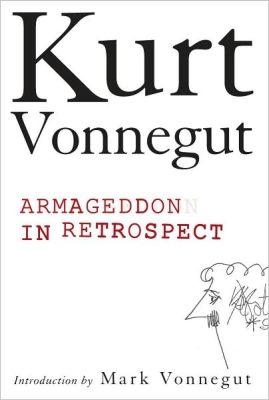
Book Review: Armageddon in Retrospect by Kurt Vonnegut

I really didn’t get into Vonnegut until the middle of college (this was about 5 or 6 years ago).  I only read about three books and initially, his writing style put me off.  I don’t know why, maybe it was the mood I was in, or maybe it was his death, or maybe because something was telling me to give him another chance, but I bought this book, and I’m glad I did.

These are stories published posthumously.  Some of them funny (his speech at Clowes Hall), some were tragic (“Wailing Shall be in all Streets”), and some were thought provoking (“Just you and Me, Sammy”).

These stories are all about war and I’m sure there’s a moral behind each story.  However, I was just reading it for fun and wasn’t really searching for a moral.

I’ll mention a few here:

“Guns Before Butter” was funny.  It talks about these American prisoners and the Nazi officer who is supposed to watch them, but these American soldiers only talk about food and what they’re going to eat once they get home.  I laughed when the Nazi officer suggested that they talk about beer, smoking, or women.  Anything but food.

“Happy Birthday 1951” was interesting.  It tells a future but the future is so riddled with war that when the next generation comes in, they think of war as normal and anything peaceful as “against nature.”  Thus, if there ever is a peaceful moment, the kids start causing trouble just so that things are “normal” again.

By far, my favorite was “Just You and Me, Sammy.”  Vonnegut starts off by saying that this isn’t a war story, but a murder story.  It certainly was a murder story, but even though it is about a murder, Vonnegut comes out in the end saying “was this moral?”  I love it when stories do that!

I’m starting to appreciate Vonnegut lately and I’m hoping with more time, I get to read more of his stories.

Posted in Book Review, Ethics, Soldiers | Leave a comment

Book Review: Tête-à-Tête, The Tumultuous Lives and Loves of Simone de Beauvoir and Jean-Paul Sartre by Rowley

I was in for a treat reading this book.  I have always been interested in the philosophies of Jean-Paul Sartre and Simone de Beauvoir.  Part of this interest deals with their relationship(s) and the other people involved.  I never knew it was so intricate and complicated.

Just to get a glimpse, Sartre and Beauvoir do not believe in monogamy (or marriage for that matter).  This is part of their existentialist creed: love (and marriage) takes away freedom and makes the other person into an object.  By doing so, love disappears because you do not want to love an object, but a subject.  Therefore, “true” love is where you respect the other person’s freedom.  Sartre and Beauvoir considered themselves an “essential” relationship but they were aloud to have “contingent” affairs as well.  And boy, do they have many.  What I expected was that they had a relationship, but the “contingent” affairs were their own “private” time, a time to get away from each other.  It turns out that these other people were brought into the intimacy of both of Sartre’s and Beauvoir’s lives.  Beauvoir even introduced some women to Sartre so that he could get “involved” with them.  But Sartre always took care of them.  He ended up taking care of nine women, including his mother and everyone considered each other “family.”

Rowley does a very good job getting the story rolling.  I felt like I was reading a novel instead of a biography of people’s relationships.  It also progresses into their development and how this influenced other people.  Now a big misunderstanding is that people think that since this deals with philosophers, it will have lots of philosophical ideas in it.  Well, that’s not the point of the book.  The book’s sole subject was the relationship itself, not really the philosophical ideas (although it is sort of the backdrop for the book so that one can get an understanding of the relationship itself).  I thought this book was well-researched, moves smoothly, and I felt like I was part of the “family” because I felt I slowly got to understand Sartre’s and Beauvoir’s relationship better.  To the end, they were “together” for 51 years (until Sartre died).  They certainly had good loves, and I am sure they had a great life.

Posted in Book Review, Existentialism, Monogamy, Sexuality | 6 Comments

Barbara Oakley on Evil Genes

At Point of Inquiry, Barbara Oakley brings out a thesis of evil genes.  She states that Zimbardo and Milgram’s experiments were flawed and suggests that we aren’t evil (or good) because of our environmental upbringing; rather, we are born evil or good.  So I guess people like Hitler and Stalin were evil because they were geneticially predisposed to be evil.  I thought it was a fascinating listen.  The end also talks about religion, but it didn’t really grab me because I already agreed with Oakley on her view.  Check it out.  You can go to the site, or listen directly here.

Posted in Ethics, Experts, Religion | 2 Comments

Two Socratic Teachers

I’ve had this idea for a week now and I’m considering writing a paper on this.

Socrates is known as the archetype of philosophy.  His Socratic Method is the paradigm of what Western philosophy is all about.  You go through each belief and idea meticulously and with precision.  You make sure that all of your beliefs are coherent and concrete.

Now part of the Socratic Method was the Socrates would go around and ask the citizens certain questions.  Things like what is justice, piety, courage, love, beauty, and so on.  Each time someone gives Socrates and answer, Socrates replies with another question in order to make the student think more about his answer.  The idea was to make sure you have a pretty good idea what you’re talking about.  Example:

  • Socrates: “Tell me, what is justice?”
  • Citizen: “Justice?  Why, it’s giving back what is due.”
  • Socrates: “Splendid!  So this means that if you borrow a sword from your neighbor, being just means that you must give back the sword?”
  • Citizen: “Of course, Socrates!”
  • Socrates: “I see, but suppose your neighbor decides to go on a murderous spree and he comes to you asking for his sword back.  Would it be just to give him his sword back?”
  • Citizen: “Heavens no, Socrates.”
  • Socrates: “So you see, justice cannot be giving back what is due.”
  • Citizen: “I see what you mean Socrates.”
  • Socrates: “So then, we are back to the beginning: What is justice?”

Now this continues on and on and on.  Now in the dialogues, the citizens can’t come up with the answer and so they depart, and we the readers don’t know the answer either.  However, part of this is to make us the reader (and the citizen) to say, “Wow, I don’t know what justice is.  Perhaps what I’m doing or what my city is doing isn’t just.  Perhaps before I can say for certainty that my state is being just, we must figure out what justice is first.”  But of course, not many people want to do this.  Most people don’t want to learn, to gain wisdom.  This is where I see Socrates, as a teacher diverge into two different teachers.

1.  The first is what I’ll call Strict Socrates.  Strict Socrates makes sure that you do learn and gain wisdom.  This is why in the dialogues it takes about an hour, or longer, to discuss the term in question.  Imagine that: you are trying to find the definition of justice (or some other term) and another person keeps proving you wrong.  Won’t that drive you crazy?  Wouldn’t you find Socrates just plain annoying?  Of course you would.  In fact, that’s why he was condemned to death.  But here’s the thing: Socrates will keep on pushing you because that’s how you get knowledge.  Teachers like Socrates says that he wants to wake you up and make you gain wisdom.  In Plato’s Apology, Socrates likens himself to a gadfly (basically, they’re horseflies).  What do horseflies do?  They annoy you.  But they keep you alert, more awake, and mentally focused.  That’s what Socrates was trying to do to the state: he wanted to wake up the state, keep them alert, make the citizens aware of what was going on and seeing what they believed.  Even if the citizens are stubborn, it’s for the best of the community if they gain wisdom.  But the point is that you will learn, even if you don’t want to.  If you try with all your might to get away from Socrates, Socrates pulls you back in.  The rule for Strict Socrates is if you don’t want to learn, he will force you to learn.

2.  Now another type of Socrates is what I’ll call Lenient Socrates.  This Socrates does want you to learn and goes through the same dialogue as above.  However, if you part ways with Socrates, Socrates takes this as someone who doesn’t want to learn.  But the difference is that Socrates will leave that person alone.  If that person doesn’t want to gain knowledge and wisdom, then Socrates isn’t interested in you.  He only wants to talk to people that truely want to gain wisdom.  They are the ones that will have an affect on society.  To those that are just stubborn, dogmatic, or wishy-washy, Socrates has no time for you because you’re not gaining wisdom.  Thus, if you find Socrates annoying and you leave, Lenient Socrates would be thinking, “fine by me, I don’t want to teach someone as stubborn as you.”  Thus, the method behind Lenient Socrates is if you don’t want to learn, I don’t want to talk to you.

Now we learn about Socrates eventually in philosophy class.  But while I was thinking about this, it seems that these two teaching methods contradict each other.  Socrates will force you to learn, but at the same time, he’ll leave you alone.

As I was thinking about this, this also happens to many teachers (myself included).  Why is it that with some students that aren’t understanding the material, I’ll approach them and ask them what troubles they’re having?  But at other times, if students aren’t understanding the material, I’ll leave those students alone?  After all, if we’re going to be consistent with our philosophy, then we should adopt one or the other.  But we cannot adopt both because they seem to contradict each other.  So how or why do we adopt both?

I’ll give other examples: a student hasn’t turned in any work during the semester.  I approach him and ask him why he hasn’t turned in any work.  In this sense, I’m Strict Socrates.  But also, some students don’t show up to class, and I don’t tell them that they missed an assignment or exam.  In this sense, I’m Lenient Socrates.

I kind of want this to be more open ended.  I’m not really looking for a solution to this problem, but maybe a realization or at the very least, I want people to recognize that this is a problem.  Perhaps other teachers can tell me their experiences because these two different Socrates’s seem to contradict each other.

*                   *                      *

I think from a student perspective, things are different too.  I had a teacher who was Strict Socrates with me.  I dreaded that class, but amazingly, it was my favorite class that whole semester.  That teacher really made me think in a different way.  I studied differently, I philosophized differently, and my teaching habits are based upon his.  But during class, he would always use the Strict Socratic Method and I wouldn’t know the answer.  He kept on pushing me and it seriously annoyed me.  (This would go on for about an hour or so.)  It was mentally exhausting.  But at the same time, this also encouraged me.  I would study harder, I would be more independent-minded, and it made me want to learn more.

However, I’ve used to Socratic Method in other non-teaching situations and it annoys people.  In fact, they don’t want to be associated with me anymore because of it.  So obviously, there are some “students” out there that don’t like this method.

I know I’m still rambling here, but maybe it’s psychological.  To me, if someone uses the Socratic method on me, it actually encourages me to think harder and do more research.  I can’t stop unless I find some answer.  But I know some people where if the Socratic Method is used on them, they stop thinking because, well, they don’t want to think, or else they’re annoyed that someone would disrupt their quiet life.

I could keep talking about this, but I feel I’ll go way off tangent if I keep going so I’ll stop and add more comments if needed.

Posted in Education, Paper Topic, Socrates, Teaching | 6 Comments

Third State to make Gay Marriage Unconstitutional

Check it here:

Connecticut’s Supreme Court has overturned a ban on same-sex marriages, making it the third US state to legalise such unions.

If this trend follows, I think the rest of the nation will follow.

UPDATE: (Nov. 5th, 2008) Perhaps not.  Now that CA has banned it along with other states, it may retard the whole process.  So I guess Connecticut is actually the second state.

Posted in Same-Sex, Sexuality | 1 Comment

North Korea Off of Terrorist List

Check it here:

A US State Department official said the deal was reached after North Korea agreed to provide full access to its controversial nuclear programme.

It probably doesn’t mean much because I think most Americans still consider North Korea as part of the “axis of evil.”

Posted in Government | 4 Comments

More options for the 2008 Election

Confused on who to vote for?  Are you tired of just the Democratic or Republican choices, but you’re not quite sure what the other candidates stand for in these “other” parties?

Have no fear, take this quiz and you’ll see what your beliefs pertain to the other candidates out there.  Believe it or not, I actually found one that is 100%.  Now I just need to research this person named “Theoretical Ideal Candidate.”

I’ll even put this quiz on my blogroll.

Posted in 2008 Election, Government, Politics | 5 Comments