Let’s See What’s in the News Today (May 4, 2015)

Abortion

  • There’s a link between sexist attitudes and antichoice attitudes in abortion.

Children

  • A great article explaining what it means to be childfree.  She also talks about the assumptions most people (especially women) have to deal with in a pro-child society.

Education

Emotions

  • A lot of philosophers talk about shame.

Ethics

Guns

Health

  • The World Happiness Report revealed that Switzerland, Iceland, Denmark, Norway, and Canada are the happiest countries.  Go here to see how they ranked it.
  • A report on graduate students’ health and well-being.

Philosophy

Politics

Relationships

Religion

Science

Self

Sexuality

Singlism

Posted in Abortion, Children, Education, Emotions, Ethics, Guns, Health, News, Politics, Relationships, Religion, Science, Self, Sexuality, Singlism | Tagged , , , , , , , , , , , , , , , , | Leave a comment

Promiscuity and the Double Sexual Standard

Two interesting stories came out this week.

First, a study by Zhana Vrangalova reveals whether promiscuous people would have more friends or not.  From the study itself:

In study after study, promiscuous people are seen as less desirable friends, spouses, or datingpartners, and are judged as less moral, likeable, intelligent, trustworthy, or psychologically healthy than sexually restricted people. One 2013 study of over 24,000 undergrads found that 70% of them would lose respect for someone who “hooks up with lots of people;” another recent studyfound that even promiscuous women themselves preferred less promiscuous women as friends. And everyone—promiscuous or not—expects to be judged harshly by others if they act in a way that suggested they were promiscuous, such as dressing “slutty” or accepting a casual sex offer from a stranger.

Because of the double sexual standard, women are punished more severely for being or looking promiscuous.  Thus, you’d probably expect promiscuous people to be more ostracized, hardly have any friends, more bullied, and more lonely than their non-promiscuous counterparts.  At least, that’s the hypothesis.  The conclusion from the study, however, tells a different story.

However, in contrast to our hypotheses, having more sexual partners was at the same time linked to:

lower loneliness,
greater likelihood of having a best friend,
more close friends
more acquaintances; and
more relatives with whom they communicated on a regular basis.

There were also no gender differences between these links.  So what’s going on?  There’s a paradox of how promiscuous people can have more social connectedness but also experience victimization.  There are a few possibilities.

Possibility one: One hypothesis is that promiscuous people tend to be more extraverted and adventurous.  Extraverted and adventurous people tend to have more friends or social connectedness.  These people love social situations and love being around people, which makes it easier for them to make friends.

Possibility two: People dislike promiscuity in the abstract, but accept it or excuse it when it comes to themselves or their close friends.

Possibility three: Because there is a stigma against promiscuous people, they must keep their reputations intact by having sexual partners away from their main social networks, or they could lie to maintain their friendships.

Some limitations on this study, however, are that the sample size came from undergrads at a single, large, elite, secular and relatively liberal university in the Northeast.  Depending on where this university was at, if the environment was more conservative, the promiscuous people could experience more victimization, in which case there may be a counterbalance them having more friends.

Possibility four: These next possibilities come from another article, but I think it relates to Vrangalova’s study.  It could be that the double sexual standard exists but only in some circumstances such as populations that hold sexist attitudes, or maybe the double sexual standard exists for particular sexual behaviors, or only when negative consequences are revealed.  For example:

If a man and a woman have casual sex but there are no negative consequences, we might judge both similarly.  However, if the sexual encounter results in a sexually transmitted infection, then the sexual double standard would come into play, where the woman would be socially rejected more than the man.

Possibility five: Or the double sexual standard is systemic rather than a position that people hold personally:

In one study, people did not show the sexual double standard when they filled out questionnaires individually, but did reveal the sexual double standard after having group discussions about the scenario, judging a man with more sexual partners as more dominant and successful, while a woman with more sexual partners was seen as less successful and less intelligent (Marks & Fraley, 2007).  This suggests that people may not endorse the sexual double standard personally, but that it might be something created socially.

Whatever the case may be, the last one is really telling.  The double sexual standard still has a social impact if we believe it exists, even if one doesn’t endorse it:

If women believe that they will be judged harshly for providing a condom in a sexual encounter, they may refrain from buying condoms — even if that belief is incorrect (Kelly & Bazzini, 2001; Caron et al., 1993; Hynie & Lydon, 1995).  If women believe that they will be derogated for their sexuality, they may lie about their sexual past, communicate less openly with their partners, or hesitate to pursue their authentic sexuality, which is likely to result in diminished sexual satisfaction for women and their partners (Greene & Faulkner, 2005; Kontula & Haavio-Mannila, 2003). Indeed, the sexual double standard is one reason that women are less likely to experience orgasm in casual sexual encounters as compared to sex within ongoing relationships (Armstrong, England, & Fogarty, 2012).

But how does this work?  How can the double sexual standard hold if individuals don’t believe in it?  It’s because of the systemtic nature of it all.  We believe that other people believe it and so we may act in ways that supports the double sexual standard, even if we don’t personally believe it.  Stearns brilliantly gives some examples:

— The mother who thinks that other people endorse the sexual double standard may caution her daughter to limit her sexual activity (or at least be very discreet about it), without passing along a similar message to her son — even if she doesn’t personally support the sexual double standard.

— The principal who believes that girls will get a bad reputation for dressing “provocatively” may create dress code policies that require girls to dress modestly, without so restricting boys’ attire — even if he personally disagrees with the sexual double standard.

— The woman who believes that others endorse the sexual double standard may feel free to publicly criticize her female friends’ sexual behaviors, while feeling more constrained about criticizing the same behavior of her male friends —  even though she personally has the same sexual standard for both men and women.

— The talk show host who thinks the audience supports the sexual double standard may create a program debating the issue, thus telling viewers that the sexual double standard still exists —even though he does not personally agree with the sexual double standard.

As long as parents and friends and school administrators and politicians and pundits all continue to believe that girls and women are judged by a more restrictive sexual standard than are men, they will be likely to continue to treat girls and women differently from boys and men.  They will feel freer to express negative judgments of women’s sexual choices.  They will continue to blame women for negative sexual outcomes.  They will urge women to constrain their sexuality so as to avoid a bad reputation.  They will create policies that restrict women’s expression of sexuality — for their own good, of course.  

In this sense, whether or not we personally support a sexual double standard is less relevant than whether we act as though it exists.  As long as we believe that the sexual double standard exists and act accordingly, we continue to create a society in which women’s sexuality will be more constrained than men’s…The double standard may or may not exist in our psychology, but it certainly exists in our society, and we are all bearing its cost.

Why does this happen?  Let’s suppose that no one, or hardly anyone believes in the double sexual standard, yet people continue to uphold it.  I think it may have to do with not only upholding sexual norms, but upholding social epistemic norms.  In both cases, people want to fit in otherwise one’s reputation will be tarnished.   If someone makes a slutty remark or a slut joke, people may laugh or join in so that we can be part of the group.  If we, instead, berate the person, we don’t fit in and that gets to us even more.  In a way, this explanation is expanding on possibility two.

But what suggestions could we have to break away from this system?  How do we break this mold?  What are some of the ways to undermine the systemic institutional structure of something when—hypothetically—hardly any individual believes it?  To that, I don’t have a clear answer.


Posted in Promiscuity, Sexuality, Studies | Tagged , , , | Leave a comment

Let’s See What’s in the News Today (Apr. 20, 2015)

Aesthetics

Economics

Education

Epistemology

Ethics

Families

Feminism

  • A gripping case of a porn star who dated an MMA fighter.  When the relationship became abusive, the twitter feeds blamed her because of the fact that she was in porn.

Guns

  • Some interesting data about those who have been killed by guns in the USA.

Humor

Love

Race

Sexuality

Posted in Aesthetics, Economics, Education, Epistemology, Ethics, Feminism, Guns, Humor, Love, News, Race, Sexuality | Tagged , , , , , , , , , , , | Leave a comment

Let’s See What’s in the News Today (Apr. 14, 2015)

Aesthetics

  • A cool video of 100 years of beauty in Korea.  It gets surreal when it hits the 1950s: 

Economics

Gender

Health

Incarceration

Math

Psychology

Relationships

Sexuality

War

Posted in Aesthetics, Economics, Gender, Health, News, Psychology, Relationships, Sexuality, Studies, War | Tagged , , , , , , , , , , | Leave a comment

Let’s See What’s in the News Today (Apr. 5, 2015)

Animals

Drugs

Economics

Education

Subject-specific lessons – an hour of history in the morning, an hour of geography in the afternoon – are already being phased out for 16-year-olds in the city’s upper schools. They are being replaced by what the Finns call “phenomenon” teaching – or teaching by topic. For instance, a teenager studying a vocational course might take “cafeteria services” lessons, which would include elements of maths, languages (to help serve foreign customers), writing skills and communication skills. More academic pupils would be taught cross-subject topics such as the European Union – which would merge elements of economics, history (of the countries involved), languages and geography.

Ethics

Family

Allowing children to live in poverty is a policy choice, not the inevitable result of a given family structure. As author and activist Barbara Ehrenreich has often argued, poverty is not a lack of character, it is a lack of money. Our tendency to shame single mothers or low-income families and express grave concern about their growing numbers improves nothing. Rather, it fosters a climate in which politicians fear a backlash for supporting programs that supposedly “validate” nontraditional family structures. Ambitious family-friendly policies that have potential to dramatically improve the lives of struggling families cannot succeed in a political climate where the nuclear family unit is valued over all others.

Health

Gender

Politics

Race

Religion

Relationships

Sexuality

Time

Trolleyology

  • The famous Trolley problem in philosophy gets more complicated when you look at the race, gender, class, or socioeconomic status of the person who is being sacrificed.
Posted in Drug Use, Economics, Ethics, Gender, Health, Marriage, Politics, Polyamory, Pornography, Race, Religion, Same-Sex, Sexuality, Time | Tagged , , , , , , , , , , , , , , , , , | Leave a comment

Let’s See What’s in the News Today (March, 23, 2015)

Feminism

  • 3AM Magazine interviews Alison Stone about Hegel, Schelling, Irigaray, Judith Butler, feminism, sexual difference, and maternity.

Film

Food

  • Nice diagrams to make eating healthy super easy.

Humor

Mathematics

Relationships

Science

Sexuality

Posted in Evolution, Feminism, Humor, News, Pornography, Science, Sexuality | Tagged , , , , , , , , , , | Leave a comment

Let’s See What’s in the News Today (March 16, 2015)

Aesthetics

Climate

Culture

Ethics

  • What does it mean to promise sex to someone?  Can it be done?

Gender

  • Why is kicking a man in the testicles taboo, even when you’re trying to win in a fight?  Could the answer be that it emasculates the man?  The article is interesting, but I think the author is missing something.  After all, losing a fight emasculates the man, yet the fighting is still allowed.
  • What does it mean to be a badass?  It means trying to be as masculine as possible.

Health

Math

  • Check out this video explaining Hilbert’s Hotel with infinite rooms: 

Performance

Relationships

  • We’re the only species that has romantic love, and we bond with a partner for a long time.  However, we typically do not bond for life.  We are, for the most part, serial monogamists.  Biologically, it seems that humans are hardwired to fall in love.  Moreover, we may also be hardwired to end a relationship, which has been called “human mate ejection.”  Currently, the evolutionary, cognitive, neurobiological, and genetic underpinnings of human mate ejection have yet to be fully elucidated.  This journal article tries to investigate the possibility of our hardwired ability to “eject” a human mate in our lives.

Religion

Sexuality

  • Feminist pornographer delves into the question: “Can porn empower women?”  It’s actually philosophical.
  • Study about pornography: any objectification of women is depicted as instrumentality.  Any objectification of men is depicted as dehumanization.  Amateur porn had more gender inequality than professional porn.  Violence and nonconsensual sex was very rare.
  • Gary Gutting calls for the Catholic Church to reconsider its stance on homosexuality.
  • Sexual consent is like offering tea:

You say: “Hey, would you like a cup of tea?”
If they say, “Yes, I would love a cup of tea! Thank you!” then you know they want a cup of tea.

If you say “Hey, would you like a cup of tea?” and they hem and haw and say, “I’m not really sure,” then you can make them a cup of tea or not, but be aware that they might not drink it.

If they don’t drink it—and this is the important bit—then don’t make them drink it.

You can’t blame them for the fact that you went to the effort of making tea, on the off-chance they wanted it. You just have to deal with them not drinking it; you making tea doesn’t mean that you are entitled to watch them drink it.

And if they say, “No thank you,” then don’t make them tea. At all. Don’t make them tea; don’t make them drink tea; don’t get annoyed at them for not wanting tea. They just don’t want tea, ok?

 And if they say, “No thank you,” then don’t make them tea. They might say, “Yes please, that’s kind of you.” And then when the tea arrives, they might not want the tea at all. Sure, that’s annoying, as you’ve already made the tea, but they remain under no obligation to drink the tea. They did want tea, now they don’t. Sometimes people change their mind in the time it takes to boil that kettle, brew the tea and add the milk. And it’s ok for people to change their mind. You are still not entitled to watch them drink it.

If they are unconscious, don’t make them tea. Unconscious people don’t want tea and can’t answer the question, “Do you want tea?” because they are unconscious.

They may have been conscious when you asked them if they wanted tea, and they said yes. But in the time it took you to boil that kettle, brew the tea and add the milk, they are now unconscious. You should just put the tea down, make sure the unconscious person is safe, and—this is the important bit—don’t make them drink the tea. They said yes then, sure, but unconscious people don’t want tea.

If someone said yes to tea, started drinking it, and then passed out before finishing it, don’t keep pouring it down their throat. Take the tea away and make sure they are safe.  Because unconscious people don’t want tea. Trust me on this.

 That doesn’t mean that they want you to make them tea all the time. If someone said “yes” to tea around your house last Saturday, that doesn’t mean that they want you to make them tea all the time. They don’t want you to come around unexpectedly to their place and make them tea and force them to drink it, while you say “But you wanted tea last week!” They don’t want to wake up to find you pouring tea down their throat, saying “But you wanted tea last night!”

Violence

War

Posted in Aesthetics, Culture, Ethics, Gender, Health, News, Pornography, Relationships, Religion, Sexuality, War | Tagged , , , , , , , , , , , , , , | Leave a comment

Impression, Attraction, and Imprints

Justin Bartels has a unique gallery showcasing what women have to go through to attract.  The results are imprints on their skin from their binding apparel they have to wear.  Here are some examples below:


check out the rest.

Posted in Aesthetics | Tagged | Leave a comment

Let’s See What’s in the News Today (March 8, 2015)

Consciousness

  • Galen Strawson has a great article about the history of the philosophy of consciousness.

Education

Ethics

Family

Free Will

  • A great comic analyzing the linguistics between compatibilism and determinism.

Health

Humor

Logic

Mind

Philosophy

Race

Relationships

  • An interesting article about how divorces don’t mean the end of a relationship, how marriages don’t end by one person’s death, and new forms of what relationships can be.  From the article itself: “So on your checklist of what you seek in a future spouse, alongside a sense of humour and desire for kids, include this: someone from whom you can envision being amicably divorced.”
  • Interesting article from Dr. Helen Fisher: “Casual Sex may be Improving America’s Marriages.”  She used to be against anti-casual sex, but the article is looking at how casual sex may actually to contribute to lasting marriages.

Religion

An updated SEP on “The Problem of Evil.”

Science

Sexuality

Stoicism

Posted in Education, Ethics, Free Will, Health, Humor, Logic, Mind, Monogamy, News, Pornography, Race, Relationships, Religion, Science, Sexuality, Stoicism | Tagged , , , , , , , , , , , , , , , , , , , | 1 Comment

On the Ethics of Offensive Humor (Part Three)

Preliminary note: I will mention offensive jokes for the purpose of making a philosophical point.  In philosophical parlance, I’ll be mentioning jokes rather than saying them.  If you’re easily offended, you probably shouldn’t continue reading the rest of this post.

In part one, I set up Benatar’s argument by looking at offensive humor through contextual and non-contextual means.

In part two, I looked at Benatar’s argument that introspection is unreliable, and therefore, the prejudiced person can’t be at fault.  I argued that because it is unreliable, the prejudiced person (and others) could be at fault.

In this final post, I want to look Benatar’s focus of three mistakes regarding humor ethics, and some guidelines toward the end.

Common Mistakes in Humor Ethics

Benatar focuses on certain mistakes that we ignore when it comes to the ethics of humor.

1.  Benefits are ignored.  When it comes to the ethics of humor, the focus is usually on the negative effects.  There are great benefits to humor, particularly the pleasure it brings. For example, using humor as a way to make fun of tyrants.  Moreover, the humor undermines the tyrant’s abuse of power.

More than that, humor generally lightens the mood by helping people cope with certain anxieties in life such as disease, disability, and death as examples.  People make the jokes in order to neutralize the stereotype.

While this may be true, jokes can also enhance the stereotype.  How can we tell when the joke does that?  Especially if we accept the contextual framework, it gets trickier to determine when the joke is harmful or beneficial.  For example, Benatar gives two examples of the same variant of a joke:

The Jewish variant reads:

Two Jews are walking down a street and see a sign on a church saying: “Become a Christian and earn $100”. They don’t know what to make of this, but decide that one will convert and will share the money with the other. The prospective convert enters the church. After a while he emerges. His friend says to him:

“Where’s my $50”.

The new Christian replies: “Is that all you people think about?”

The “black” variant reads:

Two “blacks” are walking down a street and see a sign on a building saying: “Become white and earn $100”. They don’t know what to make of this, but decide that one will become “white” and will share the money with the other. The prospec- tive “white” enters the building. After a while he emerges. His friend says to him:

“Where’s my $50”.

The new “white” replies: “Get yourself a job!”

From these jokes, we can recognize the stereotypes given to Jews and blacks.  However, Benatar states that these jokes don’t reinforce the stereotypes of Jews or blacks, but they make fun of people who hold the stereotypes.  Thus, these jokes can subvert a stereotype.

But do they?  I’m sure that these jokes can make fun of those who hold those stereotypes, but I can also see these jokes endorsing the stereotypes.

Going back to the dishwasher joke in part one, the joke does display stereotypes (women are nothing but humans that do household chores around the house; if there is a messy house, it’s the woman’s fault; and that displaying violence towards women keeps her in her place).  But does it endorse these stereotypes, or does it subvert them?  It’s hard to say because what makes them funny or offensive is how the listener interprets these stereotypes.  Thus, I think that in order to make the joke funny, the listener must either endorse or reject the stereotype but must also recognize the stereotype.  But which is it?  It has to depend on the listener (and the speaker).  Benatar’s criterion on when a joke becomes morally impermissible is when the joke causes harm.  But when is that?  It would have to be when the joke is interpreted as harmful (i.e., the joke above endorses the stereotypes).  But how do you know when the joke will be interpreted as harmful?  Benatar doesn’t think there can be clear cut rules here.  One must have practical knowledge to know what the proper context to say the joke.  Like many things that require context, it takes practical knowledge because there are no clear-cut rules on what is considered proper or improper.

I’m not sure Benatar has fully answered the objection.  I think having practical wisdom, or what Aristotle calls phronesis, is correct.  You have to know the proper time and place to say a joke that is potentially offensive.  But saying a joke to a bunch of friends is different than saying it to a bunch of strangers because I know my friends.  The stand-up comedian has a special insight to tell a joke and pushes the bounds of what is appropriate.  But a good comedian will get the audience to laugh rather than getting offended.  Suppose that the joke stipulates stereotypes.  Does the comedian have enough insight to know whether the joke will be interpreted as undermining the stereotype?  I really don’t know, but Benatar’s argument implies that the comedian can have enough insight mainly because the comedian has some sort of expertise.  (I’m imputing phronesis here as one who is excellent at practical wisdom.  Of course, Benatar could mean practical wisdom in another way.)  If my imputation is correct, then comedians are considered experts in their field, namely making people laugh and know which jokes can make people laugh.

2. Contextual Considerations are Oversimplified.  The common view is that jokes about a certain group is unacceptable unless that represented group can tell the joke.  For example, blacks can only tell black jokes, women can only tell women jokes, and the disabled can only tell disabled jokes.  Otherwise, the claim goes, the joke and/or the agent goes “too far.”  This view, however, assumes that the joke tellers from “the inside” can tell the joke without (a) the joke expression from defective attitude, or (b) the joke is viewed as an expression of a defective attitude.  But why should we hold these assumptions?

After all, for part (a) maybe there are blacks who are racist, women who are misogynist, or disabled people who are prejudiced against disabled people, and for part (b) this implies that the insiders can never be wrong when they tell offensive jokes in which they themselves are part of the group.  We can’t assume that group-insiders won’t have these problems, even towards themselves.  Moreover, there are instances where the speaker does not have the negative attitude, and it not a member of a group.  Yet, depending on the context, we can be assured that the speaker (and even the listeners) saying or hearing the joke will not be viewed as a shared expression of the negative attitudes.

Next, consider the audience.  The thought is that if a group-insider tells a joke to an audience of the same group, then the humor is morally permissible.  However, if the joke is told to the audience where the audience is outside the the group being joked about, the humor is morally suspect.  Why?  Suppose person P was a member of minority group M and P tells a joke J where the joke stipulates stereotypes about M.  If P tells J to M, it’s less likely to reinforce anti-M attitudes in M.

Moreover, we should not conclude that it’s always impermissible to say something humorous about a group to those not in the group.  This is because some people can enjoy jokes about others without developing the negative attitude toward those others.

Finally, the conventional wisdom is that it’s ok to make fun of the dominant group, but morally suspect to joke the subordinate group.  For example, making jokes about men would be permissible, but not about women.  Likewise, making jokes about whites would be permissible, but not about blacks.  Benatar sees some truth in this as well.  After all, telling jokes about a subordinate group could cause harm.  However, this does not mean that telling jokes about the disadvantaged groups always harms, or that telling jokes about advantaged groups never harms.  “For example, jokes about “whites” might be more dangerous in Zimbabwe than they are in Sweden, and jokes about male nurses may be more damaging than jokes about female doctors” (p. 38).  What matters is the context.

3.  Offense is given too much weight.  We usually take offense as a weighty moral consideration.  Benatar thinks this is a mistake.  The conventional wisdom is that if saying joke J is offensive, then saying joke J morally impermissible.  Benatar finds the conventional view untenable.  People express outrage to a joke, and that expression signifies that the joke is wrong.  But what is doing the work?  Usually, the sequence is like this: Outrage
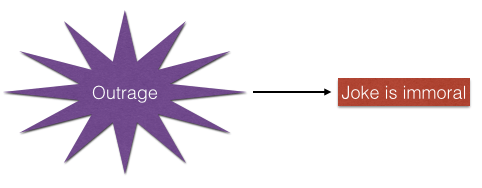
The joke is immoral because there is outrage.  However, if we stop there and make outrageousness the reasoning for making things immoral then this loosens up the territory of what is considered impermissible.  In other words, if we make things impermissible because of the outrage, which is just another way of saying “I’m offended,” then, to be consistent, “it would grant a moral veto to the hypersensitive” (p. 39).  Anyone who was offended or outraged could claim that the joke is immoral, which means that we would lose out on the justification as to why the joke was immoral.  This implies that not being offended would be a moral right.  Moreover, this would lead to inconsistent results.  Suppose A told a joke and B was offended.  Say that A was offended by B’s lack of humor.  If being offended is sufficient to determine whether something is immoral, then both A and B are immoral, which is an odd conclusion.

However, we should not conclude that being offended is irrelevant.  We should take into account when people get offended and we should take that into account.  The best example is to not tell a joke where everyone in the audience won’t benefit from it.  If person P is telling an anti-Semitic joke to a Jewish congregation, we can already see that’s a bad idea because of the gratuitous offense it would cause.

Sure, but is this a question of morality, or a question of prudence? Benatar would say that this is immoral, but maybe we could say that it’s just imprudent.

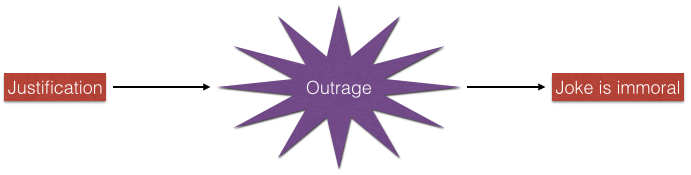
We should instead look behind the outrage:

Justification

and see what the reasons are for the outrage.  In the end, they could very well be good reasons.

Guidelines:

How do we know whether a joke is appropriate to tell or not?  There is no magic formula to tell us this.  We must use practical reason.  If there are no good reasons to defend the non-contextual criticisms of humor, then contextual criticisms of humor are the focus of moral consideration.  But if the judgement is contextual, then there cannot be a formula to tell us what is morally appropriate or not.  I would offer that we need phronesis, stemming from Aristotle.  However, Benatar offers some guidelines:

Guidelines

In conclusion, Benatar suggests that we must weigh in these factors to determine when humor is appropriate.

Posted in Article, Benatar, Ethics, Humor | Tagged , , , | 1 Comment